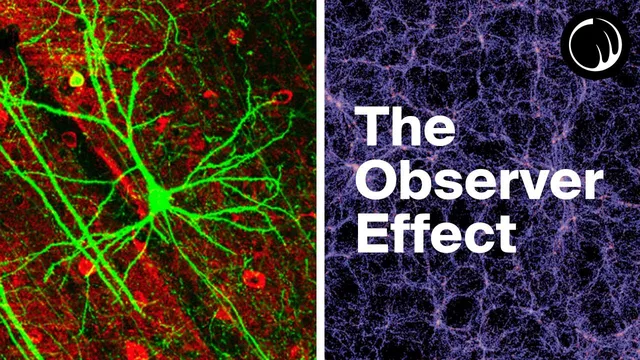
Weird Things Begin to Happen When You Examine Consciousness
Based on Pursuit of Wonder's video on YouTube. If you like this content, support the original creators by watching, liking and subscribing to their content.
The transcript uses a “sonder” moment to argue that perception is distributed across many independent experiences rather than centered on a single viewpoint.
Briefing
A sudden “sonder” moment—realizing everyone else is living a fully separate, vivid life from their own point of view—sets up a larger claim: consciousness and observation may be deeply entangled with what reality is. The transcript frames everyday perception as if there’s no single center stage, only overlapping “spotlights” across billions of minds. That shift matters because it pushes the discussion from psychology into physics and metaphysics, asking whether the world’s structure depends on how it’s observed and what kind of questions are asked of it.
The argument begins with the “observer effect” in philosophy: George Berkeley’s subjective idealism (immaterialism) holds that reality is not independent of mind but is created through observation. The transcript then confronts the obvious objection—what happens when no one is around? It notes that rooms can be left and returned to without apparent discontinuity (a candle keeps burning, wax keeps melting), which suggests continuity must come from something other than a single human observer. Berkeley’s workaround was God as the ever-present observer, but the discussion pivots to a physics-friendly alternative: maybe ubiquitous observation doesn’t require a divine watcher, just the rules of quantum measurement.
Quantum mechanics enters with a direct contrast between realism and anti-realism. Einstein is linked to realism: particles have definite properties independent of measurement. Niels Bohr is linked to anti-realism: quantum properties are undefined until measurement (or observation) forces them into a defined outcome. The transcript points to the Double Slit Experiment as a signature example of how behavior changes when measurement is made, quoting John Archibald Wheeler: “No phenomenon is a phenomenon, until it is an observed phenomenon.”
The discussion then intensifies with nonlocality and entanglement. In 1972, John Clauser’s experiments with entangled photons from calcium atoms are described as violating locality—the idea that influences can only act through immediate surroundings. Later, Clauser, Anton Zeilinger, and Alain Aspect are said to have won the Nobel Prize for work demonstrating that measuring one entangled particle determines the state of the other even across vast distances, challenging the idea that the universe is locally real or deterministic in the classical sense.
From there, the transcript argues that information may be the deeper substrate. Wheeler’s “participatory universe” and the phrase “It from Bit” are used to claim that physical reality arises from yes-or-no questions posed by measurement and the resulting equipment responses. A “delayed-choice” framing is invoked to suggest that the choice of measurement can affect what becomes defined, making reality resemble a giant game of twenty questions.
Finally, the transcript connects observer-centric physics to consciousness theories. It raises panpsychism, claiming consciousness is fundamental and ubiquitous rather than emerging only from complex brains. It then sketches a “giant brain” metaphor: if consciousness is everywhere, the universe might continuously exchange and process information with itself, potentially aligning with quantum indeterminacy and entanglement. The piece ends by returning to sonder, arguing that interconnectedness makes personal experience feel less isolated—each subjective life “weaves together” into a single, shared reality.
A sponsor segment shifts the theme from metaphysics to privacy: data brokers and search sites are described as collecting and selling personal information, with Incogni positioned as a service to remove such data and reduce risks like spam, identity theft, and harassment.
Cornell Notes
The transcript links a personal perception shift (“sonder”) to a chain of ideas about observation, quantum physics, and consciousness. It contrasts realism (Einstein: particles have definite properties independent of measurement) with anti-realism (Bohr: quantum properties become defined only when measured). Experiments on entanglement and nonlocality (Clauser; later Nobel work with Zeilinger and Aspect) are presented as evidence that locality isn’t fundamental and that measurement outcomes are correlated across distance. Wheeler’s “participatory universe” and “It from Bit” frame physical reality as arising from information-theoretic yes-or-no questions posed by measurement. Panpsychism and a “giant brain” metaphor then extend the observer-centered picture to consciousness as a fundamental feature of the universe.
What is “sonder,” and how does it function as a bridge to the rest of the argument?
How does the transcript use Berkeley to set up the observer-dependence theme?
What distinguishes realism from anti-realism in the quantum section?
What does “nonlocality” mean here, and why is Clauser’s work important?
How do Wheeler’s “participatory universe” and “It from Bit” connect measurement to reality?
Why does the transcript bring in panpsychism and the “giant brain” idea?
Review Questions
- How does the transcript’s realism vs anti-realism contrast change what “measurement” is supposed to do to quantum properties?
- What experimental claims are used to argue against locality, and what do they imply about determinism?
- In the transcript’s framework, how does “It from Bit” reinterpret the relationship between information, measurement, and physical reality?
Key Points
- 1
The transcript uses a “sonder” moment to argue that perception is distributed across many independent experiences rather than centered on a single viewpoint.
- 2
George Berkeley’s subjective idealism links observation to reality’s existence, but continuity problems are raised and addressed by invoking an ever-present observer (God) before shifting to quantum ideas.
- 3
Quantum realism (Einstein) treats particle properties as definite independent of measurement, while quantum anti-realism (Bohr) treats properties as undefined until measurement defines them.
- 4
Entanglement experiments described through Clauser’s work and later Nobel-winning results are presented as violating locality, with measurement correlations persisting across large distances.
- 5
Wheeler’s participatory universe and “It from Bit” frame physical reality as information-theoretic: measurement choices act like yes-or-no questions that help define outcomes.
- 6
Panpsychism is introduced as a way to make consciousness fundamental and ubiquitous, then extended via a “giant brain” metaphor for how the universe might process information.
- 7
A sponsor segment claims data brokers and search sites collect and sell personal information, and positions Incogni as a tool to remove it to reduce risks like identity theft.