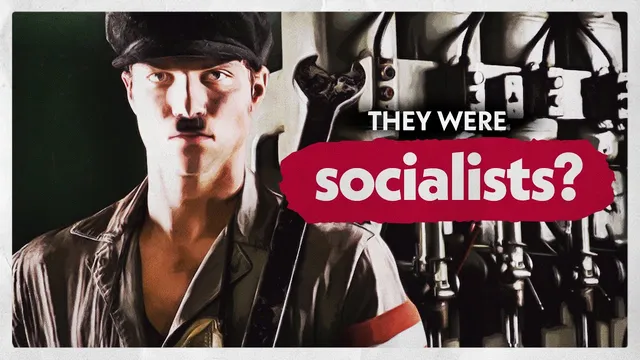
Were The Nazis Socialist?
Based on Second Thought's video on YouTube. If you like this content, support the original creators by watching, liking and subscribing to their content.
Socialism is defined around collective ownership of the means of production and democratic control of production decisions, not merely government involvement in the economy.
Briefing
Nazis were not socialists; they dismantled socialist and labor power while aligning with capitalist interests—so “socialist” in the party name functioned as branding rather than a commitment to socialism’s core principle: collective ownership of the means of production.
The case begins with a definition problem. Socialism is framed as an economic system where the means of production are held in common and production decisions are guided by democratic control rather than profit by a class of private owners. Under capitalism, private property lets capitalists profit from ownership and exert authority over workers, who can’t realistically replace bosses or control production decisions. With that baseline, the transcript argues that the Nazi record fails the test: Nazi rule targeted socialist parties, communist organizations, and labor movements, not capitalism’s “private property” foundation.
Early in Hitler’s chancellorship, repression moved quickly. A state of emergency followed a fire in the German parliament, enabling crackdowns on Communists: party members were tracked, imprisoned, and pushed out of political life. The surge in imprisonments is linked to the creation of early concentration camps, which later became central to the machinery of mass violence. The crackdown expanded beyond Communists to the Social Democratic Party, eliminating both revolutionary and reformist labor representation from parliamentary politics. Organized labor faced a similar fate. Union leaders were hunted, unions were occupied and then banned, and collective bargaining and strikes were removed. In their place came the German Labor Front, described as a Nazi-controlled “puppet” structure that eliminated the adversarial role unions normally play against capitalist authority.
The transcript adds cultural and ideological suppression as further evidence. Nazi book burnings are presented as targeted attacks on socialist literature, including works associated with major socialist figures such as Karl Marx, Friedrich Engels, Vladimir Lenin, Rosa Luxembourg, and Leon Trotsky. The pattern is summarized as a coordinated effort to destroy outlets for socialist politics—parties, labor institutions, and the intellectual material that legitimized them.
Beyond repression, the argument turns to capitalist support and economic policy. German industrialists are described as helping finance and promote Hitler’s rise, investing substantial sums and pressuring President Hindenburg to appoint Hitler to manage “class antagonisms.” This support is tied to the Great Depression and Weimar-era instability, when many Germans were turning left and when workers had recently won rights like unionization, the eight-hour workday, and unemployment insurance. The transcript portrays fascism as a convergence point: Nazis sought power and an anti-Semitic program, while industrialists sought authoritarian control to prevent socialism from threatening capitalist monopoly.
Economically, the transcript emphasizes privatization and continued capitalist ownership during Nazi rule. It claims the Nazi government sold off state-owned firms across sectors such as steel, mining, banking, utilities, shipyards, and railways, and transferred certain public services—especially labor-related and social services—to private control. The result is described as a “variant of capitalism” with labor resistance removed and state direction used mainly to serve imperialist and wartime goals. Counter-arguments are addressed by noting internal anti-capitalist factions within the Nazi movement, but the transcript says those currents were neutralized early—either abandoned or eliminated—before they could matter. It also argues that Hitler deliberately distanced “socialism” from its original meaning, using the term as a marketing device while redefining it through nationalist conspiracies like “Judeo-Bolshevism.”
Overall, the transcript’s conclusion is that Nazi Germany functioned as capitalist rule enforced through anti-labor repression and selective state control, not as socialism under any definition centered on collective ownership and democratic control of production.
Cornell Notes
The transcript argues that Nazism was not socialism because Nazi governance opposed socialism’s defining feature: collective ownership of the means of production and democratic control of work. It points to early Nazi repression of socialist and communist parties, the elimination of labor unions (including bans on strikes and collective bargaining), and the burning of socialist literature. It also claims Nazi rule relied on support from major German industrialists and preserved capitalist ownership through extensive privatization of state firms. Even when some early Nazis had anti-capitalist impulses, those factions were portrayed as quickly neutralized, while the party embraced a capitalist economy once in power.
What definition of socialism is used to test whether the Nazis qualify?
What concrete actions are cited as evidence that Nazi rule targeted socialist politics and labor power?
How does the transcript connect Nazi ideology to anti-socialist cultural policy?
What role do capitalist elites play in the argument about Nazi political economy?
What economic policy evidence is used to argue that Nazi Germany remained capitalist?
How are internal anti-capitalist currents within the Nazi movement treated as a counter-argument?
Review Questions
- If socialism is defined as collective ownership of the means of production, which Nazi actions described in the transcript most directly contradict that definition?
- How does the transcript use both political repression (parties, unions, books) and economic policy (privatization, labor exclusion) to support its conclusion?
- What does the transcript claim about why “socialism” could appear in the Nazi party name without reflecting socialist economics?
Key Points
- 1
Socialism is defined around collective ownership of the means of production and democratic control of production decisions, not merely government involvement in the economy.
- 2
Nazi rule is portrayed as systematically crushing socialist and communist parties through emergency powers, imprisonment, and removal from parliamentary life.
- 3
Independent labor power was dismantled: unions were banned, strikes and collective bargaining were eliminated, and the German Labor Front replaced them under Nazi control.
- 4
Nazi cultural policy is presented as anti-socialist, including book burnings targeting works associated with major socialist thinkers.
- 5
The transcript links Nazi rise to support from major German industrialists who feared socialism and wanted authoritarian suppression of labor and left politics.
- 6
Nazi economic policy is characterized as preserving capitalist ownership through extensive privatization of state-owned firms while using state direction mainly for wartime and imperial aims.
- 7
Internal anti-capitalist factions within Nazism are treated as short-lived and neutralized before they could reshape the party’s economic direction.