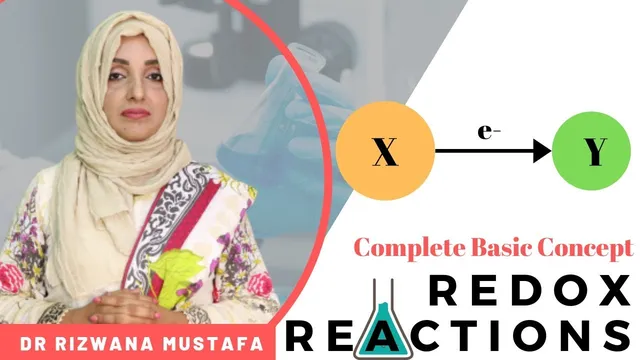
What Are Redox Reactions || Complete Basic Concept || Dr Rizwana Mustafa
Based on Dr Rizwana Mustafa's video on YouTube. If you like this content, support the original creators by watching, liking and subscribing to their content.
Redox reactions are defined by electron transfer, which is detected through changes in oxidation numbers from reactants to products.
Briefing
Redox reactions are defined by one core event: electrons shift between species, and that electron transfer shows up as a change in oxidation numbers from reactants to products. When oxidation numbers change, an electron transfer has occurred—so tracking oxidation states becomes the fastest way to identify and classify redox chemistry.
A practical way to see why this matters is through everyday systems. Human digestion is described as a major redox process: food-derived reactions convert energy into forms the body can use, with products including water and carbon dioxide. Batteries that power electronics also rely on redox reactions, using controlled electron flow to generate electrical energy. Even combustion—like burning wood—is framed as a redox reaction where electrons move from carbon-containing material to oxygen in the air. In that scenario, carbon loses electrons (oxidation), while oxygen gains electrons (reduction). The lesson is tied to terminology: substances that donate electrons are called reducing agents (electron donors), while substances that accept electrons are called oxidizing agents (electron acceptors).
To make the concept concrete, the transcript works through a specific chemical example: copper disulfide reacting with oxygen to produce copper metal and sulfur dioxide. The reaction is used to answer four standard questions: (1) whether it is a redox reaction, (2) which element is reduced and which is oxidized, (3) which is the oxidizing agent and which is the reducing agent, and (4) which element acts as the oxidant.
The method is oxidation-number bookkeeping. Oxygen starts in its elemental form, so it is assigned an oxidation number of 0. In copper disulfide, sulfur is given a negative oxidation state (the transcript assigns −2) because of its higher electronegativity relative to copper; copper is then assigned a positive oxidation state (+1) so the overall molecule remains neutral. In the products, copper metal has oxidation number 0, while sulfur dioxide assigns sulfur an oxidation number of +4 (with oxygen at −2). Comparing reactants and products shows that copper’s oxidation state drops from +1 to 0, meaning copper is reduced. Sulfur’s oxidation state rises from −2 to +4, meaning sulfur is oxidized.
From there, the electron-transfer logic maps directly to agents. The element that gets reduced is the one that accepts electrons, so oxygen is the oxidizing agent (it accepts electrons and is reduced). The element that gets oxidized is the one that donates electrons, so sulfur acts as the reducing agent (it donates electrons and is oxidized). The transcript concludes by tying everything back to the defining feature of redox chemistry: oxidation and reduction occur together because electrons must move between reactants and products.
Cornell Notes
Redox reactions are identified by electron transfer, which appears as a change in oxidation numbers between reactants and products. Oxidation corresponds to an increase in oxidation number (loss of electrons), while reduction corresponds to a decrease in oxidation number (gain of electrons). In the example of copper disulfide reacting with oxygen to form copper metal and sulfur dioxide, oxygen is reduced (0 to −2), copper is reduced (+1 to 0), and sulfur is oxidized (−2 to +4). The reducing agent is the species that donates electrons (sulfur here), and the oxidizing agent is the species that accepts electrons (oxygen here). This oxidation-number method provides a systematic way to answer which elements are oxidized/reduced and which agents drive the reaction.
How does oxidation-number change prove that a redox reaction is happening?
In the copper disulfide + oxygen → copper + sulfur dioxide example, which element is reduced and which is oxidized?
Why is oxygen assigned an oxidation number of 0 at the start of the reaction?
How do you determine the oxidizing agent and reducing agent from oxidation states?
What oxidation states are assigned to sulfur and copper in copper disulfide, and why?
Review Questions
- If a reaction shows no change in oxidation numbers for any element, can it still be a redox reaction? Why or why not?
- Given a reaction where one element’s oxidation number increases and another’s decreases, how would you identify the oxidizing agent and reducing agent?
- In a redox reaction, what oxidation-number direction corresponds to oxidation versus reduction?
Key Points
- 1
Redox reactions are defined by electron transfer, which is detected through changes in oxidation numbers from reactants to products.
- 2
Oxidation corresponds to an increase in oxidation number; reduction corresponds to a decrease in oxidation number.
- 3
Elemental forms of elements have oxidation number 0 (e.g., oxygen gas starts at 0).
- 4
The species that gets reduced is the oxidizing agent because it accepts electrons.
- 5
The species that gets oxidized is the reducing agent because it donates electrons.
- 6
In the example copper disulfide + oxygen → copper + sulfur dioxide, copper is reduced (+1 to 0), sulfur is oxidized (−2 to +4), and oxygen is reduced (0 to −2).