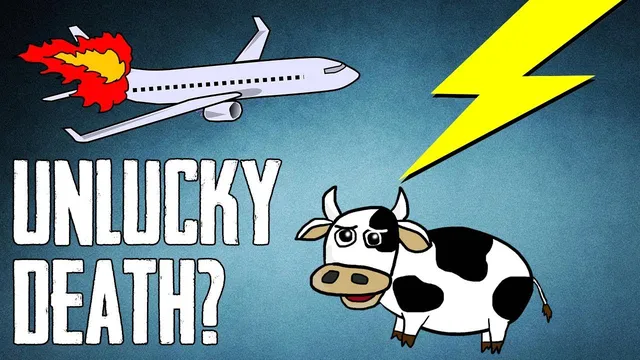
What are the Odds of Dying an Unfortunate Death?
Based on Second Thought's video on YouTube. If you like this content, support the original creators by watching, liking and subscribing to their content.
Surviving aircraft data is conditional on not being lost, so damage patterns among returnees can’t be used to infer which damage is most lethal.
Briefing
The central takeaway is that “where the bullet holes are” can mislead: most planes returning with damage show hits in wings and fewer in engines, but that pattern doesn’t mean engine strikes are rare—it reflects survivorship bias and conditional probability. Planes that take severe engine damage and catch fire are far less likely to make it back to base, so the “survivor” sample overrepresents aircraft with survivable damage locations. That means the most effective reinforcement isn’t where the visible damage on returning planes appears most common; it’s where damage most often proves fatal.
From there, the discussion pivots into a tour of unlikely death risks, using long-run odds to recalibrate everyday fears. Being struck and killed by an asteroid is estimated at about 1 in 74,817,414 per day, and the annual “91 people” figure is clarified as an actuarial projection rather than a literal count from impacts. Freak fireworks accidents land at roughly 1 in 50,729,141 per year, with 2016 reporting 11,000 fireworks-related injuries and four deaths. Fear-driven examples follow: dying from a wasp or bee sting is about 1 in 25,364,571, with nearly 100 deaths attributed to bee and wasp stings in the U.S. each year; plane crashes are around 1 in 11 million; and lightning is about 10 million to 1—still rare, but not zero. The transcript also highlights demographic differences, noting men are killed by lightning about four times as often as women.
Several risks are framed as counterintuitive because they don’t “feel” dangerous. Hot-water scalding is estimated at 5 million to 1, and the risk is elevated because it often involves children and everyday household conditions. Another surprising statistic: about 2,500 left-handed people worldwide die each year from using equipment designed for right-handed users, with right-handed power saws identified as a common culprit. Transportation comparisons sharpen the contrast between perceived and actual risk: train crashes are about 500,000 to 1, while car driving is far more lethal at about 8,000 to 1. The global baseline is stark—around 1.3 million road deaths per year, roughly 3,300 per day—making lightning and plane crashes look even less likely by comparison.
The concluding logic ties the entire odds list back to the opening question. When only the planes that return are counted, rare but catastrophic outcomes are systematically excluded. That’s survivorship bias: treating the frequency of damage among survivors as if it represented the frequency of damage among all aircraft. The practical implication is to reinforce based on what prevents loss, not what survives to be observed—an approach that depends on conditional probability rather than surface-level patterns.
Cornell Notes
The transcript argues that “damage location” on surviving aircraft can’t be used directly to estimate which threats are most dangerous. If planes with engine hits rarely return, then the low number of engine bullet holes among returning planes reflects survivorship bias, not safety. The discussion then lists odds for various causes of death—from asteroids and fireworks to bee stings, plane crashes, and lightning—showing how rare many feared events are. It also includes counterintuitive risks like scalding from hot water and injuries from right-handed tools affecting left-handed users. Finally, it compares transportation risks, emphasizing that everyday car travel is vastly more dangerous than most people assume.
Why does “most bullet holes are in the wings” not automatically mean wing hits are the main danger?
How do the odds for asteroid impacts illustrate the difference between daily probability and annual death counts?
What makes lightning a useful comparison point for fear calibration?
Which risks are highlighted as counterintuitive because they don’t look inherently dangerous?
How does the transcript quantify the gap between perceived and actual transportation risk?
Review Questions
- In the aircraft example, what specific statistical condition creates survivorship bias?
- Pick two “feared” causes of death from the list (e.g., lightning, plane crash, bee sting) and compare their stated odds; what does that comparison imply about fear versus risk?
- Why does the transcript treat “returning planes” as a misleading sample for estimating the danger of engine hits?
Key Points
- 1
Surviving aircraft data is conditional on not being lost, so damage patterns among returnees can’t be used to infer which damage is most lethal.
- 2
Engine hits may appear rare among returning planes because many engine-damage cases never make it back, a classic survivorship bias problem.
- 3
Odds for rare events (asteroids, plane crashes, lightning) are presented to recalibrate fear using long-run probability estimates.
- 4
Some high-impact risks are counterintuitive—hot-water scalding and right-handed tools harming left-handed users are both highlighted with specific odds and death counts.
- 5
Transportation risk varies dramatically: car travel is far more dangerous than train travel, and both are far more common sources of death than many feared events.
- 6
Demographic differences matter for risk estimates; men are cited as about four times more likely than women to be killed by lightning.
- 7
Actuarial projections can differ from intuitive “how many people died” expectations, as shown in the asteroid discussion.