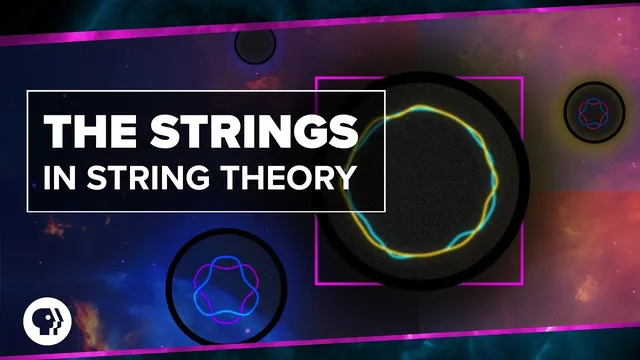
What are the Strings in String Theory?
Based on PBS Space Time's video on YouTube. If you like this content, support the original creators by watching, liking and subscribing to their content.
String theory treats particles as discrete vibrational modes of tiny one-dimensional strings, with resonant frequencies mapping to particle masses and quantum numbers.
Briefing
String theory’s core pitch is that the universe’s particles and forces—potentially including gravity—could all be different vibrational states of tiny, Planck-scale one-dimensional strings. Instead of treating particles as pointlike objects, the framework treats them as resonant patterns on strings, where only certain standing-wave frequencies are allowed. Those discrete modes then map onto particle properties such as mass, electric charge, and spin. The attraction is obvious: one fundamental ingredient (string tension, or an equivalent length scale) could replace the Standard Model’s many adjustable parameters.
The idea traces back to the 1960s, when physicists tried to understand hadrons—bound states of quarks held together by the strong force. Patterns in meson interactions suggested that quarks might be connected by “strings,” modeled as tubes of strong nuclear force. That early “strong-force string” program eventually ran into trouble: it predicted extra vibrational modes in the gluon field, including a massless spin-2 excitation. A massless spin-2 particle is closely tied to the graviton, the hypothetical quantum of gravity, which is hard to reconcile with a string built from the strong interaction alone. In the early 1970s, that coincidence flipped the question: what if the same mathematics described quantum gravity instead of hadrons?
The modern leap required shrinking the strings to an astonishingly small scale—about 20 orders of magnitude smaller than a proton, near the Planck length—and adding extra spatial dimensions. The simplest version, “bosonic string theory,” needed 26 spacetime dimensions; when fermions were incorporated via supersymmetry, the requirement dropped to 10 spacetime dimensions. In 1995, Ed Witten unified multiple superstring theories into a broader framework called M theory, which lives in 11 dimensions. The extra dimensions are not meant to be large and visible; they are “compactified,” curled up so tightly that ordinary matter would not notice them. A common analogy imagines a higher-dimensional “pac-man” direction that loops back on itself, letting strings oscillate in a way that leaves large-scale observers unaware of the extra geometry.
String interactions also address a major obstacle in quantum gravity. Point-particle approaches generate severe infinities at extremely high energies, partly because attempting to probe gravity at tiny distances can form black holes. String theory replaces pointlike quanta with extended objects, so interactions are “smeared” along the string. In this picture, the graviton corresponds to a particular closed-string vibration, and its extended nature helps avoid the worst mathematical blowups.
Yet the transcript emphasizes the cost: the theory only reproduces the needed particle spectrum when the universe has the specific dimensional structure, and the detailed physics depends on how the extra dimensions are shaped. That dependence turns the single parameter of string tension into a whole “string landscape” problem—roughly 10^500 possible compactification choices. With no confirmed predictions so far, critics argue the framework lacks testable, uniquely identifying outcomes. Supporters counter that its elegance and the way it unifies forces keep it alive as a promising path, even if the road to decisive evidence remains unclear.
Cornell Notes
String theory proposes that particles are not fundamental points but resonant vibrational modes of tiny one-dimensional strings. Discrete standing-wave patterns on a string determine particle properties—mass comes from string tension and length, while other modes encode charge and spin. The framework gains momentum because it naturally includes a massless spin-2 excitation resembling the graviton, and because extended strings soften the infinities that plague attempts to quantize gravity. To work, the theory requires extra spatial dimensions that are compactified so they remain hidden from everyday experiments. The biggest challenge is the “string landscape”: many possible compactification geometries, with no confirmed predictions yet to pick the one matching our universe.
How do vibrating strings translate into particle properties like mass, charge, and spin?
Why did early “string” ideas tied to the strong force lead to gravity-like physics?
What role do extra dimensions play, and why are they not seen directly?
How does string theory address the infinities that arise when quantizing gravity?
What is the “string landscape” problem, and why does it matter for predictions?
What did Ed Witten’s 1995 unification accomplish?
Review Questions
- What specific mechanism restricts a string to discrete vibrational frequencies, and how does that restriction relate to quantum-like behavior?
- Why does the appearance of a massless spin-2 mode push the interpretation from strong-force strings toward quantum gravity?
- How does compactification allow extra dimensions to be consistent with a universe that appears to have only three large spatial dimensions?
Key Points
- 1
String theory treats particles as discrete vibrational modes of tiny one-dimensional strings, with resonant frequencies mapping to particle masses and quantum numbers.
- 2
The idea began in the 1960s as a model for hadrons, but quantization produced a massless spin-2 mode that resembles the graviton, prompting a shift toward quantum gravity.
- 3
To reproduce key features like gravitons, string theory requires extra spatial dimensions that are compactified into tiny shapes so they are not directly observable.
- 4
Extended strings soften the infinities that arise in quantum gravity because interactions are spread along the string rather than occurring at a point.
- 5
Supersymmetry reduces the required spacetime dimensions, and Ed Witten’s 1995 work unified superstring theories into M theory in 11 dimensions.
- 6
The theory’s dependence on the geometry of compact dimensions creates a vast “string landscape” (estimated around 10^500 options), making it hard to generate unique, confirmed predictions.