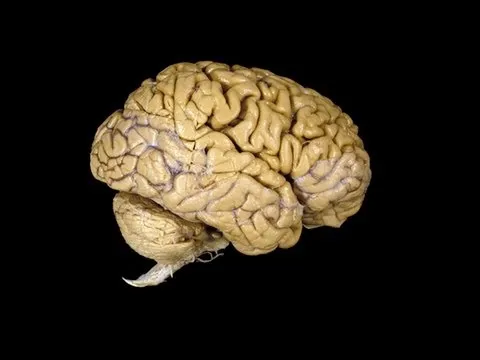
What Can You Do Without a Brain?
Based on Vsauce's video on YouTube. If you like this content, support the original creators by watching, liking and subscribing to their content.
Headless animals can still act when critical neural tissue remains, as with a chicken that retained part of the brain stem after decapitation.
Briefing
“No-brainer” turns out to be a misleading phrase: even after the brain is removed, parts of the body can still generate motion, electrical activity, and short-lived behaviors—though humans can’t survive long without neural control. The clearest evidence comes from decapitation cases and simpler nervous systems. In 1945, farmer Lloyd Olsen cut off a chicken’s head; the bird, nicknamed “Mike the Headless Chicken,” lived for another 18 months, touring and responding to feeding by having water or grain dropped into its throat. The key detail wasn’t magic—it was biology. Mike still had a portion of the brain stem, enough to support coordinated behavior.
To find something closer to a true “no-brainer,” the focus shifts to cockroaches. These insects don’t rely on a single large brain. Instead, they breathe through openings across their bodies and coordinate movement using distributed nerve bundles (ganglia) throughout the body. Even when decapitated, cockroaches can survive for weeks, walking and responding to movement, with the main limitation being eventual starvation.
Humans are far less resilient. Without a head and brain, death follows within seconds. Still, some actions don’t require conscious thinking because reflex pathways can act faster than the brain can interpret sensory input. Finger snaps can move at roughly 20 mph, and a strong sneeze can expel air at nearly 30–40 mph. Nerve impulses travel far faster—around 250 mph—but that speed can still be too slow when tissue damage is immediate, such as touching a hot stove. In those moments, the body pulls away via reflex circuits rather than waiting for the brain to process the situation. Involuntary functions and unconscious processes can also be treated as “no-brainers,” but they depend on the nervous system staying alive.
The discussion then pushes further: what happens after death, when the brain is gone entirely? Muscle cells retain stored energy in the form of ATP, so they can still produce electrical and mechanical responses briefly. Experiments using insect parts show that a detached leg can generate detectable electrical signals when touched or even breathed on. Similar effects can occur in human muscle tissue, at least in principle, because the cells themselves can respond while energy remains. Salt can also trigger behavior-like responses in fresh frog legs by inducing processes similar to action potentials, though the effect fades as cells run out of energy or decay.
Even beyond movement, other post-mortem processes can look “automatic.” Muscles relaxing can lead to loss of bodily control, and digestion continues in part because gut bacteria keep working after death. Skin adds another twist: skin cells can survive for days, harvesting from a corpse after 24 hours is possible, and hair and nails appear to grow because the skin shrinks as it dries.
The final turn is philosophical. If “you” is defined by what the brain does—your intentions and decisions—then a brainless body may not be “you” at all. Yet if “you” includes the independent behavior of cells and resident microbes, then being alive might be the real “yes-brainer.” In that sense, the question “What can you do without a brain?” becomes less about survival mechanics and more about what identity even means.
Cornell Notes
The phrase “no-brainer” breaks down under biological scrutiny: some behaviors persist without a brain, but humans still die quickly because they lack the distributed control systems seen in simpler animals. Headless chickens can live for months when brain stem tissue remains, while cockroaches can survive weeks after decapitation because their nervous system is distributed in ganglia and their breathing doesn’t depend on a head. After death, muscle cells can still show brief electrical and movement-like responses due to remaining ATP, and gut bacteria can continue parts of digestion. Skin cells can also remain active for days, and hair/nail “growth” is largely an illusion caused by skin shrinkage. The deeper question becomes whether “you” is defined by brain-driven intentions or by the independent activity of cells and microbes.
Why can a headless chicken still live and act for months?
What makes cockroaches a closer match to a true “no-brainer”?
How do reflexes qualify as “no-brainers,” and why do they matter for fast injuries?
What can still happen in a brainless body after death?
Which post-mortem processes can look automatic, and what are the misconceptions?
How does the discussion shift from biology to identity?
Review Questions
- What biological features allow cockroaches to keep functioning after decapitation, and how do those differ from humans?
- Explain how reflexes can outperform conscious brain processing during fast injuries like touching a hot stove.
- What evidence suggests that some cellular processes continue after death, and how does that complicate the idea of “you”?
Key Points
- 1
Headless animals can still act when critical neural tissue remains, as with a chicken that retained part of the brain stem after decapitation.
- 2
Cockroaches survive decapitation longer because breathing and neural control are distributed across the body rather than centralized in a head.
- 3
Reflex pathways can trigger rapid movement when sensory damage occurs faster than the brain can interpret input.
- 4
After death, muscle cells can still show electrical and mechanical responses briefly because ATP energy remains in cells.
- 5
Gut bacteria can continue parts of digestion after death, meaning some “automatic” processes persist without a functioning nervous system.
- 6
“Hair and nail growth” after death is largely an optical effect from skin shrinkage, not true continued growth.
- 7
The identity question hinges on whether “you” means brain-driven intentions or the independent activity of cells and microbes.