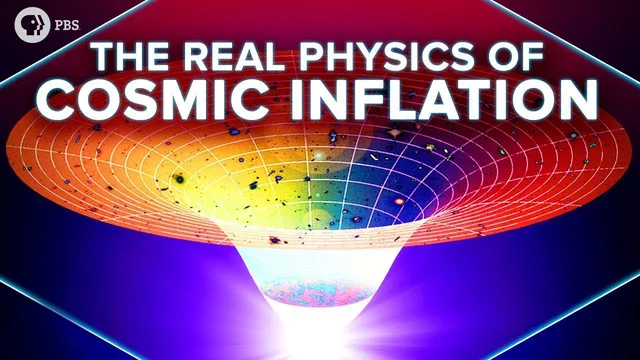
What Caused the Big Bang?
Based on PBS Space Time's video on YouTube. If you like this content, support the original creators by watching, liking and subscribing to their content.
Inflation requires a quantum field to remain trapped in a false vacuum with constant positive energy density, which acts like a cosmological constant and drives exponential expansion.
Briefing
Cosmic inflation is built around one central mechanism: a quantum field can get trapped in a “false vacuum” with constant, positive energy density, and that energy acts like a repulsive form of gravity that drives exponential expansion. The payoff is that inflation can simultaneously address several major puzzles in early-universe cosmology—why the observable universe looks so smooth, why its geometry appears nearly flat, why no magnetic monopoles are seen, and why the universe is expanding today. After inflation ends, the same energy is converted into ordinary particles, reheating the cosmos and setting the stage for the standard Big Bang timeline.
In general relativity, most forms of energy pull the universe together, but a constant energy density of empty space pushes instead. When the vacuum energy is large, Einstein’s equations imply a cosmological-constant-like term that produces exponential growth at a rate set by that vacuum energy. The challenge is scale: inflation needs an enormous expansion—roughly a factor of 10^25 in less than 10^-30 seconds—far beyond what dark energy can provide today. That requirement forces cosmologists to look beyond classical gravity and into quantum field theory, where “vacuum energy” can exist even without particles.
Quantum fields permeate space, and each field has a value at every point—its field strength. Particles are excitations of these fields, but fields can also carry intrinsic energy in a vacuum state. If a field’s potential energy landscape has a local minimum, the field can become stuck there, unable to quickly roll down to the true lowest-energy state. That trapped configuration is the false vacuum: it holds high energy but produces no particles, and it behaves like the constant vacuum energy density needed for inflation. Alan Guth’s original picture (1979) imagines the inflaton field starting at high field strength in the hot early universe, then cooling until it becomes trapped in the local minimum. The universe keeps expanding exponentially while the field remains stuck, effectively supercooling.
Inflation cannot last forever in our patch. Quantum fluctuations—rooted in the Heisenberg uncertainty principle—eventually push the inflaton field through the barrier separating the false vacuum from a deeper true vacuum. The transition proceeds via quantum tunneling, creating regions where inflation ends. These regions expand outward at nearly the speed of light, forming “bubbles” in which the inflaton energy is converted into inflaton particles. The inflaton particles then decay into familiar Standard Model particles (quarks, electrons, and others), rapidly reheating the universe into a hot, dense mixture of matter and radiation. From there, the universe evolves through the usual cooling and structure formation expected in Big Bang cosmology.
Guth’s original “old inflation” ran into a major problem: when inflation ends through bubble nucleation, energy is released mainly at bubble boundaries, and the resulting unevenness conflicts with the observed smooth temperature of the cosmic microwave background. That tension motivated improved inflation models designed to end inflation more uniformly. Deeper analysis also leads to a more unsettling conclusion: if inflation begins, it tends to continue eternally in some regions, potentially generating infinitely many bubble universes—an idea reserved for later discussion in the multiverse framing.
Cornell Notes
Cosmic inflation relies on a quantum field trapped in a false vacuum—a local minimum of its potential energy. While stuck, the field’s constant positive energy density acts like a cosmological constant, driving exponential expansion that can explain the universe’s smoothness, near-flat geometry, and the lack of magnetic monopoles. Inflation ends when quantum fluctuations cause the field to tunnel through the barrier to a true vacuum, creating bubbles where exponential growth stops. The released inflaton energy is converted into inflaton particles, which quickly decay into Standard Model particles, reheating the universe and restoring the hot, dense conditions needed for the standard Big Bang sequence. Guth’s original bubble-based exit struggled with matching the cosmic microwave background’s uniformity, prompting newer models.
How does a “false vacuum” produce exponential expansion in inflation?
Why can’t inflation’s energy come from ordinary particles dispersing as the universe expands?
What role do quantum fluctuations and the Heisenberg uncertainty principle play in ending inflation?
What happens physically inside a bubble where inflation ends?
Why did Guth’s original “old inflation” have trouble with the cosmic microwave background?
What does the discussion imply about inflation’s long-term behavior?
Review Questions
- What conditions on the inflaton field’s potential energy landscape allow a false vacuum to drive inflation?
- Trace the sequence from false vacuum → tunneling → bubble formation → reheating, naming what becomes of the inflaton energy at each step.
- Why does bubble-based “old inflation” struggle to match the observed smoothness of the cosmic microwave background?
Key Points
- 1
Inflation requires a quantum field to remain trapped in a false vacuum with constant positive energy density, which acts like a cosmological constant and drives exponential expansion.
- 2
Exponential growth in inflation is tied to Einstein’s equations: a positive vacuum energy density yields a constant doubling rate for the universe’s size.
- 3
Inflation’s required expansion factor is enormous (about 10^25) on an extremely short timescale (under 10^-30 seconds), implying vacuum energy far larger than today’s dark energy.
- 4
Quantum tunneling triggered by quantum fluctuations ends inflation locally, creating bubbles where the inflaton field transitions to a true vacuum.
- 5
Inside bubbles, inflaton energy converts into inflaton particles, which rapidly decay into Standard Model particles, reheating the universe to enable the standard Big Bang evolution.
- 6
Guth’s original old inflation faced a mismatch with cosmic microwave background smoothness because bubble boundaries dominate energy release, making the temperature too uneven unless bubbles collide often enough to undermine inflation’s duration.
- 7
Eternal inflation scenarios suggest inflation can continue indefinitely in some regions, potentially producing infinitely many bubble universes.