What Color Is A Mirror?
Based on Vsauce's video on YouTube. If you like this content, support the original creators by watching, liking and subscribing to their content.
A mirror’s apparent color depends on the wavelengths it reflects from the scene, not on a fixed pigment color.
Briefing
A mirror’s “color” isn’t a fixed property of the glass or metal—it’s determined by what wavelengths it reflects. In the ideal case, a perfect mirror reflects all visible colors equally, producing an effect that’s closer to “white” than to any single pigment color. But real mirrors aren’t perfect: their coatings absorb some light and reflect others more strongly, so the reflected spectrum can tilt toward a particular hue. In this explanation, a typical mirror most strongly reflects light around the 510 nanometer range, which corresponds to green—meaning everyday mirrors are, technically, a tiny bit green.
That distinction matters because mirrors don’t behave like colored objects. A colored sticky note appears orange because its material absorbs most wavelengths and diffuses the remaining orange light toward the eye. A mirror, by contrast, uses specular reflection: it sends incoming light back in a single direction, preserving the image of whatever sits in front of it. That’s why a mirror can seem “you-colored” in a room—its surface reflects the colors of the scene rather than generating its own pigment-like color.
The “green mirror” idea becomes visible in a mirror tunnel, where two mirrors face each other. Each bounce loses some light, and because green is reflected more efficiently than other wavelengths, the tunnel’s far end looks dimmer and greener. The effect isn’t dramatic in a single reflection, but repeated reflections amplify the spectral bias.
The discussion then broadens from mirrors to how humans assign color in the first place. People can differentiate roughly 10 million colors, yet the sky and eyes show that color perception often comes from physics rather than from “colored” materials. Blue eyes, for example, aren’t blue molecules; they look blue because of interference and scattering. Sunlight interacts with air molecules: longer wavelengths pass more easily, while shorter wavelengths scatter more strongly—so the sky away from the Sun appears blue. Remove the air and the same space would look black.
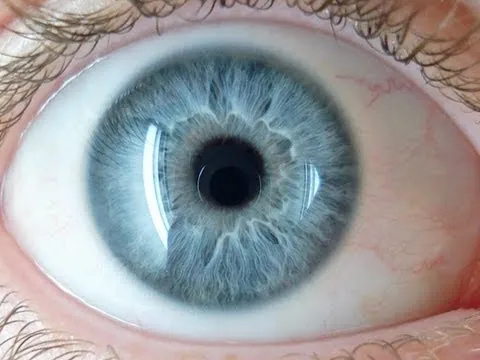
Inside the eye, a hazy layer in the iris scatters light in a similar way. Shorter wavelengths scatter more, making the eyes appear blue; variations in iris pigmentation—described here as melanin—shift the balance toward green, hazel, or brown. Even the words for “white” and “black” trace back to an ancient Proto-Indo-European root meaning “shine” or “burn,” with some languages associating it with brightness (“white”) and others with what remains after burning (“black”).
Taken together, the central insight is that “color” is not just a property of objects. For mirrors, it’s a property of reflected light; for eyes and skies, it’s a property of how light interacts with matter and then reaches the viewer.
Cornell Notes
Mirrors don’t have a single inherent color; they reflect the colors of whatever light they receive. A perfect mirror would reflect all wavelengths equally, behaving like “white,” but real mirrors absorb some light and reflect others more strongly, often favoring green around 510 nm. That spectral bias becomes obvious in a mirror tunnel, where repeated reflections gradually remove more non-green light, making the far end dimmer and greener. The broader takeaway is that perceived color often comes from physics—scattering, interference, and absorption—rather than from pigment alone, as shown by blue eyes and the blue sky.
Why does a mirror’s apparent color change depending on what it’s pointed at?
How is a mirror different from a colored object like an orange sticky note?
What makes real mirrors look slightly green, and how is that quantified?
Why does a mirror tunnel become dimmer and greener?
Why do blue eyes look blue if the eye’s molecules aren’t blue?
How do the sky’s color and the eye’s color connect to the same physical mechanism?
Review Questions
- If a mirror were truly perfect and reflected all wavelengths equally, what would it look like under white light—and why?
- In a mirror tunnel, which wavelengths should fade fastest and why, based on the mirror’s reflection spectrum?
- How do scattering and interference explain blue eyes differently from a pigment-based explanation?
Key Points
- 1
A mirror’s apparent color depends on the wavelengths it reflects from the scene, not on a fixed pigment color.
- 2
Colored objects look colored because they absorb most wavelengths and diffuse the remaining ones toward the eye.
- 3
Mirrors create images through specular reflection, sending incoming light back in a single direction.
- 4
Perfect mirrors would reflect all visible colors equally, behaving most like “white” rather than any single hue.
- 5
Real mirrors absorb some wavelengths and tend to reflect most strongly near 510 nm, making them slightly green.
- 6
Repeated reflections in a mirror tunnel amplify wavelength-dependent losses, producing a dimmer, greener view at the far end.
- 7
Perceived color in eyes and the sky can come from scattering and interference, not from inherently colored molecules.