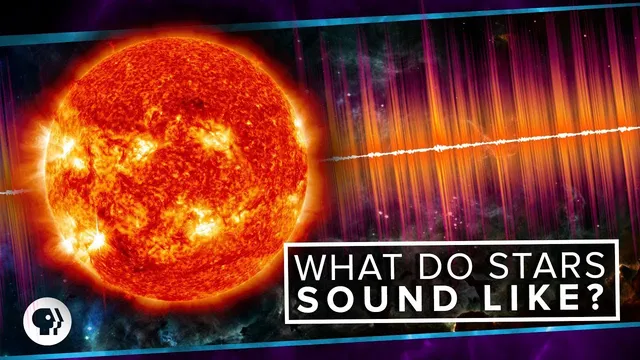
What Do Stars Sound Like?
Based on PBS Space Time's video on YouTube. If you like this content, support the original creators by watching, liking and subscribing to their content.
Stellar interiors can be probed by measuring resonant pressure-wave oscillations that form standing patterns inside stars.
Briefing
Stars may look like distant, opaque balls of plasma, but their interiors can be mapped by listening to the vibrations they naturally produce. By tracking how stellar brightness and surface motions change—signatures of resonant “seismic” oscillations—astronomers can infer internal structure, rotation, composition, and even evolutionary stage. The payoff is practical: these measurements test and refine the long-standing models built from hydrostatic equilibrium, which otherwise rely mostly on light emitted from a star’s surface.
The core idea is that stars ring like bells. Turbulence near a star’s surface drives pressure waves (the stellar analog of sound) that travel through the interior and then set up standing waves. In the Sun, the dominant oscillations are pressure modes (“p modes”), organized by spherical harmonics into patterns of density variation. Multiple modes overlap, creating a complex surface signal that can be disentangled using Fourier analysis. For the Sun, the oscillations show up as tiny brightness changes—about 1 part per million over an oscillation—and as vertical gas motions around 0.1 m/s, detectable through Doppler shifts in spectral lines.
Those mode patterns act like a diagnostic of the star’s interior because the resonant frequencies depend on how the speed of sound varies with temperature, density, and composition. Rotation adds another layer: internal spin changes the oscillation spectrum, letting helioseismology probe how different layers rotate. Observations indicate the Sun’s inner radiative zone rotates nearly like a solid body, while the outer convective zone rotates at different rates depending on latitude. That differential rotation helps power the solar magnetic field and drives the sunspot cycle.
Helioseismology has also measured the Sun’s core composition, estimating how much hydrogen has been converted into helium. The results place the Sun at roughly halfway through its ~10 billion-year lifetime, consistent with radiometric dating of the oldest meteorites.
For distant stars, resolving the surface is impossible, so the approach shifts to global measurements. Asteroseismology relies on faint, space-based brightness flickering rather than resolved Doppler velocities. Even so, the strongest oscillation modes can yield fundamental properties such as radius, mass density, and surface gravity—especially in red giants—and can constrain how close those stars are to their final evolutionary phases. Missions such as MOST and COROT pioneered this work, while Kepler contributed as a side project for planet hunting; future planet missions like TESS and PLATO are expected to extend the seismology dataset with higher precision across many more stars.
Finally, the discussion notes that for the Sun, advanced techniques can probe local events hidden from direct view. Helioseismic holography uses the wave field across the visible disk to infer conditions throughout the interior, including the far side, enabling early detection of sunspots before rotation brings them into view—an early-warning capability for potentially hazardous solar activity. The broader theme is that stellar “music” encodes physical history and structure, turning subtle oscillations into a readable record of what lies beneath.
Cornell Notes
Stars generate pressure-driven oscillations that propagate through their interiors and form standing wave patterns. By measuring tiny changes in brightness and surface motion—especially the dominant p-mode frequencies—astronomers infer how sound speed varies with temperature, density, and composition, and how rotation modifies the oscillation spectrum. Helioseismology has mapped the Sun’s internal rotation profile and estimated core hydrogen-to-helium conversion, placing the Sun about halfway through its ~10 billion-year life. Asteroseismology extends the method to distant stars using global brightness flickering from space missions, extracting properties like radius, density, and surface gravity, particularly for red giants. The technique turns otherwise inaccessible interior physics into observable “seismic” signatures.
Why can stellar interiors be studied without directly seeing beneath a star’s surface?
What wave types matter inside stars, and why are pressure waves central for Sun-like stars?
How do astronomers extract individual oscillation modes from overlapping signals?
What does helioseismology reveal about the Sun’s internal rotation and magnetic activity?
How does asteroseismology work when distant stars can’t be spatially resolved?
What is helioseismic holography, and how does it enable early sunspot detection?
Review Questions
- How do p-mode oscillation frequencies depend on interior properties, and why does that make them useful for testing stellar structure models?
- Compare helioseismology and asteroseismology in terms of what is observable (Doppler velocities vs global brightness flickering) and what that limits or enables.
- What rotational features of the Sun can be inferred from oscillation spectra, and how are those features linked to the magnetic field and sunspot cycle?
Key Points
- 1
Stellar interiors can be probed by measuring resonant pressure-wave oscillations that form standing patterns inside stars.
- 2
For Sun-like stars, pressure modes (p modes) dominate and are driven by turbulence just below the surface.
- 3
The oscillation spectrum depends on how the speed of sound varies with temperature, density, and composition, so mode frequencies act as interior diagnostics.
- 4
Helioseismology has mapped the Sun’s rotation profile, finding near-solid-body rotation in the inner radiative zone and latitude-dependent differential rotation in the outer convective zone.
- 5
Helioseismology also constrains core composition, indicating the Sun is about halfway through its ~10 billion-year hydrogen-burning lifetime.
- 6
Asteroseismology extends the method to distant stars using global brightness flickering measured from space, enabling estimates of radius, density, and surface gravity.
- 7
Helioseismic holography can infer interior wave states on the far side of the Sun, enabling earlier detection of sunspots than direct viewing alone.