What does area have to do with slope? | Chapter 9, Essence of calculus
Based on 3Blue1Brown's video on YouTube. If you like this content, support the original creators by watching, liking and subscribing to their content.
Average value on [a,b] is (1/(b−a)) times the signed area under f(x), i.e., (1/(b−a))∫[a,b] f(x) dx.
Briefing
Finding the average value of a continuous function turns out to be the same kind of calculation as measuring the slope of an antiderivative across an interval—an insight that makes the “integrals and derivatives are inverses” idea feel concrete rather than abstract. Using the sine curve as the running example, the average height of sin x from 0 to π is computed as (1/π) times the signed area under the graph. That average comes out to 2/π (about 0.64), because the integral of sin x over 0 to π equals 2.
The key move starts with a familiar finite average: add a set of values and divide by how many you sampled. For a continuum, you can’t literally add infinitely many heights, so the approach approximates the interval with evenly spaced sample points. If the spacing between samples is dx, then the number of samples is roughly π/dx. The “average height” becomes a sum of sin x values divided by the number of samples; after rearranging, that same expression looks like a sum of sin x · dx. As dx shrinks toward 0, that sum becomes the integral ∫[0,π] sin x dx. Interpreting units makes the formula feel natural: area divided by width gives an average height.
To evaluate the integral, the method relies on antiderivatives. Since the derivative of cosine is −sin x, the antiderivative of sin x is −cos x. Plugging bounds into the antiderivative gives ∫[0,π] sin x dx = (−cos π) − (−cos 0). Because cos π = −1 and cos 0 = 1, the result is 2. Dividing by the interval length π yields the average value 2/π.
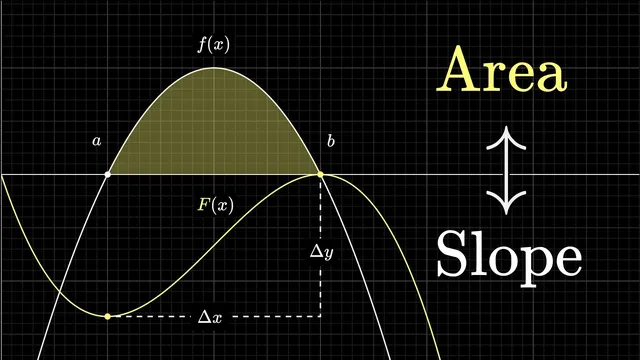
The deeper payoff is geometric. The integral of f over [a,b] equals the change in an antiderivative F across the same interval: F(b) − F(a). Dividing by (b − a) turns that change in height into a slope—specifically, the slope of the secant line connecting the points (a, F(a)) and (b, F(b)). Since F′(x) = f(x), that slope can be interpreted as the average value of f(x) across the interval. In the sine example, the average value of sin x is therefore the average slope of the tangent lines to the curve −cos x over 0 to π.
More generally, the transcript frames average value as “signed area over width,” where regions below the x-axis count negatively. It then connects that finite averaging intuition to integrals by showing how multiplying by dx converts “adding heights” into “adding little areas.” Once that bridge is built, antiderivatives explain why integrals can be computed by endpoint comparisons rather than tallying every intermediate contribution. The result is a second intuition for when integrals belong: whenever a finite, add-up-and-divide idea needs to extend to a continuous infinity, an integral is often the right language.
Cornell Notes
Average value of a continuous function f on [a,b] is defined as the signed area under f divided by the interval length: (1/(b−a))∫[a,b] f(x) dx. Approximating the interval with many evenly spaced samples turns the average of heights into a sum of f(x)·dx, which becomes the integral as dx→0. Evaluating the integral uses an antiderivative F, giving ∫[a,b] f(x) dx = F(b)−F(a). Dividing by (b−a) converts that height change into a slope, so the average value of f equals the slope of the antiderivative’s secant line over the interval. For f(x)=sin x on [0,π], the antiderivative −cos x changes by 2, so the average is 2/π.
Why does “average height” for a continuous graph become “area divided by width”?
How does the integral of sin x from 0 to π turn into a simple number?
What does dividing an integral by (b−a) mean geometrically?
How does the “average slope of tangent lines” connect to the average value of f(x)?
Why does the integral require “signed area” rather than just area?
Review Questions
- For a general function f on [a,b], write the formula for its average value and explain how it relates to signed area.
- Given f(x)=sin x on [0,π], compute its average value using an antiderivative and endpoint evaluation.
- Explain why the average value of f(x) equals the slope of the antiderivative’s secant line over the interval.
Key Points
- 1
Average value on [a,b] is (1/(b−a)) times the signed area under f(x), i.e., (1/(b−a))∫[a,b] f(x) dx.
- 2
Approximating a continuous average with evenly spaced samples turns “sum of heights” into a sum of f(x)·dx, which becomes an integral as dx→0.
- 3
For f(x)=sin x, an antiderivative is −cos x, so ∫[0,π] sin x dx = (−cos π) − (−cos 0) = 2.
- 4
Dividing F(b)−F(a) by b−a converts the antiderivative’s endpoint height change into a slope.
- 5
Because f(x)=F′(x), that secant slope can be interpreted as the average of the tangent slopes (instantaneous slopes) across the interval.
- 6
Signed area matters: portions of the graph below the x-axis contribute negatively to the average.