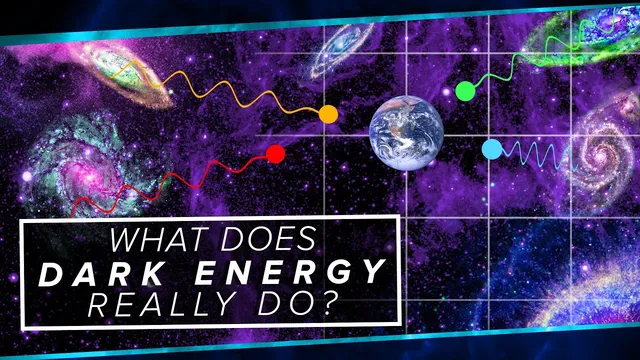
What Does Dark Energy Really Do?
Based on PBS Space Time's video on YouTube. If you like this content, support the original creators by watching, liking and subscribing to their content.
Type Ia supernovae provide distances because their intrinsic luminosities are consistent, enabling a redshift–distance test of cosmic expansion.
Briefing
Dark energy is the missing ingredient that makes the universe’s expansion history match what astronomers actually observe—most notably, the discovery that cosmic expansion has been accelerating for billions of years. The key evidence comes from Type Ia supernovae (white dwarf explosions) used as “standard candles” to measure how much the universe expanded while their light traveled to Earth. When those supernovae appear fainter than expected for a universe that would slow down under gravity, the data point to an expansion rate that sped up during the light’s journey—an effect consistent with a repulsive component of space itself.
The logic starts with Einstein’s general relativity and the Friedmann equations, which relate the universe’s expansion to its energy content and geometry. Observations indicate the universe is geometrically flat yet expanding forever, a combination that requires introducing a new energy term: the cosmological constant, often labeled dark energy. But the more direct test comes from measuring the universe’s past expansion without counting galaxies. As space expands, it stretches traveling light, producing cosmological redshift. If astronomers know the redshift and the physical distance to a source, they can reconstruct the expansion history encoded in that light.
Distance is the hard part in astronomy, so researchers rely on standard candles—objects with known intrinsic brightness. Type Ia supernovae fit the bill because a white dwarf in a binary system reaches a critical mass, triggers runaway fusion, and explodes with remarkably consistent high luminosity. By collecting many such explosions at distances of billions of light-years and comparing their redshifts to their inferred distances, two major teams found in 1998 that supernovae were dimmer (and redshifts lower) than expected if the universe’s expansion had been slowing down. The mismatch implies that something counteracted gravity’s pull on cosmic scales, causing the expansion to accelerate.
The cosmological constant provides a mathematical way to reconcile this acceleration with the Friedmann equations. Because the term is constant in time, it behaves like vacuum energy—a property of space itself. In the far future, when matter density becomes negligible and curvature is effectively zero, the expansion depends only on the cosmological constant. The result is not a constant expansion rate, but a constant Hubble parameter, meaning the universe’s doubling time stays fixed. That produces exponential growth, which looks like accelerating expansion.
The transcript also addresses uncertainties and objections. Even if the observable universe might not perfectly represent global geometry, curvature small enough to evade current sensitivity still leaves dark energy required to match the expansion-versus-density balance. And while measuring the density of an enormous “greater universe” sounds daunting, large-scale smoothness allows surveys to sample representative patches rather than the whole cosmos. Finally, the cosmological constant is treated as strongly favored because it resolves multiple measurement discrepancies within a framework—general relativity—that has been repeatedly validated. The remaining open question is whether the vacuum-energy-like term truly stays constant or changes over time, a topic deferred to a later episode.
Cornell Notes
Astronomers infer dark energy from how the universe’s expansion rate changed over time. Type Ia supernovae act as standard candles: their known intrinsic brightness lets researchers measure distance, while their redshift records how much space expanded during the light’s travel. In 1998, two teams found supernovae were dimmer and redshifts lower than expected for a universe whose expansion was slowing down under gravity, implying the expansion accelerated instead. The cosmological constant explains this by behaving like vacuum energy—energy inherent to space—so that at late times it dominates and drives exponential growth. The acceleration has been underway for roughly six billion years, but whether the “constant” truly stays constant remains an open question.
How do redshift and distance together reveal the universe’s expansion history?
Why are Type Ia supernovae treated as “standard candles”?
What exact observational pattern pointed to accelerated expansion in 1998?
How does a constant cosmological constant produce accelerating expansion?
What concerns arise about measuring curvature and the density of a “greater universe,” and how are they addressed?
Review Questions
- How does the redshift–distance relationship differ from using redshift alone, and why does distance measurement drive the difficulty of reconstructing expansion history?
- Explain the chain of reasoning from Type Ia supernova brightness to the conclusion that expansion accelerated between then and now.
- In the far future, why does a constant cosmological constant lead to exponential growth rather than a constant expansion rate?
Key Points
- 1
Type Ia supernovae provide distances because their intrinsic luminosities are consistent, enabling a redshift–distance test of cosmic expansion.
- 2
Cosmological redshift records how much space expanded during a photon’s travel time, linking observed spectra to the universe’s past expansion rate.
- 3
In 1998, supernovae were dimmer (and redshifts lower) than expected for a decelerating universe, indicating accelerated expansion.
- 4
A positive cosmological constant can be interpreted as vacuum energy—energy inherent to space—that dominates the universe’s dynamics at late times.
- 5
With dark energy dominating, the Hubble parameter approaches a constant, producing exponential growth that looks like acceleration.
- 6
Current observational limits allow small curvature, but dark energy remains necessary to reconcile expansion behavior with the universe’s energy content.
- 7
The cosmological constant’s physical cause and whether it truly stays constant are unresolved and deferred to later discussion.