What does it feel like to invent math?
Based on 3Blue1Brown's video on YouTube. If you like this content, support the original creators by watching, liking and subscribing to their content.
Infinite sums become well-defined only after specifying a convergence criterion based on finite truncations getting arbitrarily close to a target value.
Briefing
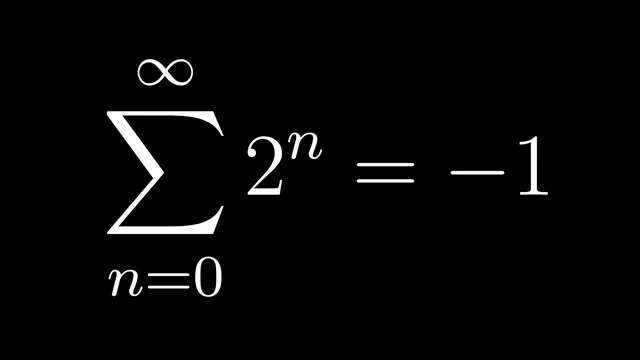
A geometric-looking “nonsense” identity—1 + 2 + 4 + 8 + … = −1—can be made meaningful once mathematicians redefine what “distance” and “infinite sum” mean. The core move is to treat certain infinite series not as literal completed computations, but as limits under a new notion of convergence. In the usual real-number sense, the partial sums of 1 + 2 + 4 + 8 + … blow up, so the expression can’t equal −1. But with a different metric, the same sequence of partial sums can be said to approach −1, turning the equation into a legitimate statement rather than a contradiction.
The path starts with a more familiar paradox: 1/2 + 1/4 + 1/8 + … = 1. Early on, the transcript frames the discovery as an “early mathematician” trying to justify what it means to add infinitely many terms. The key definition is convergence: an infinite sum equals x if the finite truncations form a list that gets arbitrarily close to x—meaning that for any tiny tolerance, the tail of the list eventually stays within that tolerance. This reframes “approach” as a precise limiting behavior, not as a vague feeling.
From there, the discussion generalizes the idea by changing how the interval is split. Instead of halving each time, imagine cutting a segment into proportions p and 1−p, then repeatedly splitting the right piece in the same ratio. The resulting geometric series has the form (1−p) + p(1−p) + p²(1−p) + …, which sums to 1 when 0 < p < 1. The transcript then highlights a crucial tension: the algebraic formula still “works” if p is replaced by values outside that range, producing outcomes like 0.9 repeating = 1, but also producing absurdities such as alternating sums for p = −1 and explosive growth for p = 2.
To rescue the p = 2 case, the transcript argues that the real obstacle isn’t the algebra—it’s the underlying notion of distance. In the usual real metric, powers of 2 don’t get close to 0; they race away. So the discussion introduces a shift-invariant distance function and constructs one by organizing rational numbers into nested “rooms” based on powers of 2 they share. Two numbers are declared close if they fall into the same smallest room in this hierarchy; the distance halves each time the shared room becomes more specific. This produces the 2-adic metric, a member of the broader p-adic family.
Under the 2-adic metric, powers of 2 do approach 0, and therefore the partial sums 1, 3, 7, 15, 31, … genuinely approach −1. The transcript closes by tying the story to a broader philosophy: mathematicians often begin with ill-defined or “fuzzy” discoveries, then invent rigorous concepts—like convergence and p-adic distance—that make those discoveries precise and useful, expanding the toolkit for future questions.
Cornell Notes
The transcript explains how “infinite sums” become meaningful only after defining what convergence means. It starts with a standard geometric series, 1/2 + 1/4 + 1/8 + … = 1, and formalizes convergence using finite truncations that get arbitrarily close to a target value. It then shows that algebraic formulas for geometric series can produce contradictions when parameters fall outside the usual range (for example, p = 2 leads to 1 + 2 + 4 + 8 + … = −1). The resolution comes from changing the notion of distance: the 2-adic metric groups rational numbers into nested “rooms” based on shared powers of 2. In that metric, powers of 2 approach 0, and the partial sums 1, 3, 7, 15, … approach −1, making the identity valid.
What definition turns an infinite series into a statement that can be “true” rather than merely formal?
Why does 1/2 + 1/4 + 1/8 + … = 1 feel plausible geometrically, and how is it generalized?
What goes wrong when the same geometric-series algebra is pushed to p = −1 or p = 2?
How can changing “distance” make powers of 2 approach 0 instead of diverging?
Why does the 2-adic metric make 1 + 2 + 4 + 8 + … = −1 meaningful?
What broader pattern does the transcript suggest about how new math concepts emerge?
Review Questions
- How does the transcript’s definition of “infinite sum equals x” depend on finite truncations and a tolerance parameter?
- Why does the identity 1 + 2 + 4 + 8 + … = −1 fail under the usual real-number notion of distance, and what changes under the 2-adic metric?
- Explain the “room” hierarchy idea: what determines the distance between two numbers in the 2-adic metric?
Key Points
- 1
Infinite sums become well-defined only after specifying a convergence criterion based on finite truncations getting arbitrarily close to a target value.
- 2
Geometric series can be derived from repeated interval-splitting, producing formulas that sum to 1 for 0 < p < 1.
- 3
Algebraic continuation of geometric-series formulas outside the usual parameter range can yield contradictions because the real-number notion of convergence no longer applies.
- 4
The decisive fix for 1 + 2 + 4 + 8 + … = −1 is changing the underlying notion of distance, not the algebra.
- 5
The 2-adic metric is built from nested “rooms” determined by shared powers of 2, making powers of 2 approach 0.
- 6
Under the 2-adic metric, the partial sums 1, 3, 7, 15, 31, … approach −1, so the infinite series becomes meaningful.
- 7
New, rigorous mathematics often starts by rescuing “fuzzy” discoveries through new definitions that make them precise and useful.