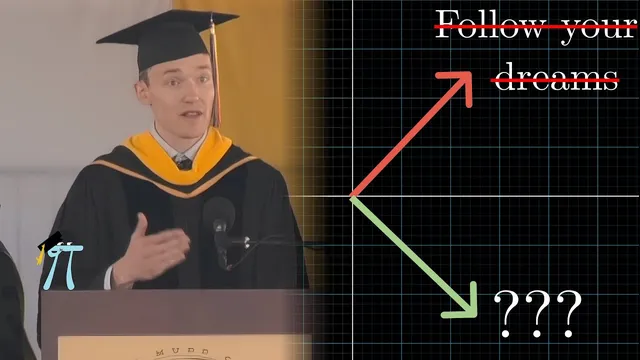
What "Follow Your Dreams" Misses | Harvey Mudd Commencement Speech 2024
Based on 3Blue1Brown's video on YouTube. If you like this content, support the original creators by watching, liking and subscribing to their content.
Career advice built on “follow your dreams” often misses the post-college requirement to add value to others, not just pursue personal enjoyment.
Briefing
“Follow your dreams” is too vague to be reliable career advice because it ignores how careers actually work: passion is real, but success depends on adding value to others, taking action before motivation, and navigating timing and change. Grant Sanderson’s core message to the Harvey Mudd class of 2024 is that graduates should treat passion as a starting force, not a fixed destination—and should choose paths that fit both the needs of other people and the realities of the future.
Sanderson opens by challenging the cliché directly. Passion can make people create “the biggest ripples,” and doing work one loves is often more enjoyable. But not everyone has a pre-made dream waiting to be followed, and even when someone does, turning personal enjoyment into a career requires pragmatic alignment. The biggest shift comes after college: learning and growth are the end goal in school, while post-graduation success hinges on how effectively someone adds value to others. He illustrates the difference with a music analogy—Paganini-style technical perfection may win grades, but a Taylor-style focus on resonating emotionally can be better for a real career. The takeaway is blunt: if a dream is only about the self, it will struggle.
He then offers a sequence of practical adjustments. First, action precedes motivation. People often feel driven after they begin—like waking up after getting out of bed or building exercise habits. In his own case, he entered college with a math passion and later drifted toward teaching and video creation almost by accident: he built a rudimentary Python library for math visualizations, posted proofs and problems online, and those personal projects gradually turned into conversations and work connected to Khan Academy. That story becomes a lesson in how careers can emerge from experimentation rather than from a single preplanned dream.
Next comes survivorship bias, both obvious and subtle. Inspirational speeches tend to feature winners from high-risk paths—athletics, arts, startups—while the many who don’t succeed rarely get a platform. There’s also a timing bias: some interests match the future’s shape. Software enthusiasm in the late 1980s aligned with the dot-com boom; niche film skills aligned with YouTube-era distribution. Sanderson argues graduates should ask what is possible now that wasn’t possible 10 years ago—and what may get harder 10 years from now—because opportunity often grows in less crowded windows.
He also broadens whose dreams matter. Talithia Williams’s story highlights how a teacher’s encouragement in high school calculus—“you’re really good at this… consider majoring in math”—can trigger a chain of outcomes. As people age, they increasingly influence those younger than them, so shaping others’ aspirations becomes part of leadership.
Finally, Sanderson warns against treating dreams as a static target. The world changes unpredictably, and even personal values shift over decades—toward family, toward industry, back toward graduate school, or into jobs that didn’t exist at graduation. His concluding framework reframes passion as initial velocity: it gives direction, but the path should adapt to new forces. Graduates who prioritize adding value, begin with action, track changing opportunity, leverage influence on the next generation, and stay nimble are more likely to steer the future rather than chase a fixed script.
Cornell Notes
“Follow your dreams” is unreliable career advice because it overlooks the real mechanics of success: adding value to others, acting before motivation, and adapting to timing and change. Grant Sanderson argues that after college, the goal shifts from learning for its own sake to using expertise to help others. He reframes passion as initial velocity—use it to start, but expect the direction to change as the world and your own values evolve. His own path—from building math visualization tools in Python to teaching and online lessons—illustrates how opportunity can emerge from personal projects when they align with broader timing. The practical message: pursue opportunities that fit both your strengths and what others need, then stay adaptable as careers and the world shift.
Why does “follow your dreams” fail as career guidance, even when passion is real?
How does Sanderson justify the idea that action should come before motivation?
What is survivorship bias in the context of career advice, and what’s the “subtle” version?
How should graduates think about timing and opportunity windows?
Why does he say dreams aren’t only personal?
What does it mean to treat passion as “initial velocity” rather than a destination?
Review Questions
- What specific shift does Sanderson describe between the student goal of growth and the post-college goal of adding value?
- How does survivorship bias operate both in who gets to give advice and in how timing affects which paths succeed?
- In Sanderson’s framework, what should graduates do when their passion points them toward a path that has little precedent?
Key Points
- 1
Career advice built on “follow your dreams” often misses the post-college requirement to add value to others, not just pursue personal enjoyment.
- 2
Passion can be real without being a ready-made career plan; graduates should look for intersections between their skills and what others need.
- 3
Action precedes motivation: starting projects and building habits can create the drive that later makes a path sustainable.
- 4
Inspirational stories are shaped by survivorship bias, including timing effects—some opportunities only exist when the world’s infrastructure is ready.
- 5
Opportunity is often greatest in less crowded windows; graduates should ask what’s newly possible now and what may become harder later.
- 6
Dreams aren’t purely individual: encouragement from teachers and the influence graduates have on younger people can redirect entire careers.
- 7
Treat passion as initial velocity: use it to start, but expect the direction to change as the world and personal values evolve.