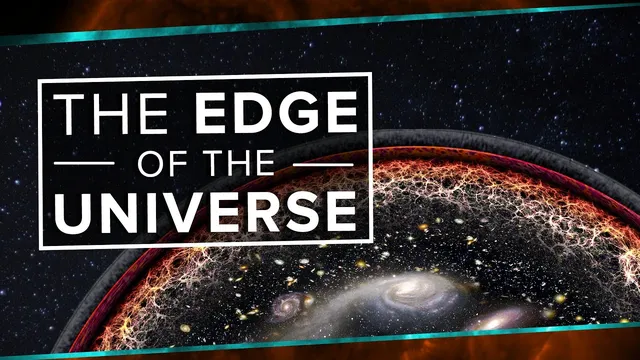
What Happens At The Edge Of The Universe? | Space Time | PBS Digital Studios
Based on PBS Space Time's video on YouTube. If you like this content, support the original creators by watching, liking and subscribing to their content.
The “edge of the universe” is usually a horizon of causality, not a physical boundary you can reach.
Briefing
The universe doesn’t have a single, physical “edge” that can be reached like a cliff—what people call an edge is usually a boundary set by causality. The most important limit is the particle horizon: the maximum distance from which light (and any information) could have reached us since the Big Bang. Using the current best cosmology, that horizon sits about 46 billion light-years away in radius (often summarized as 93 billion light-years across), corresponding to the most distant region we can see in any direction—identified observationally through the cosmic microwave background (CMB). But reaching that boundary is not a matter of simply traveling 46 billion light-years. Because space itself has been expanding, the “proper distance” you’d need to cover grows as you move, and the journey effectively requires an infinite amount of travel even for a ship moving at light speed.
A second, even more restrictive boundary is the cosmic event horizon, analogous to a black hole’s event horizon. For the universe, it marks regions from which no new signals emitted today can ever reach us, because the expansion rate outpaces light’s ability to cross the growing gap. With current measurements of cosmological parameters, this event horizon is estimated to be around 16 billion light-years away. That means there are galaxies visible now that we will never be able to reach or communicate with—more like “ghost images” of regions that are already slipping beyond causal contact. As expansion continues, more of the universe will cross this event horizon and become permanently inaccessible.
What lies beyond these horizons depends on the universe’s large-scale geometry. On the biggest scales, observations of the CMB and the distribution of galaxies suggest spacetime is extremely close to flat, though not known with infinite precision. If the universe is perfectly flat, the simplest extrapolation of Einstein’s general relativity implies an infinite universe with no true boundary to cross. But if there is slight positive curvature—small enough to hide within current measurement uncertainties—the universe could behave like the surface of a 3D hypersphere embedded in a higher-dimensional space. In that case, a sufficiently advanced “warp-ship” could eventually loop back to its starting point. A recent estimate for the minimum curvature radius implies an astonishing travel distance: at least about 18 times the particle-horizon distance, assuming expansion freezes during the trip.
Even that picture is conditional. It relies on extending general relativity in a straightforward way and on treating cosmic expansion as predictable over extreme distances. Alternative ideas tied to cosmic inflation sometimes model our universe as a bubble inside a larger, exponentially inflating multiverse. Bubble universes could be finite and have a genuine edge, raising the question of whether the laws of physics—or even the number of dimensions—match on the other side. The upshot: the “edge” most people mean is a horizon of what can ever influence us, not a reachable boundary of spacetime. Beyond it, the answer ranges from “more universe” to “a curved cosmos that loops” to “a different region of a multiverse,” depending on geometry and the underlying model of cosmic origins.
Cornell Notes
The “edge of the universe” usually refers to horizons set by causality, not a physical boundary you can reach. The particle horizon marks the farthest distance from which signals could have reached us since the Big Bang; it’s about 46 billion light-years in radius, but reaching it would require effectively infinite travel because space keeps expanding. The cosmic event horizon is closer (about 16 billion light-years away) and defines regions from which signals emitted today will never reach us, making some currently visible galaxies forever unreachable. What lies beyond depends on the universe’s geometry: near-flatness suggests “more universe,” while slight positive curvature could imply a hyperspherical universe that eventually loops back. Inflation-based multiverse ideas add another possibility: a true edge of a finite bubble universe with unknown physics beyond it.
What is the particle horizon, and why isn’t it just a distance you can drive to?
How does the cosmic event horizon differ from the particle horizon?
Why are some observable galaxies described as “ghost images”?
What does “flatness” mean in this context, and what would slight curvature change?
How far would a loop-around trip be if the universe is positively curved?
How do inflation and multiverse ideas complicate the idea of a true edge?
Review Questions
- What causal definition distinguishes the particle horizon from the cosmic event horizon?
- Why does expansion make reaching the particle horizon effectively impossible even at light speed?
- Under what geometric condition could a traveler eventually return to the starting point, and what scale does that imply?
Key Points
- 1
The “edge of the universe” is usually a horizon of causality, not a physical boundary you can reach.
- 2
The particle horizon (≈46 billion light-years in radius) marks the farthest region that could have influenced us since the Big Bang, but reaching it would require effectively infinite travel due to ongoing expansion.
- 3
The cosmic event horizon (≈16 billion light-years away) limits what signals emitted today can ever reach us, making some currently visible galaxies forever unreachable.
- 4
If spacetime is exactly flat, the simplest general-relativity extrapolation implies an infinite universe with no true edge.
- 5
If spacetime has slight positive curvature, the universe could be a 3D hypersphere, allowing a loop-back trip at a distance of at least ~18 times the particle-horizon distance (under simplifying assumptions).
- 6
Inflation-based multiverse models suggest our observable bubble could be finite, potentially with a true edge whose outside physics is unknown.