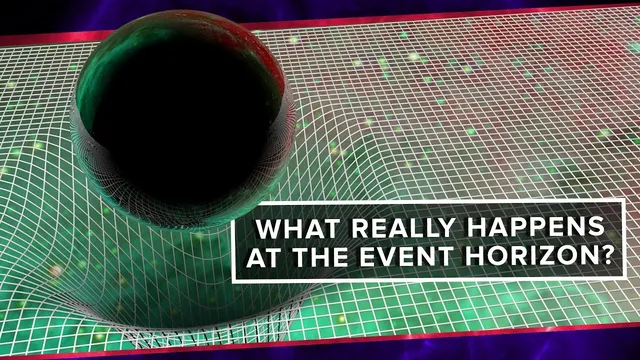
What Happens at the Event Horizon? | Space Time | PBS Digital Studios
Based on PBS Space Time's video on YouTube. If you like this content, support the original creators by watching, liking and subscribing to their content.
Penrose diagrams compactify infinite spacetime and keep light cones at fixed 45° angles, making horizon causality readable.
Briefing
At the event horizon, black holes don’t just hide information—they reshape what “future” and “escape” even mean. Using Penrose diagrams, the episode turns the usual, misleading intuition (“everything freezes at the horizon”) into a precise picture of how light cones tip and how different observers experience time. The key takeaway is that the outside universe sees infalling matter slow down and never fully cross the horizon, but the infalling traveler experiences nothing special at the crossing and continues toward the singularity; the apparent contradiction comes from how each viewpoint slices spacetime.
The episode starts with the standard, “sanitized” description: the event horizon is the boundary where escape velocity reaches light speed, so anything crossing it cannot return. It then stresses that even the simplest black hole in Einstein’s general relativity—non-rotating, uncharged, static—produces counterintuitive behavior. To make those behaviors legible, it introduces Penrose (Carter-Penrose) diagrams, a specialized spacetime map that compactifies infinite distances and times onto a finite grid and keeps light rays at fixed 45° angles everywhere. In this representation, light cones always point the same way on the page, so the diagram becomes a reliable guide to what can influence what.
In flat spacetime, the diagram’s light cones define a forward light cone (what an observer can affect) and a past light cone (what can affect the observer). Dropping a black hole into the diagram changes the geometry: the event horizon becomes the “end of the line” for outward travel in the relevant direction. Inside the horizon, the roles of space and time effectively swap in the diagram’s structure—space behaves like a one-way flow toward the singularity, and all future-directed paths end there. The episode emphasizes that escape would require widening the future light cone by moving faster than light, which is impossible.
With the diagram in hand, the episode runs “black hole monkey physics.” A monkey emits light signals while approaching the horizon. From far away, the signals arrive more and more slowly because light must traverse increasingly warped spacetime; the final signal at horizon crossing never reaches the outside observer. If the monkey fires a jet pack at the last instant, it can still escape—but only through a tiny sliver of the outside universe and only by following a long, near-light-speed route. Without such a maneuver, the monkey’s last view of the outside universe is limited to what its past light cone can include; it does not watch the entire future of the universe play out.
Attempts at rescue also fail in a specific way: even if rescuers race toward the horizon at near light speed, the monkey appears to remain just out of reach because the outside observer’s timeline never includes the crossing event. Once inside, however, the rescue scenario changes—signals can propagate toward the interior observer since neighboring radial layers don’t outrun each other locally. Still, the inward flow toward the singularity means any “outgoing” light is ultimately doomed to hit the singularity.
Finally, the episode notes that the full Schwarzschild Penrose diagram contains additional regions—an Einstein-Rosen bridge and a white hole—plus more complex structures when rotation or charge are added. The episode closes by pivoting to a separate discussion of quantum interpretations (including De Broglie-Bohm theory), but the black hole lesson remains: the event horizon is best understood as a causal boundary encoded in spacetime geometry, not as a place where time simply stops for everyone.
Cornell Notes
Penrose diagrams provide a compact, light-cone–faithful way to understand what happens at a black hole’s event horizon. In these diagrams, light always travels at 45° angles, so tipping light cones reveal which events can influence which observers. From outside the horizon, infalling objects appear to slow and never fully cross because the outside observer’s future light cone can’t include the crossing event. For the infalling traveler, crossing the horizon is not a special moment; inside, all future-directed paths lead to the singularity because the geometry forces a one-way inward flow. The “frozen at the horizon” feeling is an artifact of comparing different spacetime slices, not a literal universal freeze.
Why does the “everything freezes at the horizon” intuition arise, and what does Penrose’s causal picture correct?
What changes inside the event horizon in terms of light cones and “future-directed” motion?
If the monkey fires a jet pack at the last instant, can it escape—and why is the escape window so small?
Does the monkey see the entire future history of the universe when it crosses the horizon?
Why can’t rescuers catch the monkey by racing toward the horizon, even at near light speed?
Once inside the black hole, can a rescue mission work at all?
Review Questions
- How do Penrose diagrams keep light rays at fixed angles, and why does that matter for determining causal reach near horizons?
- What specific causal reason prevents an outside observer from ever receiving the signal emitted at the exact moment of horizon crossing?
- Inside a Schwarzschild black hole, what does the diagram imply about the direction of all future-directed paths?
Key Points
- 1
Penrose diagrams compactify infinite spacetime and keep light cones at fixed 45° angles, making horizon causality readable.
- 2
The “frozen at the horizon” effect comes from signal delay and causal access limits for outside observers, not from a universal stop of time.
- 3
Crossing the event horizon is not a special moment for the infalling traveler; the specialness is about what the outside can later observe.
- 4
Inside the horizon, all future-directed paths end at the singularity because the geometry forces an inward, one-way flow.
- 5
A late jet-pack escape is possible only if the maneuver leaves a tiny causal sliver of the outside universe inside the monkey’s future light cone.
- 6
Rescue attempts from outside fail because the horizon-crossing event remains outside the rescuers’ accessible causal future.
- 7
The complete Schwarzschild Penrose diagram includes additional mathematical regions (Einstein-Rosen bridge and white hole), and rotation/charge expand the diagram further.