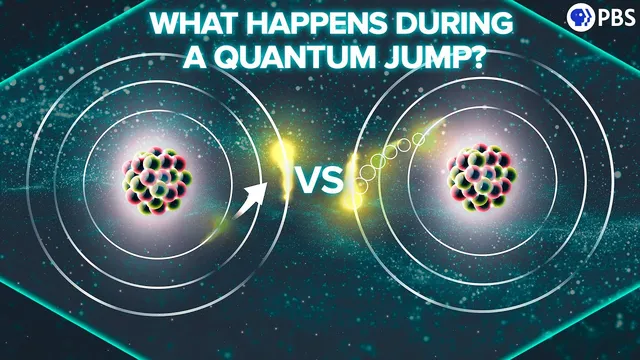
What Happens During a Quantum Jump?
Based on PBS Space Time's video on YouTube. If you like this content, support the original creators by watching, liking and subscribing to their content.
Bohr’s quantized energy levels explained emission spectra by tying electron transitions to photon energies, but left the physical mechanism of the jump unclear.
Briefing
Quantum jumps—electrons (or other quantum systems) snapping between energy levels—have long been treated as instantaneous, random events. New experiments now show the “snap” isn’t actually a single instant: the transition unfolds continuously through intermediate states over microseconds, even though the timing of when the jump starts still looks random. That combination matters because it directly targets the core dispute in quantum mechanics: whether nature truly “rolls dice” at the moment of transition, or whether the apparent randomness hides a more structured process.
The story begins with the early quantum model. In 1913, Niels Bohr used quantized electron energy levels to explain emission spectra—sharp lines of light from energized gas. Electrons could only occupy specific energies, and a jump between levels would emit or absorb a photon whose energy matched the gap. This framework became the Bohr model, later folded into full quantum mechanics through Werner Heisenberg and Erwin Schrödinger in the mid-1920s. Yet the mechanism of the jump remained mysterious: what actually happens during the transition, and what determines when it occurs?
The Copenhagen interpretation offered a blunt answer. Transitions between quantum states are fundamentally random; measurement “collapses the wavefunction,” producing an instantaneous change. Erwin Schrödinger rejected that picture from the start. In 1926 he complained about “quantum jumps,” and by 1952 he published “Are there quantum jumps?” comparing them to epicycles—ingenious fixes that don’t describe reality. Schrödinger’s alternative leaned on waves: quantum behavior could be understood as continuous evolution of a superposition, with emission spectra arising from vibrational-like modes rather than discrete, instantaneous leaps. He also argued that focusing on single particles led to “ridiculous consequences,” since experiments typically involve ensembles.
For decades, experiments couldn’t directly watch a single jump unfold. That changed in the 1980s. By trapping and cooling single atoms (such as mercury or barium) with lasers, researchers engineered a cycle between two levels (1 and 2) that produced fluorescence. Adding a third, more stable level (3) allowed the atom to “go dark” when the electron was shelved there, then return to fluorescence after a decay. The timing of the return appeared random, matching Bohr’s predictions—but the setup still couldn’t determine whether the transition itself was instantaneous or whether intermediate states occurred.
The decisive leap came decades later with superconducting “artificial atoms” inside microwave cavities. Researchers could monitor state evolution with far higher resolution and even interrupt transitions midflight. The result: the jump onset looked random in timing, but the state change was not instantaneous. Instead, it progressed continuously through intermediate states over a few microseconds and matched quantum trajectory theory. Intriguingly, the system’s behavior shifted in advance of each jump in a way that made the onset predictable enough to reverse it by adjusting the microwave field.
That leaves room for both camps. The theorists’ recent proposal ties the continuous, predictable evolution to the Quantum Zeno Effect: measurement strength can suppress or reshape transitions, allowing some changes to proceed predictably through superposition pathways while leaving other events genuinely unpredictable. The upshot is that quantum jumps may be neither pure “instant snaps” nor purely deterministic clockwork—timing can look dice-like, while the transition itself can be continuous and structured.
Cornell Notes
Quantum jumps were long treated as instantaneous, random transitions between quantized energy levels. Bohr’s model and the Copenhagen interpretation linked jump timing to fundamental randomness, while Schrödinger argued for continuous wave-based evolution and disliked the “unnatural” jump postulate. Experiments in the 1980s used trapped single atoms and a shelving level to show that jump-related events occur at seemingly random times, but they still couldn’t resolve whether the transition itself was instantaneous. Later experiments with superconducting artificial atoms monitored transitions directly and found they unfold continuously through intermediate states over microseconds, while the spacing between jumps still appears random. Theoretical work now suggests the Quantum Zeno Effect and measurement coupling strength may explain why some aspects look predictable and others remain unpredictable.
Why did Bohr’s model make quantum jumps seem both necessary and mysterious?
What did the Copenhagen interpretation claim about quantum jumps, and why did Schrödinger object?
How did the 1986 single-atom experiments make jump timing look random?
What new capability changed the question from “when” to “how” a jump happens?
What did the superconducting artificial-atom experiments find about the nature of the transition?
How does the Quantum Zeno Effect enter the explanation for continuous yet unpredictable behavior?
Review Questions
- What experimental limitation in the 1980s prevented a direct test of whether quantum jumps are instantaneous?
- How do the superconducting artificial-atom results reconcile random jump timing with continuous transition dynamics?
- In what way does measurement strength (as in the Quantum Zeno Effect) change which parts of the evolution look predictable versus unpredictable?
Key Points
- 1
Bohr’s quantized energy levels explained emission spectra by tying electron transitions to photon energies, but left the physical mechanism of the jump unclear.
- 2
Copenhagen interpretation links quantum state transitions to fundamental randomness and treats measurement as collapsing the wavefunction, producing an effectively instantaneous jump.
- 3
Schrödinger rejected quantum jumps as an unphysical add-on, arguing quantum evolution should be continuous and wave-like through superpositions.
- 4
Single-atom laser experiments in the 1980s used a shelving level to make fluorescence stop and resume, yielding jump-related events that appeared random in time.
- 5
Superconducting artificial-atom experiments later resolved the transition itself and found it unfolds continuously through intermediate states over microseconds, not as a single instant.
- 6
The pre-jump dynamics in the newer experiments were predictable enough to reverse transitions, suggesting structure beneath apparent randomness.
- 7
The Quantum Zeno Effect has been proposed as a mechanism where measurement coupling strength can suppress or reshape transitions, producing both predictable and truly unpredictable jump events.