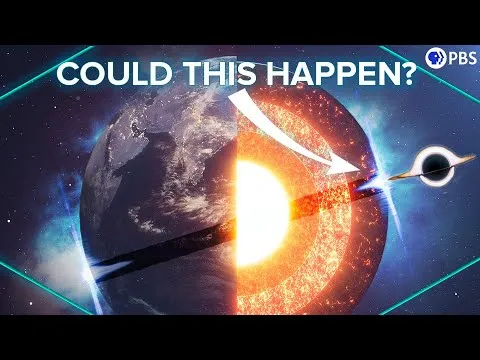
What Happens If A Black Hole Hits Earth?
Based on PBS Space Time's video on YouTube. If you like this content, support the original creators by watching, liking and subscribing to their content.
Stellar-mass black holes like Cygnus X-1 are too far away for Earth impacts, making primordial black holes the more relevant scenario.
Briefing
A black hole hitting Earth is unlikely to be noticed in real time—but if primordial black holes exist in the “asteroid-mass” range, they could still pass through the solar system often enough that the question becomes scientifically valuable. The nearest known stellar-mass black hole, Cygnus X-1, sits about 1,000 light-years away, and even the many unseen stellar-mass black holes wandering the galaxy are so sparse in the right trajectories that a close encounter with Earth is considered extremely unlikely. The more plausible route comes from the early universe: regions with slightly higher density could have collapsed into primordial black holes (PBHs). Those PBHs might span a wide range of masses, but most possibilities have been squeezed by observations—gravitational lensing constraints rule out PBHs heavier than roughly 10^19 kilograms, while Hawking evaporation eliminates lighter ones below about a trillion kilograms. That leaves a narrow, contentious window around asteroid masses, where PBHs would be hard to spot directly yet numerous enough to make encounters possible.
If PBHs in that window make up a large fraction of dark matter, the solar system should contain an enormous amount of them—estimated at about 10^18 kilograms of dark matter in the Milky Way’s local neighborhood. Translated into asteroid-mass PBHs, that implies dozens to thousands of PBHs could be present at any given time, and over long periods some should literally cross paths with Earth. The key reassurance is that an asteroid-mass PBH would not “vacuum-clean” the planet. A representative case uses a mass comparable to Phobos (about 10^16 kg), giving an event horizon roughly the size of a hydrogen atom. At interstellar speeds—tens to hundreds of kilometers per second—it would traverse Earth in about a minute, consuming only a few thousand tonnes of material, too little to cause global destruction. Still, the local encounter would be catastrophic for anything directly in its path.
The danger shifts from global destruction to detectable signatures. As the PBH enters the atmosphere, intense gravity accelerates surrounding matter to near-light speeds near the event horizon, producing extreme temperatures and radiation. Feeding the black hole is limited by the Eddington limit, so the smallest PBHs in the allowed range would shine less broadly but still intensely—potentially comparable to a “bright shooting star” and capable of generating a destructive shockwave before the PBH tunnels through the ground. The discussion draws a comparison to the 1908 Tunguska event, where witnesses reported a sun-bright flash and widespread shock damage without an obvious crater. Some physicists once suggested a black hole passage, but the lack of a second shockwave from an exit point weakens that idea; modern consensus favors an asteroid or comet airburst, though the uncertainty of 1908 observations leaves room for debate.
Even if live impacts are rare—possibly once per million years for the smallest PBHs—the PBH’s passage through Earth would generate seismic waves equivalent to at least a magnitude 4 earthquake, felt across the globe. No such global, PBH-like signature has been detected. Finding past impacts on Earth is also difficult because erosion and tectonics erase small scars quickly. The Moon, however, preserves impact history. A newer theoretical proposal predicts distinctive “line explosion” craters: because a PBH punches through rather than stopping, it should produce deeper craters, ejecta that rises more than it spreads, and crater pairs with an entrance and exit. It also suggests exotic high-pressure minerals—like unusual quartz and pyrite—seared by the plasma, with a “line” of that material connecting the two craters. No such paired crater pattern has been found yet, but a thorough search has not been completed.
The segment ends by noting that even a single confirmed PBH impact would be a major scientific breakthrough: it would support primordial black holes as a dark matter candidate and help pin down their mass distribution. The broader discussion then pivots to related black-hole alternatives—especially the “fuzzball” idea from string theory—along with comment-driven debate about how such models might be tested via gravitational-wave signatures and potential deviations near event horizons detectable by instruments like the Event Horizon Telescope.
Cornell Notes
The most realistic way for a black hole to “hit Earth” comes from primordial black holes (PBHs) formed in the early universe. Most PBH masses are ruled out by gravitational lensing and Hawking evaporation, leaving a narrow asteroid-mass window where PBHs would be hard to detect directly but could still be numerous enough to pass through the solar system. An asteroid-mass PBH would not destroy Earth: its event horizon would be atomic-scale, and it would traverse the planet in about a minute while consuming only a few thousand tonnes. The main detection route is indirect—atmospheric shockwaves, global seismic signatures, or distinctive lunar crater patterns predicted to come in pairs with “line explosion” geometry and exotic high-pressure minerals. No confirmed PBH impact has been found, but targeted searches—especially on the Moon—could change that.
Why are ordinary stellar-mass black holes considered a poor explanation for Earth impacts?
What observational constraints narrow primordial black holes to an “asteroid-mass” window?
If an asteroid-mass PBH hits Earth, why doesn’t it “eat the planet”?
How could a PBH passage be detected even if it’s too rare to witness?
Why does the Moon offer a better archive for PBH impacts than Earth?
What distinctive crater geometry does the PBH “line explosion” model predict?
Review Questions
- What early-universe condition allowed primordial black holes to form, and why did smoothness prevent most matter from collapsing into black holes?
- Which two observational methods eliminate most PBH masses, and what mass range remains after those exclusions?
- What specific lunar crater features would distinguish a PBH passage from a conventional asteroid impact?
Key Points
- 1
Stellar-mass black holes like Cygnus X-1 are too far away for Earth impacts, making primordial black holes the more relevant scenario.
- 2
Primordial black holes are constrained by gravitational lensing (ruling out masses above ~10^19 kg) and Hawking evaporation (ruling out masses below ~10^12 kg).
- 3
The remaining asteroid-mass window implies PBHs could be numerous enough that some may pass through the solar system and occasionally cross Earth’s path.
- 4
An asteroid-mass PBH would not destroy Earth; for a Phobos-mass example (~10^16 kg), the event horizon is atomic-scale and the crossing time is about a minute.
- 5
Detection is most plausible through indirect signatures: atmospheric shockwaves, global seismic patterns, or distinctive lunar crater pairs and mineralogical changes.
- 6
Earth is a poor archive for micro black hole impacts because erosion and tectonics erase evidence, while the Moon preserves impact records.