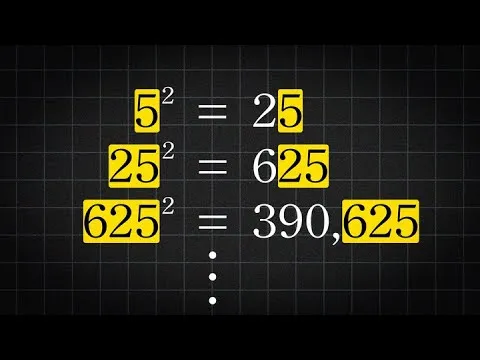
What happens if you just keep squaring?
Based on Veritasium's video on YouTube. If you like this content, support the original creators by watching, liking and subscribing to their content.
Squaring a number repeatedly can stabilize more and more trailing digits, leading to a 10-adic number n with n² = n.
Briefing
A simple “keep squaring” pattern leads to a number that is equal to its own square—an object with infinitely many digits to the left of the decimal point. Starting from 5, then 25, then 625, the last digits keep matching the previous number for longer stretches: squaring 390,625 preserves the final 5 digits, squaring the matching tail preserves more, and the shared suffix grows without end. That iterative stabilization behaves like a convergence, but in a different direction than ordinary real-number limits. The result is a 10-adic number n satisfying n² = n, meaning n is its own square.
The central payoff is that these “left-infinite” numbers are not mathematical nonsense; they live in a different number system—p-adic arithmetic—where distance and size are defined by how far two numbers agree in their base-p expansions. In 10-adics, addition and multiplication work digit-by-digit from the right, because each new digit depends only on digits already fixed to the right. This makes it possible to represent fractions without writing division symbols. For instance, multiplying a specific 10-adic number ending in 857142857143 by 7 yields 1, so that number equals 1/7. Similarly, 1/3 can be encoded as an infinite string of digits that, when multiplied by 3, produces a 1 in the units place and zeros everywhere else—an analogue of the familiar 0.999… = 1 argument, but flipped to the left.
The transcript then tackles why p-adics are powerful despite looking alien. In ordinary arithmetic, factoring relies on the idea that if a product is zero, at least one factor must be zero. That property fails in base 10 because 10 is composite (5×2), allowing nonzero 10-adic numbers to multiply to zero via digit-carry interactions. The fix is to switch to a prime base p. In p-adics, the “zero product” behavior returns: a product of nonzero p-adic numbers cannot be zero. This prime-base structure is what makes p-adics a reliable tool for solving equations.
A major example comes from Diophantine problems tied to Fermat’s Last Theorem. The transcript uses Kurt Hensel’s method: build solutions as expansions in increasing powers of a prime (like 3), determining coefficients one modulus at a time (mod 3, then mod 9, then mod 27, and so on). Applied to a “sum of squares” equation derived from Diophantus, the digit-by-digit lifting process produces a 3-adic solution whose base-3 expansion is an infinite string of 1s. Even though that expansion makes no sense as a real number, p-adic geometry interprets it correctly: the infinite series behaves like a geometric series with ratio 3, yet it still yields a finite p-adic value. The result corresponds to a rational solution—specifically, a rational x = -1/2 that generates a square-area identity.
Finally, the transcript connects the abstract machinery to real breakthroughs: Wiles’s proof of Fermat’s Last Theorem used p-adic methods and famously required a “three, five trick,” switching from prime 3 to prime 5 when the prime-3 approach hit obstacles. The takeaway is that p-adics reshape notions of size and closeness so drastically that problems impossible over the reals become tractable—turning “infinite left digits” into a practical computational framework for modern number theory.
Cornell Notes
A “keep squaring” digit pattern produces a number n with n² = n, but n is not a real number—it has infinitely many digits extending leftward. Those objects make sense inside 10-adic and, more generally, p-adic number systems, where addition and multiplication are performed digit-by-digit and “distance” depends on how many base-p digits two numbers share. In base 10, zero-product factoring fails because 10 is composite, so p-adics use a prime base to restore the key property that a product is zero only when one factor is zero. Using Hensel-style lifting (solving mod p, then mod p², then mod p³, etc.), the transcript constructs a 3-adic solution to a Diophantine “sum of squares” problem and interprets an infinite base-3 expansion as a finite p-adic value, yielding a rational solution. This framework later underpins major results such as Wiles’s proof of Fermat’s Last Theorem, including the “three, five trick.”
How does the “keep squaring” pattern lead to a number equal to its own square?
Why do 10-adic numbers allow fractions and negatives without writing division or minus signs?
What breaks in 10-adics that mathematicians rely on in ordinary factoring?
Why does switching to a prime base p fix the zero-product problem?
How does Hensel-style digit lifting turn modular solutions into a p-adic solution?
How can an infinite geometric series with ratio 3 yield a finite p-adic value?
Review Questions
- What digit-stabilization property of squaring produces the self-squaring 10-adic number, and why does it require infinitely many digits to the left?
- Explain why base 10 fails the “zero product implies a zero factor” principle, and how choosing a prime base p restores it.
- In Hensel lifting, what does solving the equation mod p, then mod p², then mod p³ accomplish in terms of determining coefficients?
Key Points
- 1
Squaring a number repeatedly can stabilize more and more trailing digits, leading to a 10-adic number n with n² = n.
- 2
10-adic arithmetic supports addition, subtraction, multiplication, and even fractions by constructing digit expansions that satisfy equations digit-by-digit.
- 3
The 10-adic “zero product” property fails because 10 is composite (5×2), allowing nonzero factors to multiply to zero.
- 4
Using a prime base p restores the crucial algebraic behavior: a product is zero only if at least one factor is zero.
- 5
p-adic distance is determined by the lowest power of p where two numbers differ, reversing the real-number intuition about what “large” and “small” mean.
- 6
Hensel lifting builds p-adic solutions by solving the equation modulo p, then p², then p³, refining coefficients one digit at a time.
- 7
p-adic methods played a role in major number-theory breakthroughs, including Wiles’s Fermat’s Last Theorem proof and the “three, five trick.”