What Happens If You Keep Slowing Down?
Based on Veritasium's video on YouTube. If you like this content, support the original creators by watching, liking and subscribing to their content.
Edgerton’s strobe photography froze motion by combining a darkroom setup with a capacitor-discharge flash lasting about 10 microseconds.
Briefing
Slowing time isn’t just a parlor trick—it’s a toolkit for freezing fast motion, then rebuilding it frame-by-frame. The through-line is simple: when ordinary cameras can’t react quickly enough, researchers borrow physics to create ultrashort “strobe” flashes or to trade spatial detail for extreme temporal resolution. The payoff is the ability to watch light wavefronts propagate, capture the instant a bullet pierces a card, and—at the far end—track how electrons rearrange inside molecules.
The story begins with Harold “Doc” Edgerton’s strobe photography. Factory motors in the early 20th century were vulnerable to electrical grid surges, producing unpredictable behavior that was impossible to photograph with the long exposure times of the era. Edgerton noticed that triggering those surges produced a bright flash. By turning off room lights and leaving a camera shutter open, he could prevent any exposure—until a precisely timed, extremely brief flash illuminated the moving parts. His solution used a capacitor charged by high voltage; a trigger pulse ionized a gas in a glass tube (argon or xenon), allowing the stored charge to discharge through the chamber. The gas heated to roughly 10,000 Kelvin and emitted a flash lasting about 10 microseconds, then quickly returned to darkness as electrons recombined.
Edgerton’s timing problem became a practical engineering challenge: how to fire the strobe at the exact moment something happens. The method highlighted is sound-triggering—using a microphone to detect a sharp event (like a balloon pop) and then firing the strobe after a small, repeatable delay. That approach produces crisp images of motion that would otherwise smear, from tennis balls pancaked against rackets to hummingbirds frozen mid-flutter.
Military demand accelerated the technique. In 1939, George Goddard asked Edgerton for a strobe bright enough to illuminate the ground from a plane for night reconnaissance. Calculations led to flashes releasing about 60,000 joules in a millisecond—around 60 megawatts peak power—enabling Allied night photography of Normandy before D-Day.
Modern comparisons show why strobe images can still look “better” than high-speed video in certain cases. A 2020 research-grade camera shooting at 20,000 fps struggles to match the sharpness because cameras face a fundamental trade-off: spatial resolution versus temporal resolution, limited by how fast sensors can read out pixels. Push frame rate high enough and the image collapses into very few pixels; push pixel count high and the frame rate drops.
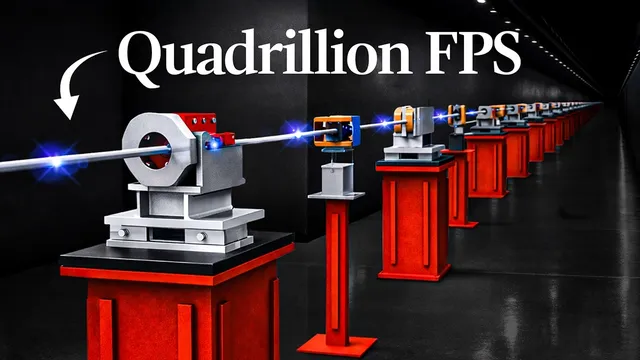
That trade-off leads to the other extreme: single-pixel, trillion-fps time-of-flight imaging. Instead of recording many pixels at once, the system counts photons arriving at one sensor point nearly a trillion times per second, then scans the scene point-by-point using steering mirrors. Because light propagation is fast and the scene is repeatable, the method reconstructs a “speed of light” movie by accumulating many measurements.
Finally, the transcript moves from freezing motion of objects to probing motion of electrons. At SLAC, a 3.2 km accelerator generates electron pulses moving at over 99.999992% the speed of light. Undulators force the electrons to wiggle and emit X-rays; microbunching then produces coherent, ultrashort X-ray pulses—down to hundreds of attoseconds. Those X-rays ionize molecules, and the kinetic energy of ejected core electrons reveals local electron density. By repeating the experiment with slightly different X-ray probe delays, researchers build an atto-second “molecular movie,” aiming to watch charge redistribution after an electron is removed—essentially a strobe, but for electrons inside matter.
Cornell Notes
Ultrashort “time-stopping” methods let researchers capture motion that normal cameras blur. Harold Edgerton’s strobe photography used capacitor discharge through an ionized gas to create ~10-microsecond flashes, letting a camera shutter stay open in darkness until the exact instant of illumination. Sound-triggering (microphone detection of a pop) solves the timing problem for repeatable events. Modern imaging faces a trade-off between spatial and temporal resolution, which motivates single-pixel, trillion-fps time-of-flight scanning to reconstruct light propagation. The frontier extends this idea to electrons: attosecond X-ray pulses at SLAC ionize molecules, and the kinetic energy of emitted electrons reveals changing electron density, enabling “molecular movies” with ~300-attosecond step sizes.
How did Edgerton’s strobe photography turn an unpredictable motor into a photographable moment?
What engineering trick makes strobe timing reliable for events like a balloon pop?
Why can a high-speed camera struggle to match the sharpness of strobe photography?
How does single-pixel, trillion-fps imaging reconstruct a “speed of light” movie?
How do attosecond X-ray experiments turn electron motion into measurable data?
Review Questions
- What physical mechanism produces Edgerton’s brief strobe flash, and why does the camera need to be kept in darkness before the flash?
- What specific trade-off limits conventional high-speed cameras, and how does single-pixel scanning circumvent it?
- In the attosecond electron-density method, how does changing the X-ray probe delay translate into a “molecular movie”?
Key Points
- 1
Edgerton’s strobe photography froze motion by combining a darkroom setup with a capacitor-discharge flash lasting about 10 microseconds.
- 2
Ionizing a gas in a glass tube (argon or xenon) provided a fast switch that let stored charge surge and then quickly shut off as electrons recombined.
- 3
Sound-triggering using a microphone solved strobe timing for repeatable events by firing the flash after detecting a sharp acoustic cue.
- 4
High-speed cameras face a spatial-versus-temporal resolution trade-off driven by sensor readout limits, often forcing fewer pixels per frame at extreme FPS.
- 5
Single-pixel, trillion-fps imaging reconstructs light propagation by counting photons at one point at a time and scanning the scene point-by-point under repeatable conditions.
- 6
Attosecond “molecular movies” at SLAC use coherent, ultrashort X-ray pulses to ionize molecules; the kinetic energy of ejected core electrons reveals evolving electron density.
- 7
Electron dynamics can be probed by repeating experiments with slightly different X-ray probe delays, stepping by hundreds of attoseconds to build time-resolved snapshots.