What Happens Inside a Proton?
Based on PBS Space Time's video on YouTube. If you like this content, support the original creators by watching, liking and subscribing to their content.
The strong force’s large coupling makes QCD calculations with truncated Feynman diagrams impractical, unlike QED where the fine structure constant (~1/137) suppresses higher-order terms.
Briefing
Simulating the inside of a proton hinges on one bottleneck: quantum chromodynamics (QCD) is too strongly coupled for standard “add up Feynman diagrams” methods to work. Quarks are never seen alone; they’re locked inside hadrons like protons and neutrons, and the gluon-mediated strong force makes the interior of a hadron a turbulent quantum field. That turbulence prevents straightforward calculations of measurable hadron properties, which is why lattice QCD became the key computational workaround.
The contrast starts with quantum electrodynamics (QED), where the electromagnetic interaction is weak because its coupling strength—the fine structure constant—is about 1/137. In that regime, higher-order Feynman diagrams contribute less and less, so calculations can stop once the remaining terms fall below the desired precision. QCD refuses to cooperate: the strong coupling constant is of order 1 (and varies with energy), so adding more interaction “vertices” doesn’t rapidly suppress contributions. As a result, the diagram-by-diagram approach becomes impractical even with computers, except in special cases like asymptotic freedom where the coupling effectively weakens at high energies.
Testing QCD also forces a conceptual shift. The virtual particles used in diagram methods are mainly a calculational tool; real particles correspond to sustained oscillations of quantum fields. For the strong force, the quark–gluon field disturbances are too intense to be captured by simple virtual-particle approximations. Instead, lattice QCD simulates the fields themselves—tracking how the quantum field configurations evolve between initial and final states.
That field-first strategy borrows the logic of the Feynman path integral, which sums over all possible paths—except lattice QCD replaces “paths through space” with “paths through field configuration space.” Three computational hurdles follow. First, spacetime must be discretized (“pixelated”) so a computer can store it. Second, even after discretization, the number of possible field histories is astronomical. Third, the path-integral weights involve complex phases that are awkward for Monte Carlo sampling.
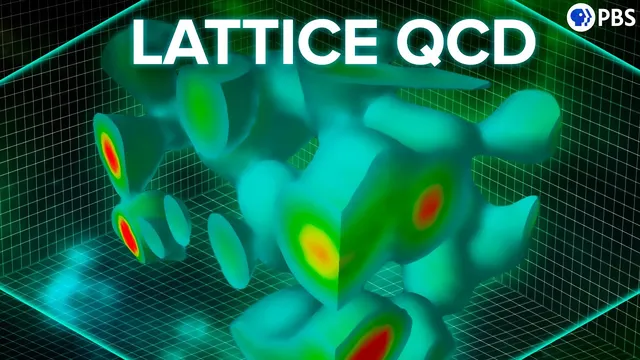
Lattice QCD’s solution is a sequence of hacks: use Monte Carlo sampling to randomly sample field configurations according to their likelihood, and apply a Wick rotation—treating time as an imaginary dimension—to remove the problematic complex phases. With time rotated and discretized, the simulation becomes a four-dimensional lattice that resembles a classical crystal. Then statistical mechanics methods can evolve the lattice using the rules of the underlying quantum field theory.
Because spacetime isn’t truly discrete, results depend on lattice spacing. The standard fix is to run simulations at multiple lattice spacings and extrapolate to the zero-spacing limit, recovering continuum physics. This procedure—introduced by Ken Wilson in 1974—has since produced accurate predictions for hadron masses, decay frequencies, and even properties of quark–gluon plasma. It also played a role in the prediction side of the new muon g-2 results. The payoff is more than numbers: lattice QCD’s field-based approach helps clarify what virtual particles mean, strengthening the view that they’re not literal objects driving interactions but rather bookkeeping for the deeper dynamics of quantum fields.
Cornell Notes
Lattice QCD makes it possible to compute properties of protons and neutrons by simulating quark and gluon fields directly, rather than relying on Feynman diagrams built from virtual particles. The strong force is too strongly coupled for diagram truncations to work the way they do in QED, where the fine structure constant (~1/137) suppresses higher-order contributions. Lattice QCD discretizes spacetime into a lattice, then uses Monte Carlo sampling to sum over field configurations, not particle trajectories. A Wick rotation removes complex phases so the sampling becomes tractable, and results are extrapolated to zero lattice spacing to recover continuum physics. The method has produced accurate hadron and quark–gluon plasma predictions and supported calculations relevant to muon g-2.
Why does QCD resist the usual “add more Feynman diagrams until it’s precise enough” strategy that works in QED?
What changes conceptually when moving from diagram-based QED-style calculations to lattice QCD?
How does lattice QCD adapt the idea of the Feynman path integral to make it computable?
Why is Wick rotation used, and what problem does it solve for Monte Carlo methods?
How do lattice QCD results become predictions for real, continuous spacetime?
What does lattice QCD contribute beyond producing numbers for hadrons?
Review Questions
- What specific role do the fine structure constant and the strong coupling constant play in determining whether diagram truncations are feasible?
- Describe the sequence of computational “hacks” lattice QCD uses to make summing over quantum field histories tractable.
- How does extrapolating to zero lattice spacing correct for the artificial discretization of spacetime?
Key Points
- 1
The strong force’s large coupling makes QCD calculations with truncated Feynman diagrams impractical, unlike QED where the fine structure constant (~1/137) suppresses higher-order terms.
- 2
Quarks are confined inside hadrons, so measurable targets are hadron properties rather than free-quark scattering outcomes.
- 3
Lattice QCD simulates quark and gluon fields directly, replacing virtual-particle diagram methods with field-configuration evolution.
- 4
Monte Carlo sampling approximates the enormous sum over field histories on a discretized spacetime lattice.
- 5
Wick rotation removes complex phase factors, making the Monte Carlo approach feasible.
- 6
Predictions require extrapolating results from finite lattice spacing to the zero-spacing (continuous spacetime) limit.
- 7
Lattice QCD has produced accurate hadron and quark–gluon plasma predictions and supported calculations relevant to muon g-2.