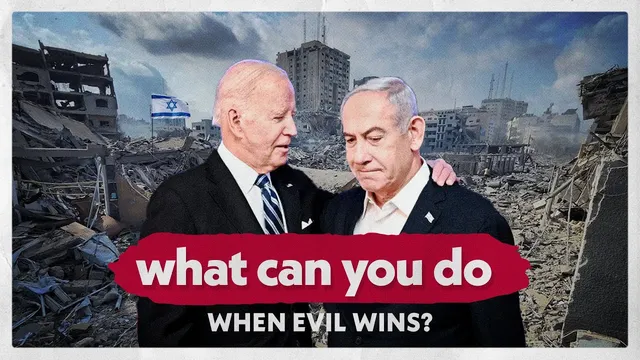
What Happens When Evil Wins?
Based on Second Thought's video on YouTube. If you like this content, support the original creators by watching, liking and subscribing to their content.
The discussion frames Israel’s Gaza campaign as genocide and links it to earlier Zionist-era expulsions and land seizure, including the Nakba.
Briefing
On October 7, 2023, Palestinian resistance launched an attack on Israel, but the central claim driving the rest of the discussion is that Israel’s subsequent campaign in Gaza amounts to genocide—and that it has continued with little effective consequence despite widespread international condemnation. The argument ties the present crisis to a longer history of Zionist settlement backed by British power, the 1947–1949 Nakba, and a continuing pattern of land seizure, expulsions, and restrictions on Palestinian life.
The account begins with the political Zionist project and the founding of Israel in 1948 on land described as stolen from Palestinians. It emphasizes that the UN’s 1947 partition plan (UN resolution 181) allocated 55% of the land to settlers without Palestinian consultation, followed by war and the Nakba: roughly 750,000 Palestinians expelled from ancestral homes, Zionist forces seizing about 78% of historic Palestine, bulldozing more than 500 villages and cities, and killing at least 15,000 Palestinians. From there, the discussion rejects the idea that the Nakba ended in 1948, arguing instead that it marked an early escalation in a longer extermination campaign.
In Gaza, the narrative portrays a system of total control: the strip is described as enclosed and cut off, with Israeli military control over entrances and exits, heavily restricted imports and exports, limited employment, and water described as undrinkable “by design.” Civilian infrastructure is said to be targeted through air strikes, while permits for building homes and basic services like roads, sewage systems, and schools are routinely denied. The discussion frames this as a “concentration camp” model—control of food, water, electricity, fuel, and medicine—combined with lethal force to advance an ethnostate.
A key part of the argument is the mismatch between the scale of civilian deaths and the lack of political or institutional consequences. The discussion cites child-killing comparisons, including a claim that Israeli forces are killing about 139 children per day, contrasted with Nazi killings of 127 children per day during Germany’s extermination ramp-up. It also asserts that Israel has killed over 27,000 Palestinians in four months, compared with 15,000 killed during the Nakba over two years. Despite global protests and disruptions, the claim is that Western corporate media and political leadership continue to frame blame as lying with Palestinians.
The explanation offered for that impunity is geopolitical: Israel is portrayed as a strategic asset of the United States, requiring billions in support and serving as an intelligence outpost, weapons trade partner, and destabilizing foothold in the region. The discussion argues that leaders can absorb backlash because they see ordinary people as politically manageable, and because attention can be diverted by other conflicts. It then pivots to a counterpoint: even if “evil” appears to win in the short term, historical trajectories can reverse. The conclusion urges action—supporting Palestine-related marches, rallies, and aid efforts—and argues that public pressure is eroding support for Israel, including a claimed decline in American backing. The final message is that the future depends on sustained mass opposition, not complacency.
Cornell Notes
The discussion argues that Israel’s actions in Gaza represent genocide and that the pattern is continuous with earlier Zionist-era expulsions and land seizure, including the 1947–1949 Nakba. It describes Gaza as a tightly controlled enclosure—restricted movement, constrained imports, damaged civilian infrastructure, and water described as undrinkable—used to advance an ethnostate. A major theme is impunity: despite international condemnation and large-scale protests, Western media and governments are said to keep minimizing or misframing responsibility. The explanation offered for that lack of consequences centers on U.S. strategic interests, including military and intelligence value. The closing message insists that mass opposition and sustained organizing can still change outcomes over time.
How does the discussion connect the 1947–1949 Nakba to today’s Gaza crisis?
What specific features of Gaza are used to support the claim of genocide and total control?
Why does the discussion say Western institutions and media have not imposed meaningful consequences?
What role do comparisons of child deaths play in the argument?
What does the discussion offer as a path forward if “evil” seems entrenched?
Review Questions
- What historical events and policies does the discussion use to argue that the Gaza crisis is part of a continuous project rather than a new conflict?
- Which mechanisms of control over Gaza does the discussion highlight, and how are those mechanisms tied to its genocide claim?
- How does the discussion explain the lack of consequences from international condemnation, and what does it say people can do to counter that trajectory?
Key Points
- 1
The discussion frames Israel’s Gaza campaign as genocide and links it to earlier Zionist-era expulsions and land seizure, including the Nakba.
- 2
It argues that UN resolution 181 allocated 55% of land to settlers without Palestinian consultation, setting conditions for war and subsequent expulsions.
- 3
It describes Gaza as an enclosed system with Israeli control over movement, restricted imports/exports, constrained employment, and water described as undrinkable by design.
- 4
It claims civilian infrastructure in Gaza is repeatedly targeted and that permits for housing and basic services are routinely denied.
- 5
It argues that impunity persists because U.S. strategic interests make Israel a protected asset, including military and intelligence value.
- 6
It uses casualty and child-death comparisons to argue that the scale of harm is unprecedented in modern terms.
- 7
It concludes that sustained mass organizing and aid efforts can still shift long-term outcomes, even if the short-term outlook looks grim.