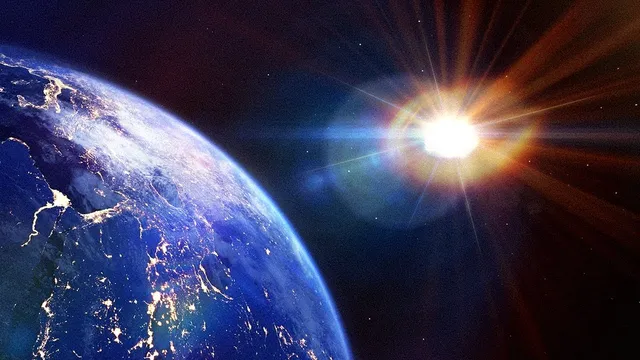
What if a star explodes near Earth?
Based on Veritasium's video on YouTube. If you like this content, support the original creators by watching, liking and subscribing to their content.
Supernovae become possible when an iron core grows to about 1.4 solar masses, after which electron capture and rapid core collapse create a neutron star.
Briefing
A nearby supernova is powerful enough to outshine entire galaxies, but the real danger to Earth isn’t just the flash—it’s the cascade of radiation and particles that can erode the atmosphere and drive biological harm. The chain reaction starts deep inside a massive star: once fusion can no longer support the core against gravity, an iron core collapses, producing a neutron star and triggering a supernova explosion powered largely by an enormous burst of neutrinos. Those neutrinos escape first, arriving hours before the visible light, giving astronomers an early warning window.
For most of a star’s life, gravity and pressure from fusion balance each other. As fuel runs out, the core contracts and heats, allowing heavier elements to fuse—hydrogen to helium, then helium to carbon, carbon to neon, neon to oxygen, oxygen to silicon, and finally silicon to nickel. But the process stops at iron because iron is the most stable element: fusing iron into heavier nuclei costs energy rather than releasing it. The iron core grows until it reaches about 1.4 solar masses, the Chandrasekhar limit, where quantum effects take over. Electrons are forced into their lowest energy states, get absorbed by protons, and the core collapses at roughly 25% of the speed of light. The result is a compact neutron star: an object only about 30 kilometers across, formed from a region that was thousands of kilometers wide.
Collapse alone doesn’t guarantee a full supernova. A shock wave forms when the infalling material rebounds off the newborn neutron star, but the decisive kick comes from neutrinos. Although neutrinos interact extremely weakly—trillions pass through a person every second—they are produced in staggering numbers during core collapse, around 10^58. In the dense core, many neutrinos are trapped long enough to deposit energy, helping revive the shock and drive the explosion. Only a tiny fraction of the total energy emerges as visible electromagnetic radiation (about 1/100 of 1%), yet even that is enough to make supernovae brighter than hundreds of billions of stars. Most energy instead leaves as neutrinos, and that’s why neutrino detections can precede photons.
Not every massive star ends this way: some collapse directly into black holes. Another route involves a white dwarf in a binary system that accretes matter until it hits the same Chandrasekhar limit, collapsing and detonating. Asymmetries in explosions also help explain fast-moving neutron stars, including one observed at about 1,600 kilometers per second.
Historically, humans have seen supernovae for millennia, including Kepler’s “new star” of 1604, which faded over time. The 1054 event produced the Crab Nebula, a remnant now about 11 light-years across. The aftermath matters for Earth: supernovae generate cosmic rays and radioactive decay products that can increase atmospheric nitrogen chemistry, potentially reducing ozone. A supernova within roughly 30 light-years is rare—about once every 1.5 billion years—but research suggests lethal effects could extend much farther, even out to around 150 light-years. Evidence for a nearby event 2.6 million years ago comes from ocean sediments containing iron-60, an isotope made mainly in supernovae and decaying with a half-life of 2.6 million years.
Even more extreme are gamma-ray bursts. Hypernovae—rapidly spinning stars at least 30 solar masses—can produce GRBs that beam energy into narrow angles. A GRB within about 6,000 light-years could be catastrophic by stripping ozone enough to trigger mass extinction. While direct proof is lacking, estimates suggest a substantial chance of an ozone-damaging GRB near Earth within the last 500 million years.
The paradox is that these same cosmic explosions likely helped create the solar system: 4.6 billion years ago, a nearby supernova shock may have triggered the collapse of a gas-and-dust cloud that became the Sun and planets. In short, supernovae are both existential threats and the engines of cosmic recycling that made Earth possible.
Cornell Notes
Massive stars end in supernovae when an iron core grows to about 1.4 solar masses (the Chandrasekhar limit) and collapses. Electron capture turns protons into neutrons, producing a neutron star and releasing neutrinos; those neutrinos deposit energy in the dense core and help drive the explosion. Only a tiny fraction of the energy becomes visible light, but supernovae can still outshine entire galaxies, and neutrinos can arrive hours before photons. Nearby events can threaten Earth by increasing cosmic rays and radioactive decay products that can damage ozone, with evidence for a supernova about 2.6 million years ago from iron-60 in ocean sediments. Even rarer gamma-ray bursts from hypernovae may remove ozone at larger distances, potentially contributing to past mass extinctions.
Why does fusion stop at iron, and how does that lead to collapse?
What physical process turns an iron core into a neutron star?
How do neutrinos—normally nearly undetectable—power a supernova explosion?
What makes neutrinos an early warning signal compared with visible light?
How can a nearby supernova affect Earth’s atmosphere and biology?
What evidence supports a nearby supernova 2.6 million years ago?
Review Questions
- What changes in core physics at the Chandrasekhar limit make electron capture and rapid collapse inevitable?
- Why can neutrinos arrive before photons, and what does that imply for how supernovae are detected?
- Which atmospheric chemistry pathway links supernova-driven cosmic rays to ozone depletion?
Key Points
- 1
Supernovae become possible when an iron core grows to about 1.4 solar masses, after which electron capture and rapid core collapse create a neutron star.
- 2
Iron fusion halts because iron is the most stable element; further fusion requires energy rather than releasing it.
- 3
Neutrinos dominate the energy budget of core collapse and can power the explosion by depositing energy in the dense core.
- 4
Only a tiny fraction of supernova energy emerges as visible light, yet that fraction can still outshine entire galaxies.
- 5
Not all massive stars explode as supernovae; some collapse into black holes, while others can produce supernovae via white-dwarf accretion in binaries.
- 6
Nearby supernovae can threaten Earth through cosmic rays and radioactive decay products that can reduce ozone and increase harmful radiation exposure.
- 7
Gamma-ray bursts from hypernovae can be even more dangerous because they channel energy into narrow beams capable of stripping ozone at large distances.