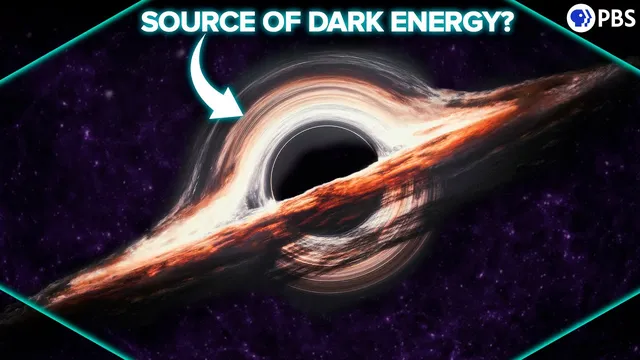
What If Black Holes ARE Dark Energy?
Based on PBS Space Time's video on YouTube. If you like this content, support the original creators by watching, liking and subscribing to their content.
GEODE models treat black hole interiors as vacuum-energy regions with negative pressure rather than matter crushed to a singularity.
Briefing
A provocative new line of research claims black holes may be made of dark energy—and that this could help explain why the universe’s expansion is accelerating. The core mechanism is “cosmological coupling”: compact regions of dark energy inside black holes would stay linked to the universe’s overall expansion, so black holes would gain mass as space grows. If that mass growth is real, it could address two puzzles at once: black holes would appear to grow faster than expected from ordinary feeding and mergers, and the energy stored in black holes could behave like dark energy, driving acceleration.
The idea traces back to a mid-1960s paper by Russian physicist Erast Gliner, who reinterpreted the cosmological constant as vacuum energy in the fabric of space with unusual properties such as negative pressure. That vacuum-energy framework later became central to theories of cosmic inflation and dark energy. Gliner also speculated that such an energetic vacuum might be an endpoint of gravitational collapse—meaning the interior of a black hole could be dominated by vacuum energy rather than crushed matter. Over time, related models emerged under a shared label: GEODEs (generic objects of dark energy). GEODEs are designed to mimic black holes in key ways—being compact, intensely gravitational, and largely invisible—while potentially differing in subtle observational signatures such as gravitational-wave behavior during mergers.
The recent hype centers on a specific claim by University of Hawaii astrophysicists Duncan Farrah and Kevin Croker and collaborators. Using a reformulation of the Friedman equations, they argue that dark-energy “chunks” can be coupled to the expansion of the cosmos, so a GEODE’s mass should scale with the universe’s increasing volume. Under that assumption, supermassive black holes (SMBHs) in galaxy centers should be larger than standard growth channels—accretion and black-hole mergers—can easily produce. Their analysis reportedly finds that the black hole-to-galaxy mass ratio has shifted over the last ~10 billion years in a way consistent with cosmological coupling, with an extremely high confidence level reported for excluding “zero coupling.” A related 2021 study also claims LIGO-detected merging black holes are too massive in the same sense.
The most consequential extension goes further: the dark energy inside black holes might not just imitate dark energy—it could be the source of the universe’s acceleration. In standard cosmology, dark energy is often treated as a constant energy density of space itself: as the universe expands, matter and dark matter dilute, while dark energy’s density stays constant, producing acceleration. The proposal tries to reproduce that behavior by relocating the energy into black holes. As space expands, the black holes would grow in mass; although they become more separated, their energy density would remain effectively constant, so the population of GEODEs could collectively act like dark energy. The team argues that the total mass in black holes formed from stellar deaths over cosmic history could be enough—if those black holes grow with expansion.
Skepticism focuses on two weak links. First, there is no direct evidence that black hole interiors are vacuum energy, nor a compelling physical mechanism for how such energy would arise. Second—and more seriously—general relativity is usually local: black holes’ interiors and exteriors communicate only through processes tied to the event horizon, not through the universe’s large-scale expansion. The coupling claim depends on a specialized reinterpretation of the Friedman equations, and outside analysis has not yet thoroughly tested it. On the observational side, measuring black hole growth over cosmic time is notoriously difficult, with uncertainties in mass estimates and in whether distant galaxies are true progenitors of today’s systems. The reported statistical confidence for excluding zero coupling is therefore viewed as premature without a fuller accounting of biases and alternative explanations.
Even so, the proposal has value as a stress test of theory space. If the speculative parts—especially the cosmological coupling and the interpretation of growth data—survive independent scrutiny, black holes could end up unifying two of cosmology’s biggest mysteries: dark energy and black hole physics.
Cornell Notes
The proposal links black holes to dark energy by treating black hole interiors as “energetic vacuum” (GEODEs) with negative pressure. A key claim is “cosmological coupling,” where the mass of these dark-energy regions scales with the universe’s expansion, making black holes grow faster than ordinary accretion and mergers predict. If GEODEs also supply the energy driving acceleration, their mass growth could keep their effective energy density constant, letting them act like dark energy. The strongest objections are theoretical locality issues in general relativity and the lack of direct evidence about black hole interiors, plus observational challenges in measuring black hole growth across cosmic time. Independent verification is still missing.
What is the chain of ideas that turns black hole interiors into a candidate for dark energy?
Why does “cosmological coupling” matter for black hole growth measurements?
What theoretical obstacle does the coupling idea face in standard general relativity?
How does the proposal attempt to reproduce dark energy’s “constant energy density” behavior?
Why is the observational evidence for rapid black hole growth hard to trust?
Review Questions
- What assumptions must be true for GEODEs to both grow with cosmic expansion and mimic dark energy’s constant energy density?
- Which parts of the proposal are most constrained by locality in general relativity, and what modification is required to evade that constraint?
- Why do uncertainties in black hole mass estimates and galaxy progenitor matching complicate tests of black hole growth over cosmic time?
Key Points
- 1
GEODE models treat black hole interiors as vacuum-energy regions with negative pressure rather than matter crushed to a singularity.
- 2
The central new claim is “cosmological coupling,” where a GEODE’s mass scales with the universe’s expansion volume.
- 3
If coupling is real, supermassive black holes should grow faster than accretion and mergers predict, shifting the black hole-to-galaxy mass ratio over time.
- 4
A further extension argues that growing black holes could collectively act like dark energy by keeping an effective energy density constant.
- 5
The strongest theoretical challenge is reconciling cosmological coupling with the usual locality expectations of general relativity and event-horizon causal structure.
- 6
The strongest observational challenge is that black hole growth across cosmic time is hard to measure and sensitive to mass-estimation and progenitor-selection biases.
- 7
High-confidence statistical claims for excluding zero coupling are viewed as premature without a fuller accounting of uncertainties and alternative explanations.