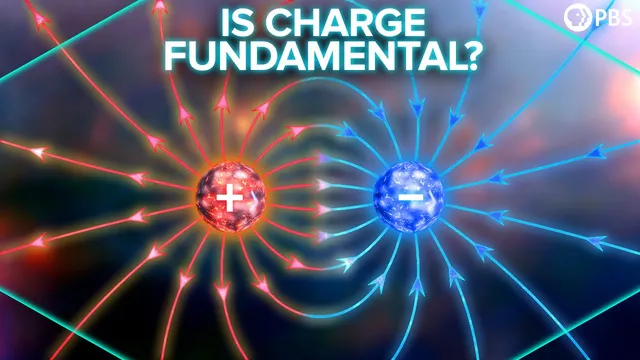
What If Charge is NOT Fundamental?
Based on PBS Space Time's video on YouTube. If you like this content, support the original creators by watching, liking and subscribing to their content.
Electric charge is not treated as a standalone fundamental property; its observed pattern can be derived from deeper weak-force charges.
Briefing
Electric charge may not be a truly fundamental property of matter. Instead, its familiar rule—like charges repel, opposite charges attract—can be traced to deeper, more basic quantum charges tied to the weak force and to symmetry breaking in the early universe.
The trail starts with a long-standing puzzle: electromagnetism’s equations (Maxwell’s equations) and quantum electrodynamics describe how charge behaves, but they don’t answer why charge exists in the first place or why it takes the values it does. That “just because” feeling motivates a historical detour through particle physics, where researchers repeatedly found that charge patterns line up with other, more structural quantities.
In 1932, Werner Heisenberg tried to make sense of the near twin relationship between protons and neutrons. Since the neutron is neutral while the proton carries electric charge, Heisenberg proposed that they might be two states of a single underlying particle, the nucleon, distinguished by a new conserved quantity called isospin. In this picture, the proton corresponds to an “up” isospin state and the neutron to a “down” state. Isospin helped explain why nuclei tend to contain roughly equal numbers of protons and neutrons and it improved predictions for proton–neutron collision outcomes. But isospin alone didn’t naturally generate electric charge; it suggested charge might be emergent rather than fundamental.
Decades later, the particle “zoo” pushed the idea further. Physicists noticed groups of particles with similar masses but different electric charges, hinting that they could be different states of the same underlying constituents. Kazuhiko Nishijima and Murray Gell-Mann identified hypercharge as another conserved quantity, and they found a tight relationship among electric charge, isospin, and hypercharge: electric charge can be expressed as isospin plus half of hypercharge. Even more striking, the allowed combinations of these quantities weren’t arbitrary—they formed geometric patterns consistent with a mathematical symmetry, SU(3). That symmetry, in turn, pointed to quarks as the underlying building blocks, with isospin and hypercharge emerging from quark content.
Yet the story doesn’t end with quarks. The strong-force versions of isospin and hypercharge appear in composite particles, but the deeper reason for the charge pattern is linked to the weak force—the most unusual of the fundamental interactions. The weak force can transform particles into other particles and it acts only on left-handed chirality. That chiral selectivity leads to “weak isospin,” a conserved quantity tied to left-handed components, and to “weak hypercharge,” associated with the Z boson. Crucially, the same structural rule reappears: electric charge equals weak isospin plus half weak hypercharge.
Putting it together, electric charge looks like a shadow of an earlier, unified electroweak force. In the early universe, electroweak symmetry breaking forced the electroweak charges to combine in exactly the way that today manifests as electric charge. The implication is clear: charge is not fundamental in the same sense as the weak-force charges and the symmetries that govern them; it is a consequence of how the universe’s fields separated after the Big Bang.
Cornell Notes
Electric charge may be emergent rather than fundamental. Historical attempts to relate protons and neutrons led to isospin, while patterns in the particle zoo led to hypercharge; together they reproduce the observed relationship between electric charge, isospin, and hypercharge. The allowed combinations of these quantities fit SU(3) symmetry, pointing to quarks as constituents whose content generates the “strong-force” versions of these properties. The deeper connection comes from the weak force: because it acts only on left-handed chirality and mediates particle transformations, it defines weak isospin and weak hypercharge. After electroweak symmetry breaking in the early universe, the combination weak isospin + 1/2 weak hypercharge becomes what we observe as electric charge.
Why did isospin enter the story of electric charge, and what did it explain?
How did hypercharge connect to electric charge, and what pattern made it compelling?
What role did SU(3) symmetry and the omega baryon play?
Why does the weak force matter for explaining electric charge?
How does electroweak symmetry breaking turn weak charges into electric charge?
Review Questions
- What evidence motivated Heisenberg to introduce isospin, and what limitation remained regarding electric charge?
- How do isospin, hypercharge, and SU(3) connect to the quark model?
- Explain why chirality and the weak force lead to weak isospin and weak hypercharge, and how their combination yields electric charge.
Key Points
- 1
Electric charge is not treated as a standalone fundamental property; its observed pattern can be derived from deeper weak-force charges.
- 2
Isospin helped relate protons and neutrons by treating them as two states distinguished by a conserved quantum number, but it didn’t fully explain electric charge.
- 3
Hypercharge was introduced after systematic patterns in the particle zoo suggested another conserved quantity, leading to the relation Q = I + 1/2 Y (with I as the relevant isospin component).
- 4
Geometric constraints on allowed isospin–hypercharge combinations matched SU(3) symmetry and supported the quark model, including the prediction and discovery of the omega baryon.
- 5
The weak force’s chiral selectivity (left-handed particles only) naturally defines weak isospin and weak hypercharge tied to W and Z bosons.
- 6
Electric charge emerges after electroweak symmetry breaking as a specific combination of weak isospin and weak hypercharge from the early-universe unified electroweak theory.