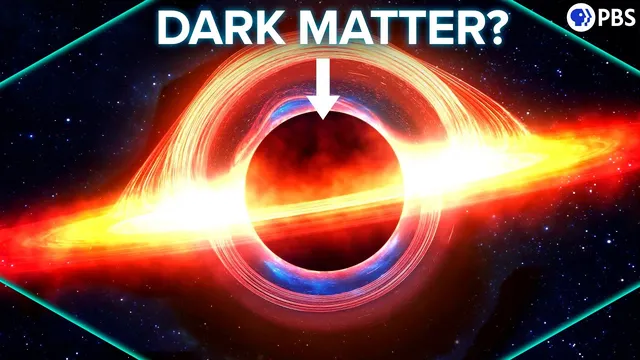
What If Dark Matter Is Just Black Holes?
Based on PBS Space Time's video on YouTube. If you like this content, support the original creators by watching, liking and subscribing to their content.
A black-hole dark matter model must match both the total mass budget (~80% of the universe) and the halo-like spatial distribution around galaxies.
Briefing
Dark matter may not be made of black holes after all. By checking how black holes would have to be distributed—matching the dark-matter halo around galaxies—and by eliminating mass ranges where they would leave clear astrophysical fingerprints, researchers have squeezed most of the primordial and stellar black-hole possibilities out of contention. The remaining “windows” are narrow and likely reflect gaps in observational sensitivity rather than a universe where nearly all dark matter sits in those overlooked masses.
The case starts with the requirements. Dark matter accounts for about 80% of the universe’s mass and forms a broad halo around galaxies, far more extended than ordinary stars. If black holes are the dark matter, they must be abundant enough to outweigh all the atoms by roughly a factor of four and spread out in the same halo-like pattern. That leaves one major free parameter: the mass of each black hole. The strategy then becomes a systematic falsification: each observational method rules out black holes only within the mass range where they would be detectable.
A first, decisive blow targets black holes formed from dead stars. Stellar black holes come from the cores of massive stars after supernova explosions. But estimates based on cosmic star-formation history and the abundance of heavy elements indicate there haven’t been enough supernovae to produce enough black holes to supply all dark matter. There’s also a timing problem: dark matter’s gravitational effects show up in the cosmic microwave background long before the first stars formed. So if black holes make up dark matter, they must have existed from the beginning—pointing to primordial black holes.
Primordial black holes could form when early-universe density fluctuations collapse. Those fluctuations would naturally produce a characteristic mass scale, potentially ranging from tiny fractions of a grain of salt to tens of thousands of solar masses, depending on early-universe conditions. That means the hypothesis only survives if the entire relevant mass range avoids observational constraints.
At the high end, supermassive black holes—millions to billions of solar masses—can’t work because they sink to galactic centers quickly. At the low end, black holes below about a billion tons (roughly mountain-mass) would have evaporated via Hawking radiation by now. The next mass band—asteroid to small-moon scale—also runs into trouble: making enough of them would require absurdly high numbers, which would disrupt white dwarfs and neutron stars. Microscopic black holes passing through white dwarfs could trigger runaway fusion and type Ia supernovae, while those hitting neutron stars would be swallowed from the inside out. Observations show far too few type Ia supernovae and far too many neutron stars for this to be common.
For planet-mass and nearby scales, microlensing becomes the key tool. Compact objects passing in front of background stars bend spacetime and briefly magnify the light. Surveys toward the galactic bulge and especially the Magellanic Clouds have constrained “MACHOs” (massive, compact halo objects), ruling out a large span from roughly the Moon’s mass up to about 10 solar masses as the dominant dark matter. Yet microlensing toward the Magellanic Clouds and Andromeda still allows that up to about 20% of the Milky Way’s halo could be dark, compact objects around small-star masses—though there’s no strong evidence that they are primordial black holes.
Heavier black holes are harder to detect with microlensing because there are fewer of them. Still, intermediate masses—tens to thousands of solar masses—face constraints from dwarf galaxies and the survival of wide binary stars. Dwarf-galaxy structure suggests no more than about 4% of dark matter could be black holes in that tens-to-thousands solar-mass range. With most mass ranges squeezed and the remaining gaps looking like blind spots, the balance of evidence points away from black holes as the main dark matter component.
The conclusion is less “mystery solved” than “mystery redirected.” If black holes aren’t the answer, dark matter likely belongs to physics not yet explained. A final speculative twist is that an evaporated black hole might leave behind a tiny Planck relic—an effectively undetectable remnant—though it would require an implausibly large number of such specks to matter cosmologically.
Cornell Notes
Dark matter’s gravitational signature demands an extended halo making up ~80% of the universe’s mass, so any black-hole explanation must match both abundance and spatial distribution. Stellar black holes fail because supernova rates and heavy-element production can’t generate enough, and dark matter’s effects appear before the first stars. That pushes the idea toward primordial black holes formed from early-universe density fluctuations, but observations then eliminate most mass ranges. Microlensing surveys constrain compact objects from roughly Moon-mass up to ~10 solar masses, while white-dwarf and neutron-star disruption rules out asteroid-to-small-moon masses. Constraints from dwarf galaxies and wide binaries limit tens-to-thousands solar-mass black holes to only a few percent of dark matter, leaving only narrow, likely-not-meaningful windows.
What two “non-negotiables” must a black-hole dark matter model satisfy?
Why do stellar black holes from dead stars fail as the main dark matter source?
How do primordial black holes enter the picture, and what mass-range problem does that create?
What observational effects rule out very small and very large black holes?
How does microlensing constrain black holes in the planet-mass to small-star-mass regime?
What limits remain for tens-to-thousands-of-solar-mass black holes?
Review Questions
- If dark matter must already influence the cosmic microwave background before stars form, what class of black-hole candidates does that rule out immediately?
- Which mass ranges are primarily constrained by Hawking evaporation, and which are constrained by microlensing? Explain the observational reason for each.
- Why do dwarf galaxies and wide binary stars become especially important for testing intermediate-mass black holes that microlensing might miss?
Key Points
- 1
A black-hole dark matter model must match both the total mass budget (~80% of the universe) and the halo-like spatial distribution around galaxies.
- 2
Supernova-driven (stellar) black holes can’t supply enough mass, and dark matter’s early gravitational imprint appears before stars could die.
- 3
Primordial black holes could form from early-universe density fluctuations, but their characteristic mass scale means entire mass ranges must be tested.
- 4
Black holes that are too massive sink to galactic centers, while black holes that are too small would have evaporated via Hawking radiation.
- 5
Asteroid-to-small-moon-mass black holes would need extreme abundances that would overproduce type Ia supernovae and disrupt neutron stars, which observations don’t support.
- 6
Microlensing surveys constrain MACHOs from roughly Moon mass to about 10 solar masses as the dominant dark matter component.
- 7
Dwarf-galaxy structure and the survival of wide binaries limit tens-to-thousands-of-solar-mass black holes to only a few percent of dark matter.