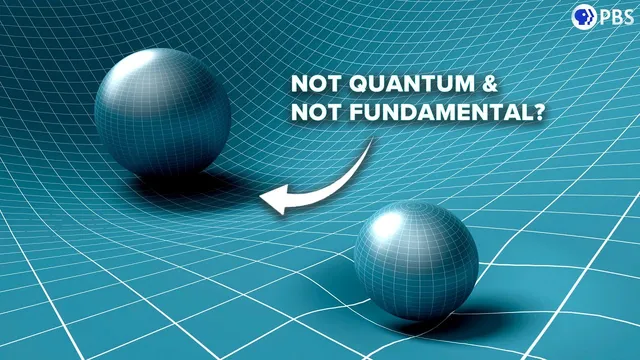
What If Gravity is NOT A Fundamental Force? | Entropic Gravity
Based on PBS Space Time's video on YouTube. If you like this content, support the original creators by watching, liking and subscribing to their content.
Entropic gravity treats gravity as an emergent effect tied to entropy growth rather than a fundamental interaction.
Briefing
Gravity’s weakness and its stubborn refusal to fit neatly into quantum theory have pushed some physicists to ask a provocative question: what if gravity isn’t fundamental at all, but instead emerges from entropy—an arrow-of-time effect tied to how many microscopic configurations a system can have. In the entropic gravity framework associated with Erik Verlinde, the force that pulls objects together is treated as a statistical byproduct of the universe’s tendency toward disorder, not a primary interaction built into spacetime.
The idea leans on holography, a principle that links physics in a higher-dimensional “bulk” to physics on a lower-dimensional boundary. Black hole thermodynamics provides the key clue: the maximum information (and thus entropy) that fits inside a black hole scales with surface area, captured by the Bekenstein–Hawking entropy. Holography generalizes that scaling to space itself, suggesting that the contents and dynamics of the bulk can be encoded on an enclosing boundary. In this picture, gravity in the bulk is not necessarily fundamental; it can be an emergent phenomenon arising from how boundary degrees of freedom behave.
To make the entropy-to-force connection concrete, the framework borrows a familiar statistical mechanics example. A long molecule in a thermal box tends to coil rather than stay straight because there are far more microstates corresponding to curled configurations. Straightening it requires work, and releasing it produces an effective restoring force. This is an entropic force: when a small displacement changes the entropy of the system, the temperature and the entropy gradient determine the force needed to oppose that change. The same logic—motion that increases entropy produces an effective pull—becomes the template for gravity.
Verlinde’s derivation then imagines a mass in the bulk, surrounded by spherical surfaces. Each surface can be assigned an entropy tied to how much information about the interior is hidden from an outside observer. When a small test particle approaches the surface, the boundary entropy increases because information about the particle becomes inaccessible to the exterior region, analogous to how entropy changes when matter crosses a black hole horizon. The temperature associated with the boundary degrees of freedom and the minimal entropy increase associated with the particle’s approach combine to yield an entropic force.
With additional assumptions—especially that the relevant entropy scales with area in a way analogous to black holes—the algebra reproduces Newton’s universal law of gravitation, at least at the level of form and constants. The deeper claim is that if bulk motion corresponds to maximizing boundary entropy, then gravitational attraction follows as the statistical tendency of the boundary system.
Extending the approach beyond Newtonian gravity is more demanding. Verlinde’s 2010 work argues that general relativity can emerge from the same entropic logic, while later work (2016) proposes that dark matter and dark energy might also be explained, though only with extra assumptions. The central vulnerability remains the holographic premise: without a holographic dual that matches our universe (a role played by AdS/CFT in related contexts), the entropic gravity program depends on a major “if.” The debate is active, and the framework remains influential precisely because it ties gravity’s behavior to thermodynamics and information—turning the usual direction of reasoning on its head.
Cornell Notes
Entropic gravity treats gravity as an emergent, thermodynamic effect rather than a fundamental force. Using holography, it links the entropy of a boundary system to the gravitational pull experienced in the bulk. A key step is the idea of an entropic force: when a small displacement increases entropy, the temperature and entropy gradient imply an effective force. Verlinde’s construction assigns area-scaling entropy to spherical surfaces around a mass, then shows that when a test particle approaches, the resulting entropy change can reproduce Newton’s law. The approach aims to go further toward general relativity and even dark matter/dark energy, but it hinges on whether a holographic dual matching our universe exists.
What does “entropic force” mean, and why does it produce something that looks like a pull?
How does holography connect boundary entropy to bulk gravity?
What happens to boundary entropy when a test particle moves toward a bulk surface?
How does the framework recover Newton’s law from thermodynamics?
Why is the approach controversial?
Review Questions
- What is the entropic-force mechanism in the molecule thought experiment, and how is it quantified in terms of temperature and entropy change?
- In Verlinde’s construction, what is the physical meaning of the entropy assigned to a spherical surface, and how does a test particle’s position change that entropy?
- Which assumptions are most critical for deriving Newtonian gravity, and what obstacle remains for extending the idea to our universe?
Key Points
- 1
Entropic gravity treats gravity as an emergent effect tied to entropy growth rather than a fundamental interaction.
- 2
Holography links bulk physics to boundary degrees of freedom, with black hole thermodynamics motivating area-scaling entropy via the Bekenstein–Hawking formula.
- 3
An entropic force arises when motion changes entropy; at fixed temperature, the force depends on the entropy gradient.
- 4
Verlinde assigns entropy to spherical surfaces around a mass and computes the entropy increase when a test particle approaches within about its Compton wavelength.
- 5
Combining boundary temperature, entropy change, and area scaling yields Newton’s universal law of gravitation in the entropic framework.
- 6
Extending the approach to general relativity and to dark matter/dark energy requires additional assumptions beyond the Newtonian derivation.
- 7
The program’s biggest open question is whether a holographic dual matching our universe exists, since AdS/CFT is not directly applicable.