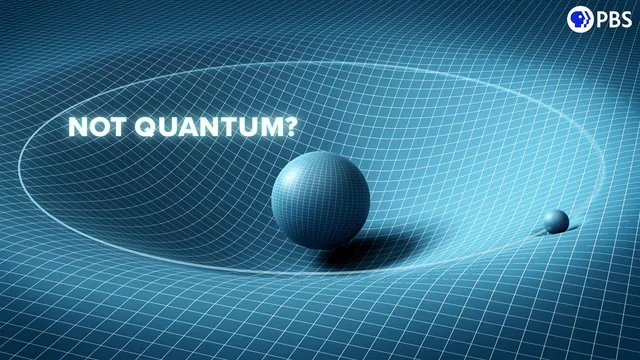
What If Gravity is NOT Quantum?
Based on PBS Space Time's video on YouTube. If you like this content, support the original creators by watching, liking and subscribing to their content.
Quantizing gravity by analogy with other forces would introduce a hypothetical graviton as the discrete carrier of the gravitational field.
Briefing
The strongest takeaway is that the most direct way to prove gravity is quantum—detecting a single graviton—runs into a hard physical wall: the required detector would collapse into a black hole, erasing the very information needed to confirm quantization. That “no-go” result doesn’t settle whether gravity is quantum, but it explains why the century-long effort to unify general relativity with quantum mechanics keeps stalling.
For decades, physicists have tried to follow a successful pattern: quantize fields by treating their forces as mediated by discrete particles. Quantum electrodynamics emerged when the electromagnetic field was quantized, with photons acting as the force carriers. The same logic later applied to the strong and weak forces, yielding gluons and W and Z bosons. By analogy, quantizing gravity would imply a graviton—an individual quantum of the gravitational field—whose detection would offer a clean experimental confirmation and a way to test ideas like string theory and loop quantum gravity.
Freeman Dyson’s line of reasoning starts with a key question: what would it take to detect a single graviton using a gravitational-wave detector? Gravitational waves are ripples in spacetime produced by accelerating massive objects, and in a quantum picture they would be built from many gravitons. Using estimates for the energy density and frequency of gravitational waves like those measured by LIGO, Dyson finds that even typical detectable waves contain an enormous number of gravitons per cubic meter. The challenge is that detecting just one would require improving detector sensitivity by a factor comparable to that graviton count—an extreme leap beyond current capabilities.
But the deeper problem appears when the thought experiment is pushed to the quantum limits of measurement. A detector sensitive to a graviton would need to measure tiny changes in distance—on the order of the Planck length—between masses. Achieving that precision forces the masses into a regime where the Heisenberg uncertainty principle implies large momentum uncertainties and, crucially, demands mass–distance configurations that fall within the Schwarzschild radius. Any mass compacted into a region smaller than that radius becomes trapped by its own gravity, forming a black hole.
So the universe doesn’t just make the graviton hard to catch; the act of building a detector capable of catching it would trigger gravitational collapse. The result is an information paradox: even if a graviton interaction occurred, the black hole would swallow the measurement details, preventing a reliable confirmation of the graviton’s quantum nature.
That doesn’t rule out quantum gravity. Other strategies remain on the table, including searching for extremely rare graviton-producing interactions with ordinary matter, or using indirect quantum effects—such as gravitationally induced entanglement between particles—to demonstrate that gravity can generate quantum correlations. Still, the central message is cautionary: both theoretical arguments and the physics of measurement itself suggest that nature may be actively blocking the most straightforward experimental tests of quantum gravity.
Cornell Notes
Gravity’s quantum nature is often framed as a matter of detecting a single graviton, but Dyson’s analysis suggests that a detector capable of that would inevitably form a black hole. The argument begins with the quantum measurement requirement: to register one graviton, a setup must resolve distance changes at roughly the Planck length. Heisenberg uncertainty then links the needed position precision to momentum uncertainty, which translates into constraints on the masses and separations used in the detector. Those constraints force the detector into configurations inside the Schwarzschild radius, where collapse into a black hole prevents extracting the measurement information. Quantum gravity therefore remains testable only through indirect or alternative approaches, not straightforward single-graviton detection.
Why does quantizing gravity naturally lead to the idea of a graviton?
What is the core logic behind the Bohr–Rosenfeld argument for why a force field should obey quantum uncertainty?
Why can’t the same Bohr–Rosenfeld trick be straightforwardly applied to gravity?
How does Dyson estimate the number of gravitons in a typical gravitational wave signal?
Why does the single-graviton detector thought experiment end in black hole formation?
What alternatives remain if direct single-graviton detection is blocked?
Review Questions
- What experimental requirement does Dyson identify as necessary to claim a single graviton detection, and why does it connect to the Planck length?
- How do Heisenberg uncertainty and the Schwarzschild radius combine to produce the black-hole “no-go” result for single-graviton detectors?
- What makes gravitationally induced entanglement a potentially stronger indirect test of quantum gravity than searching for rare graviton interactions?
Key Points
- 1
Quantizing gravity by analogy with other forces would introduce a hypothetical graviton as the discrete carrier of the gravitational field.
- 2
A direct single-graviton detection would require sensitivity to distance changes on the order of the Planck length.
- 3
Dyson’s graviton-count estimate for LIGO-like signals implies an enormous sensitivity improvement—on the order of 10^37—before even considering feasibility.
- 4
The Heisenberg uncertainty principle forces detector mass–separation choices that, in Dyson’s setup, fall inside the Schwarzschild radius.
- 5
A detector that collapses into a black hole would prevent extracting the measurement information needed to confirm gravity’s quantum nature.
- 6
Negative mass would be required to replicate the Bohr–Rosenfeld “pristine interaction” trick for gravity, but negative mass is believed to be fundamentally impossible.
- 7
Quantum gravity may still be testable through indirect signatures like gravitationally generated entanglement or extremely rare graviton-producing interactions.