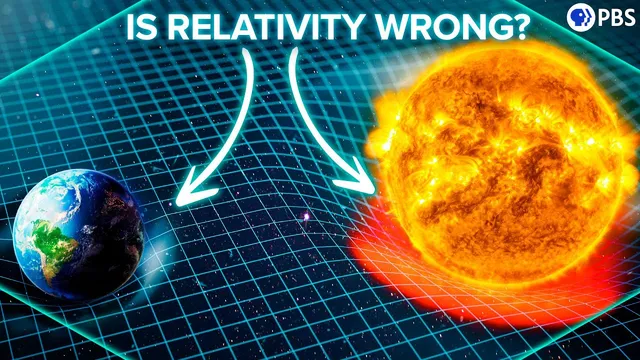
What If Our Understanding of Gravity Is Wrong?
Based on PBS Space Time's video on YouTube. If you like this content, support the original creators by watching, liking and subscribing to their content.
MOND replaces the dark-matter explanation for flat spiral galaxy rotation curves by changing gravity’s behavior at very low accelerations.
Briefing
The search for dark matter has lasted more than half a century, but a growing line of thought argues the real problem may be gravity itself. Instead of adding invisible mass to explain why galaxies rotate too fast, Modified Newtonian Dynamics (MOND) proposes that gravity behaves differently at very low accelerations—flattening galaxy rotation curves without requiring extra matter. The idea traces back to Vera Rubin’s observations of spiral galaxies in the early 1960s, which showed stars orbiting far faster than visible matter alone could account for, and it extends to other dark-matter-style evidence such as galaxy clusters and gravitational lensing.
MOND starts from a simple challenge to the usual assumptions behind dark matter: rotation curves are computed by applying Newton’s gravity to the observed mass. If either the mass estimates or the gravity law is wrong, the “missing” component could be an artifact. Newton’s law predicts that gravitational influence falls off with distance squared, so orbital speeds should decline with radius. MOND instead introduces a minimum acceleration scale: as acceleration drops below that threshold, the effective decline with distance weakens and the rotation curve flattens. The original formulation by Israeli physicist Mordehai Milgrom (1982) could be tuned with a single parameter to match spiral galaxy rotation data across many systems.
That success, however, runs into three major tests. First, MOND struggles with other dark-matter phenomena. When tuned for galaxies and applied to galaxy clusters, it reduces the required dark matter but still leaves roughly 20% of the usual cluster mass discrepancy unresolved. Second, early MOND versions conflict with established physics. They fail to conserve key quantities like energy, momentum, and angular momentum, and they don’t reproduce MOND behavior from general relativity in the “weak field limit,” instead reverting to ordinary Newtonian gravity where it should match.
Third, MOND’s strongest case comes from unexpected consistency with known galaxy scaling relations. Spiral galaxies follow the tight Tully-Fisher Law linking rotation speed to luminosity. MOND’s tuning for flat rotation curves automatically yields the correct speed–brightness relationship, a result described as neither engineered nor obvious.
To make MOND more compatible with relativity, Jacob Bekenstein and Milgrom reformulated it using Lagrangian mechanics and added extra gravitational fields. Their early relativistic attempt, “AQuaL,” fixed conservation laws and enabled tests of gravitational lensing, but it predicted faster-than-light waves, breaking causality. Bekenstein later introduced TeVeS (Tensor Vector Scalar gravity), which improved lensing and addressed causality issues by using tensor, vector, and scalar fields. Yet TeVeS faced cosmological problems: the cosmic microwave background’s early-universe “lumpiness” is naturally explained if dark matter can clump without interacting with light, whereas MOND-like alternatives often can’t seed structure formation quickly enough.
A newer relativistic MOND effort—RelMOND—was proposed in 2020 by Constantinos Skordis and Tom Złosnik. It changes how the scalar field behaves over time, acting like a form of “dark dust” early on to kickstart structure formation, then shifting toward TeVeS-like behavior later. Even so, modified gravity still faces hard observational pressure, including the Bullet Cluster, where gravitational lensing signals appear offset from ordinary matter during cluster collisions. The debate now resembles a tradeoff between complexity and naturalness: dark-matter proponents argue MOND requires heavy fine-tuning, while MOND proponents argue dark matter particle behavior would also need precise tuning to reproduce MOND-like regularities. For now, neither side has fully won—leaving gravity and the universe’s missing mass in an unresolved, high-stakes standoff.
Cornell Notes
MOND offers an alternative to dark matter by changing how gravity behaves at very low accelerations. Instead of adding unseen mass to keep galaxy rotation curves flat, it introduces a minimum acceleration scale so gravity’s effective strength “plateaus” in the outskirts of galaxies. The original MOND fits spiral galaxy rotation data with a single parameter and naturally reproduces the tight Tully-Fisher Law linking rotation speed to luminosity. But early MOND versions fail conservation laws and don’t match general relativity in the weak-field limit, and even relativistic versions struggle with galaxy clusters and cosmology. Newer work like RelMOND tries to fix those issues by letting the MOND scalar field evolve over cosmic time, though challenges such as the Bullet Cluster remain.
What observational problem does MOND try to solve, and why does it point to gravity rather than missing matter?
How does MOND produce flat rotation curves in practice?
Why does MOND face trouble beyond spiral galaxies?
What went wrong with early MOND from a physics-consistency standpoint?
How did Bekenstein and Milgrom try to make MOND relativistic, and what failures followed?
What is the key idea behind RelMOND, and why does it matter for cosmology?
Review Questions
- What specific modification does MOND make to the relationship between acceleration and gravity, and how does that flatten galaxy rotation curves?
- Which three criteria are used to judge whether a MOND-like gravity change is viable, and where does MOND fail most clearly?
- How do TeVeS and RelMOND differ in their approach to matching gravitational lensing and early-universe structure formation?
Key Points
- 1
MOND replaces the dark-matter explanation for flat spiral galaxy rotation curves by changing gravity’s behavior at very low accelerations.
- 2
The original MOND model by Mordehai Milgrom can fit many spiral galaxy rotation curves using a single acceleration-scale parameter.
- 3
MOND’s first major shortfall is galaxy clusters: even tuned versions typically leave about 20% of the cluster mass discrepancy unexplained.
- 4
Early MOND formulations conflict with conservation laws and don’t reproduce MOND behavior from general relativity in the weak-field limit.
- 5
Relativistic MOND attempts (AQuaL and TeVeS) use additional gravitational fields to address conservation and lensing, but they encounter causality or cosmological problems.
- 6
RelMOND (Skordis and Złosnik) introduces time-dependent scalar-field behavior, acting like “dark dust” early to seed structure formation and shifting later toward TeVeS-like behavior.
- 7
The debate remains unresolved because modified gravity still struggles with cluster-collision evidence like the Bullet Cluster, while dark-matter advocates argue MOND requires excessive fine-tuning.