What If Physics IS NOT Describing Reality?
Based on PBS Space Time's video on YouTube. If you like this content, support the original creators by watching, liking and subscribing to their content.
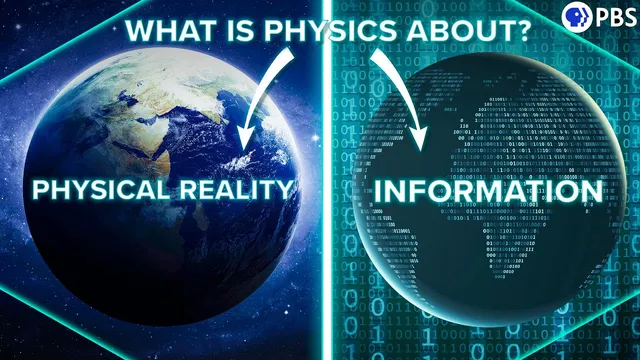
Physics can be interpreted as modeling what can be said about nature—patterns in observations—rather than directly mapping an observer-independent world.
Briefing
Quantum mechanics’ “weirdness” becomes easier to interpret if physics is treated as a model of information rather than a direct map of reality. Neils Bohr’s distinction—physics concerns what can be said about nature—sets up the core claim: the mathematical laws of physics may describe patterns in observations and knowledge, not the underlying world itself. Werner Heisenberg sharpened that view by saying quantum laws deal with what can be known about elementary particles, not the particles “themselves.” From there, the discussion moves to informational interpretations, including John Archibald Wheeler’s provocative “it from bit,” where information is treated as the most fundamental ingredient and physical behavior emerges from the relationship between observer and observed (with “observer” not necessarily meaning conscious).
Anton Zeilinger’s approach makes the idea concrete by rebuilding quantum systems out of informational building blocks. Instead of starting with particles and fields as the smallest pieces of reality, Zeilinger treats a quantum system as a collection of propositions—answers to questions that could be asked about it. The most elementary proposition is a binary one: a yes-no answer, or one bit. With that rule, quantum indeterminacy stops looking mysterious. Take quantum spin: an electron prepared “spin up” relative to a Stern–Gerlach apparatus contains one bit of information—up versus down along that measurement axis. Rotate the apparatus by 90 degrees and the “left-right” orientation is no longer defined; it becomes a superposition that yields random outcomes when measured. The bit of information is effectively “used up” to answer the first question, so asking a complementary question forces the previously defined property to become undefined.
Entanglement follows the same logic. Two electrons can be prepared so their spins are opposite relative to a chosen direction. If each electron can carry only one bit, that bit is not stored locally as a complete set of independent answers. Instead, the information is distributed across the pair: measuring one electron’s spin relative to a Stern–Gerlach device determines the other’s outcome as well. The correlations look instantaneous across distance, producing the familiar “spooky action” impression—but in this informational framing, the effect arises because the shared bit is distributed non-locally and becomes defined only when a particular question is asked.
The uncertainty principle also fits. Beyond the usual measurement-error form, information-theoretic methods yield entropic uncertainty, using Shannon entropy as a measure of how many binary questions are needed to extract a system’s information. That framework has been used to interpret wave–particle duality in Wheeler’s delayed-choice experiment: the wavefunction can supply answers to one of two complementary questions (which path or phase/interference), but not both at once, because its finite information content cannot support simultaneous certainty.
The discussion ends by confronting the “whose information?” problem. If the wavefunction is not an observer-independent object but a representation of knowledge, then claims about reality without observers become untestable. The payoff is interpretive: many quantum oddities align with the idea that direct experience is structured by an informational space-time, even if the universe itself likely isn’t a simulation. The transcript then briefly pivots to follow-up comments about Milky Way mergers and stellar collisions, and to a cosmology clarification: expansion of space is not equivalent to matter shrinking because general relativity predicts redshift behavior tied to expanding space, and shrinking would imply different astrophysical outcomes (like the nonexistence of “pygmy mammoths”).
Cornell Notes
The transcript argues that quantum theory can be understood as a framework for predicting outcomes of questions about nature, not as a direct description of an observer-independent reality. In Zeilinger’s informational approach, a quantum system is built from propositions—answers to yes-no questions—so the smallest quantum “unit” is one bit. With only one bit available, complementary properties (like spin along different axes) cannot be simultaneously well-defined: measuring one direction forces randomness in the other. Entanglement is reinterpreted as distributed information across multiple systems, producing strong correlations when measurements ask compatible questions. Information-theoretic tools like entropic uncertainty then connect to wave–particle duality in delayed-choice experiments by limiting how much can be known about complementary questions at once.
Why does treating quantum laws as models of knowledge (rather than of particles) change how indeterminacy feels?
How does the Stern–Gerlach example illustrate the “one bit” rule for quantum systems?
What does entanglement mean in an informational interpretation?
How does entropic uncertainty connect information theory to the uncertainty principle?
How is wave–particle duality explained using entropic uncertainty and delayed-choice experiments?
Review Questions
- In Zeilinger’s framework, what does it mean for a quantum system to be a collection of propositions, and why does that imply a limit of one bit for an elementary system?
- Using the spin example, explain why measuring along one axis makes the orthogonal axis outcomes random rather than predetermined.
- How does entanglement differ from ordinary correlation in this informational picture, and what role does “distributed information” play?
Key Points
- 1
Physics can be interpreted as modeling what can be said about nature—patterns in observations—rather than directly mapping an observer-independent world.
- 2
In Zeilinger’s informational approach, a quantum system is a set of propositions (answers to questions), and the smallest building block is a one-bit yes-no answer.
- 3
Quantum indeterminacy follows from complementarity: fixing the answer to one binary question (e.g., spin up/down along one axis) leaves no information for the complementary question (e.g., left/right along a rotated axis).
- 4
Entanglement can be reframed as non-local distribution of limited information across multiple particles, producing strong measurement correlations when specific questions are asked.
- 5
Entropic uncertainty uses Shannon entropy to quantify how much information can be extracted across complementary measurements, tightening the usual uncertainty story.
- 6
Wave–particle duality in delayed-choice experiments can be interpreted as a consequence of limited information: the wavefunction can’t supply simultaneous certainty about complementary properties.
- 7
Claims about an observer-independent wavefunction face the “whose information?” challenge: knowledge is always tied to the act of measurement, making some questions empirically unresolvable.