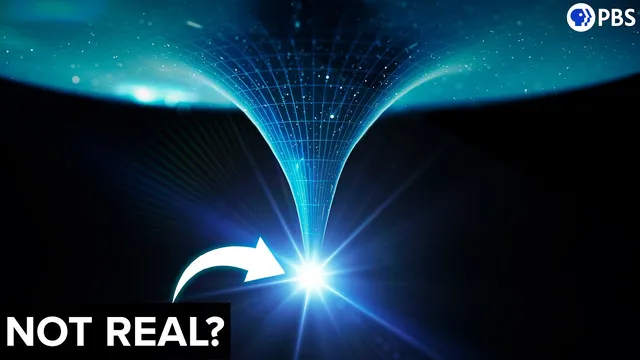
What if Singularities DO NOT Exist?
Based on PBS Space Time's video on YouTube. If you like this content, support the original creators by watching, liking and subscribing to their content.
The Penrose Singularity Theorem links event horizons to geodesic incompleteness, but Kerr argues that this does not automatically translate into a physical singularity.
Briefing
A new challenge to the idea that black holes must contain “real” singularities is gaining attention: Roy Kerr argues that the logic behind the Penrose Singularity Theorem hinges on a technical mismatch—bounded geodesic parameters for light don’t necessarily mean spacetime ends in a physical singularity. If that critique holds up, the long-standing expectation that singularities are unavoidable consequences of general relativity (and therefore demand quantum-gravity rescue) may be less certain than physicists have assumed.
For decades, the Penrose Singularity Theorem has served as a cornerstone of the singularity story. It links the behavior of spacetime “paths” to the existence of singularities by showing that, inside an event horizon, geodesics must become incomplete—mathematically, their description cannot be extended indefinitely. In the usual interpretation, geodesic incompleteness signals that spacetime pinches off into a region where the laws of physics break down.
Kerr’s objection targets the interpretation of that incompleteness. Penrose’s theorem is built using null geodesics, the trajectories of light. For light, the standard clock-based parameter used for massive particles—proper time—doesn’t apply because light has no proper time along its path. Instead, the theorem uses an affine parameter, a mathematical quantity that tracks progress along a null geodesic. Kerr argues that an affine parameter can be bounded even when physical time does not stop. In other words, the parameter reaching a limit does not automatically mean the universe hits a “dead end” where nothing can continue.
Kerr also emphasizes that the black holes used in idealized proofs may not match real astrophysical objects. Real black holes almost certainly rotate, so the relevant solutions are closer to the Kerr metric than the non-rotating Schwarzschild case. In the Kerr geometry, the central singularity is not a point but a ring singularity, and the interior structure differs: there is an inner horizon, and the region between horizons behaves differently from the Schwarzschild picture. Kerr claims that even with finite affine parameter, not all null geodesics terminate at a singularity. Families of lightlike paths can pass through the inner horizon and continue indefinitely, tracing trajectories without “stopping existing.”
The practical takeaway is not that singularities are definitively disproven, but that the Penrose theorem’s common conclusion may be too strong. Kerr’s critique suggests that bounded affine parameters for light do not, by themselves, establish the presence of a physical singularity. That distinction matters because it changes what general relativity alone can be forced to predict. If singularities are not an inevitable endpoint of classical spacetime, physicists may have more room to develop consistent interior physics without immediately invoking quantum gravity.
Still, the argument remains under scrutiny. Kerr’s paper has sparked sharp debate precisely because it challenges a widely accepted inference. But for now, it offers a reason to be less certain that black hole interiors must end in a catastrophic singularity—and more confident that the theoretical landscape inside event horizons could be richer than the standard singularity narrative.
Cornell Notes
Roy Kerr challenges the usual interpretation of the Penrose Singularity Theorem by focusing on how “geodesic incompleteness” is defined for light. Penrose’s theorem uses null geodesics and shows their affine parameter is bounded inside black holes, which many readers interpret as spacetime ending in a singularity. Kerr argues that affine parameters do not track physical time the way proper time does for massive particles, so bounded affine parameter does not necessarily mean time (or spacetime) truly terminates. He further points to rotating black holes described by the Kerr metric, where an inner horizon and different interior causal structure allow some null geodesics to continue without hitting the supposed singularity. The upshot: the theorem’s inference to unavoidable physical singularities may be incorrect, even if geodesics become mathematically incomplete.
What does the Penrose Singularity Theorem connect, and why did it become so influential?
Why does Kerr’s critique hinge on the difference between null geodesics and massive-particle geodesics?
What is an affine parameter, and how does Kerr use it to undermine the “dead end” interpretation?
How does the Kerr metric change the interior picture compared with the Schwarzschild solution?
What does Kerr claim about null geodesics in a Kerr black hole?
So does Kerr say singularities don’t exist?
Review Questions
- How does the role of proper time for massive particles differ from the role of affine parameter for null geodesics, and why does that matter for interpreting geodesic incompleteness?
- What specific logical step does Kerr challenge in the usual reading of the Penrose Singularity Theorem?
- In what ways does the Kerr metric’s inner horizon and rotating interior structure alter the expected fate of null geodesics?
Key Points
- 1
The Penrose Singularity Theorem links event horizons to geodesic incompleteness, but Kerr argues that this does not automatically translate into a physical singularity.
- 2
Penrose’s theorem relies on null geodesics (lightlike paths), where proper time is not a meaningful parameter, so an affine parameter is used instead.
- 3
Kerr’s central critique is that bounded affine parameter does not necessarily mean physical time or spacetime truly terminates.
- 4
Rotating black holes described by the Kerr metric have an inner horizon and different interior dynamics than the non-rotating Schwarzschild case.
- 5
Kerr claims that some null geodesics can pass through the inner horizon and continue indefinitely without encountering a singularity endpoint.
- 6
The debate is about the strength of the inference from mathematical incompleteness to physical singularities, not necessarily a blanket denial of singularities everywhere.