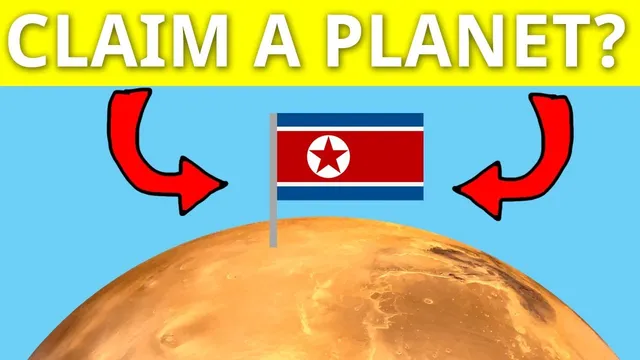
What if Someone Tries to Claim a Planet?
Based on Second Thought's video on YouTube. If you like this content, support the original creators by watching, liking and subscribing to their content.
The Outer Space Treaty bans nuclear weapons in space and forbids nations from claiming celestial bodies or space resources like the moon or planets.
Briefing
Outer space law already blocks countries from claiming celestial bodies, but it leaves a loophole for private individuals—raising the question of what would happen if someone tried to “own” a planet like Mars. The Outer Space Treaty, agreed in 1967 by the United States, the UK, and the Soviet Union and now backed by more than a hundred nations, bans placing nuclear weapons in space and explicitly forbids nations from claiming space resources such as the moon or a planet. So far, no government has attempted to seize a celestial body, and the treaty’s enforcement has largely kept the peace.
The scenario changes when the claimant isn’t a state. The treaty does require non-government entities to operate with authorization and remain responsible to their parent nations, but it does not clearly spell out whether an individual can make a legal claim to a planet or moon. That ambiguity becomes the basis for a thought experiment: if a figure like North Korea’s Kim Jong-un somehow landed on the moon, planted a flag, and tried to defend the “prize,” the likely outcome would be diplomatic backlash, stern responses from treaty partners, and intensified sanctions on Earth. If the moon claim were paired with a nuclear delivery capability, global retaliation would likely escalate dramatically.
A private claim, however, would create a different kind of problem. With private spaceflight advancing—citing SpaceX’s Falcon Heavy as a recent milestone—the transcript turns to the idea that Elon Musk could attempt a “supervillain” takeover of Mars. It frames legal ownership using the doctrine of first possession, a “finders keepers” style principle: to claim something, a claimant must show intention and control, and possession is considered effective once both criteria are met. Under that logic, planting a flag could demonstrate intent, but control would require infrastructure—such as building roads and outposts across large portions of the planet—to justify territorial claims.
Even if such a claim were made, it would likely be challenged. On Earth, American authorities would probably demand the claim be withdrawn, and other treaty members could treat it as a threat and take further action. The transcript argues that full ownership of Mars would be nearly impossible without an all-at-once effort: sending enough people, materials, and supplies to establish a self-sufficient colony and effectively cut off Earth’s ability to intervene. If a colony gained a 10–20 year head start before major agencies like NASA or the ESA could arrive, the political and practical leverage would shift—especially if the settlers were hostile to outsiders.
The closing takeaway is less about any specific person and more about governance. As private groups and governments expand into space, rules for ownership and jurisdiction will likely need to evolve. The unresolved question is whether Earth law will apply to space colonies uniformly, or whether regulations will differ by celestial body—determining whether space becomes a regulated frontier or a new “Wild West.”
Cornell Notes
The Outer Space Treaty bans countries from claiming celestial bodies and from placing nuclear weapons in space, but it does not clearly address whether individuals can claim a planet or moon. Using the doctrine of first possession, a claim would require both intention and control: a flag could signal intent, while roads and outposts could be used to justify control over territory. A state-backed moon takeover would trigger sanctions and likely severe retaliation, especially if nuclear delivery systems were involved. A private Mars claim would be harder to stop quickly, because other nations might arrive years later and face a fait accompli. The core issue is how law and enforcement should work as private space settlement accelerates.
What does the Outer Space Treaty prohibit, and why has it mattered so far?
Why does the transcript treat individual claims as a legal gray area?
How does the doctrine of first possession translate into a Mars ownership plan?
What would likely happen if a state tried to claim the moon?
Why is stopping a private Mars claim portrayed as difficult?
What governance question remains as space settlement grows?
Review Questions
- How do intention and control under the doctrine of first possession differ, and which actions in the transcript are used to satisfy each?
- What enforcement mechanisms would likely differ between a government-backed moon claim and an individual-backed Mars claim?
- Why does the transcript suggest that timing—arriving years later—could determine whether a claim becomes a fait accompli?
Key Points
- 1
The Outer Space Treaty bans nuclear weapons in space and forbids nations from claiming celestial bodies or space resources like the moon or planets.
- 2
The treaty’s language creates ambiguity for individuals because it focuses on authorization and parent-nation responsibility for non-government entities rather than explicitly banning individual ownership claims.
- 3
A first-possession style claim would require both intention (e.g., planting a flag) and control (e.g., building roads and outposts).
- 4
Even if first possession were invoked, the claim would likely be challenged on Earth and could trigger diplomatic and legal pressure to retract it.
- 5
A state-backed celestial takeover would likely bring sanctions and potentially severe escalation if nuclear delivery capabilities were involved.
- 6
A private Mars settlement could be difficult to reverse quickly because major agencies may not be able to mount a fast manned mission, allowing a colony to gain a head start.
- 7
Future space governance will hinge on whether Earth law applies consistently to colonies or whether rules diverge by celestial body.