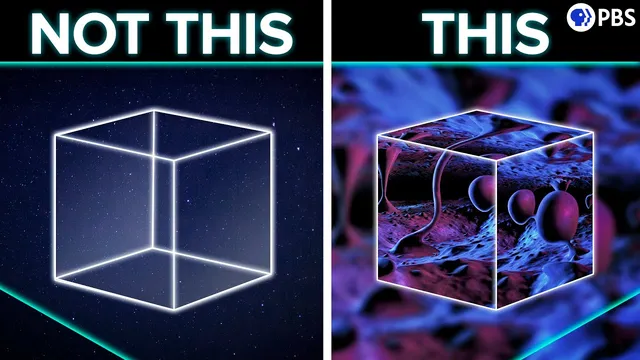
What If Space is NOT Empty?
Based on PBS Space Time's video on YouTube. If you like this content, support the original creators by watching, liking and subscribing to their content.
Spacetime foam is a prediction that spacetime geometry becomes fundamentally uncertain near the Planck length (~1.6×10^-35 m).
Briefing
Spacetime may not be smooth or empty at the tiniest scales; it could be “foamy,” with rapidly fluctuating geometry that briefly forms black holes and wormholes before vanishing. The core idea is that the same principles that make quantum particles inherently uncertain—combined with Einstein’s rule that energy and mass shape geometry—imply a fundamental limit to how precisely spacetime can be measured. Once that limit is reached near the Planck length (~1.6×10^-35 meters), the curvature of spacetime becomes so uncertain that wildly different geometries can momentarily dominate.
The argument starts from a marriage of two pillars of modern physics. Quantum mechanics, via the Heisenberg uncertainty principle, prevents perfect knowledge of certain pairs of quantities. In the “Heisenberg microscope” picture, measuring position more precisely requires higher-energy photons, which in turn add energy and warp spacetime through general relativity. The trade-off bottoms out when the uncertainties balance at the Planck length, suggesting that spacetime cannot be treated as a perfectly well-defined stage at smaller scales. Trying to probe a region of size equal to the Planck length forces the introduced curvature to be comparable to the region itself—so curvature becomes the dominant source of uncertainty.
At that point, the kinds of geometries that fit the bill are extreme: configurations with curvature radii comparable to their size include black holes and wormholes. The foam is expected to be transient, not a stable structure. Planck-scale black holes would likely evaporate quickly through Hawking radiation, while wormholes would be unstable and collapse on very short timescales. The “foam” picture is also linked to quantum fluctuations in the vacuum: energy-time uncertainty implies that even empty space cannot have exactly zero energy over arbitrarily short intervals. When that fluctuating energy is fed into Einstein’s equations, it corresponds to fluctuating gravitational fields and thus fluctuating spacetime geometry.
Because the underlying quantum-gravity theory remains untested, the foam claim is framed as robust logic rather than a specific model of what spacetime is made of. Whether the uncertainty sits mainly in the “stuff” (fields and energy) or in the geometry itself, the conclusion is similar: if gravity obeys a reasonable uncertainty principle, spacetime should behave like a churning quantum medium at Planckian scales.
Testing it directly is likely out of reach, since the relevant effects are far smaller than any foreseeable instrument can resolve. Instead, researchers look for indirect signatures using the analogy of a choppy ocean: a rowboat feels the waves, while a large ship barely notices. If spacetime foam perturbs the paths of light over enormous distances, it could blur interference patterns. The proposed observational handle is diffraction. Photons from distant sources create sharp interference patterns when they arrive with consistent angles; tiny angle variations smear those patterns into a blur. Studies using Hubble Space Telescope data have searched for such effects in quasars and gamma-ray bursts, ruling out models that predict especially strong foam. Some results sit near the sensitivity threshold, leaving open the possibility that a future ultraviolet-sensitive space telescope could detect the effect more decisively. Until then, spacetime foam remains an inference—plausible, testable in principle, and still waiting for a clear observational win.
Cornell Notes
Spacetime foam is the idea that, near the Planck length (~1.6×10^-35 m), spacetime geometry becomes fundamentally uncertain rather than smooth. Combining the Heisenberg uncertainty principle with general relativity leads to a limit on how precisely distances can be measured; probing smaller regions forces curvature uncertainty to dominate. At those scales, geometries resembling tiny black holes and wormholes can briefly appear, then disappear quickly (black holes via Hawking radiation; wormholes via instability). Because direct tests are impractical, researchers search for indirect effects—especially blurring of light interference patterns from extremely distant objects. Hubble-based studies have constrained the strongest foam models, but improved ultraviolet-sensitive observations may be needed for a definitive detection.
Why does measuring position more precisely eventually force spacetime to become uncertain?
What does “foamy” mean in terms of geometry at the Planck scale?
How do quantum vacuum fluctuations connect to spacetime foam?
Why are indirect tests based on light interference patterns plausible?
What role does ultraviolet sensitivity play in searching for spacetime foam?
Review Questions
- What balance of uncertainties sets the Planck-length limit in the spacetime-foam argument?
- How would spacetime foam change the appearance of diffraction patterns from extremely distant sources?
- Why might black-hole-like and wormhole-like structures be expected to be short-lived at the Planck scale?
Key Points
- 1
Spacetime foam is a prediction that spacetime geometry becomes fundamentally uncertain near the Planck length (~1.6×10^-35 m).
- 2
The argument combines Heisenberg uncertainty with general relativity: measurement photons that improve position precision also curve spacetime, increasing distance uncertainty.
- 3
At Planckian scales, curvature uncertainty becomes so large that black hole– and wormhole–like geometries can briefly emerge and then vanish.
- 4
Vacuum energy fluctuations from time-energy uncertainty can be translated into fluctuating gravitational fields via Einstein’s equations, reinforcing the foam picture.
- 5
Because direct probing of Planck-scale structure is far beyond current capability, researchers target indirect signatures such as blurring of interference/diffraction patterns from very distant light sources.
- 6
Hubble Space Telescope ultraviolet observations have constrained the strongest spacetime-foam models, but some results are near the detection threshold, leaving room for improved future instruments.