What If the Galactic Habitable Zone LIMITS Intelligent Life?
Based on PBS Space Time's video on YouTube. If you like this content, support the original creators by watching, liking and subscribing to their content.
The Sun is broadly typical as a G-type main-sequence star, so its suitability doesn’t automatically explain why technological life hasn’t been detected.
Briefing
The Milky Way’s “Galactic Habitable Zone” doesn’t just determine where planets can form—it also shapes how long life has had to get started, which may be key to the Fermi Paradox. Even though the Sun isn’t uniquely suited for life compared with most stars, the galaxy’s habitability window is uneven: only a minority of stars form in regions and eras that balance heavy-element availability, radiation risk, and enough time for biology to take hold.
From a star-by-star perspective, the Sun looks ordinary. It’s a G-type main-sequence star—about 5% of Milky Way stars—and it formed roughly 5 billion years ago from a collapsing overdense gas region in the Milky Way’s disk. Planet formation is also common: the Kepler mission found that most stars host planets, including an estimated ~40 billion Earth-analog rocky planets in the habitable zone where stellar light could allow liquid water.
The catch is that “habitable zone” applies at multiple scales. Stars can sit in the right orbital distance, but galaxies also have regions where life-friendly planetary systems are unlikely. The galactic habitability depends on metallicity (the heavy-element content needed to build rocky planets), the timing of supernova enrichment, and the danger of too much nearby radiation. Massive stars seed the galaxy with heavy elements through supernovae, but excessive supernova activity can strip atmospheres and drive damaging mutation. The Milky Way’s inner core illustrates the tradeoff: early on it likely had too much radiation, and later it became metal-rich enough to produce many giant planets—often a recipe for disrupting Earth-like worlds. Dense stellar neighborhoods also raise the odds of close encounters that can destabilize comet reservoirs and trigger repeated mass extinctions.
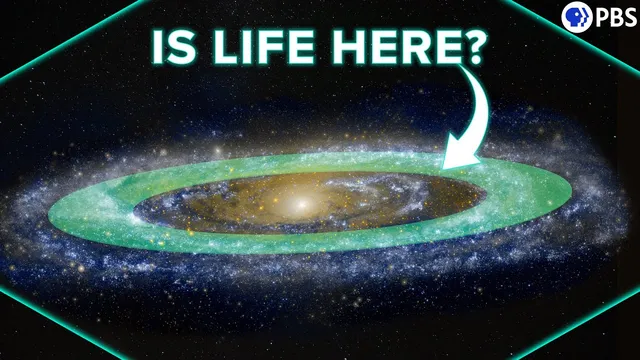
As the Milky Way assembled, the earliest stars formed from nearly pristine gas, leaving no chance for planets. Only after successive generations of stars enriched the interstellar medium did planet-building become feasible. Over time, the habitable region shifted: the outer rim formed later from metal-poor gas and still lacks sufficient time and enrichment, while the inner regions became too metal-rich and dynamically hostile. The result is a band—the Galactic Habitable Zone—roughly half the Milky Way’s disk, emerging about 8 billion years ago and expanding as supernova rates fell and metallicity rose.
Astrophysicists Charlie Lineweaver, Yeshe Fenner, and Brad Gibson modeled how often life-friendly planetary systems should arise by combining star-formation history, heavy-element abundance, supernova survival odds, and the time available for life to emerge. Their estimate suggests fewer than 10% of Milky Way stars have optimal conditions for life, dropping to about 1–2% if red dwarfs are excluded. Yet the most surprising finding is timing: among stars that can currently support life, about 75% are older than the Sun by an average of roughly a billion years. That doesn’t solve the Fermi Paradox—it intensifies it—because other civilizations might have had ample time to develop and spread.
The discussion then pivots to a “great filter” idea: the bottleneck likely isn’t forming habitable planets, since that step seems achievable in many places. Instead, the roadblock may lie between simple life and complex, technologically visible civilizations—meaning the galaxy may be full of potential starting points, but far fewer successful outcomes.
Cornell Notes
The Milky Way’s habitability is shaped by a “Galactic Habitable Zone,” not just by whether a planet orbits in the right place. Rocky planets require enough heavy elements (metallicity), which arrive through supernovae, but too many nearby supernovae can damage atmospheres. The galaxy’s inner core becomes problematic due to extreme radiation early on and later due to high metallicity producing many giant planets and frequent stellar encounters; the outer rim is metal-poor and younger. Modeling by Lineweaver, Fenner, and Gibson suggests fewer than 10% of stars have optimal life conditions (about 1–2% excluding red dwarfs), and most life-capable stars are older than the Sun by ~1 billion years. That timing makes the lack of detected technological life harder to explain, pointing to a later “great filter” between simple life and complex civilizations.
Why isn’t the Sun’s “habitable zone” enough to explain where life can arise in the Milky Way?
How do metallicity and supernovae jointly determine where Earth-like planets can form?
Why are both the galactic core and the outer rim considered poor places for life-friendly planetary systems?
What is the Galactic Habitable Zone, and how did it change over time?
What did Lineweaver, Fenner, and Gibson find about how common life-capable systems are—and what surprised them?
What “great filter” shift does the discussion imply after ruling out planet formation as the main bottleneck?
Review Questions
- What three galactic factors (beyond orbital distance) determine whether a region of the Milky Way can support life-friendly planets?
- How do high metallicity and high stellar density each create different problems for life in the galactic core?
- Why does the finding that most life-capable stars are older than the Sun intensify the Fermi Paradox rather than resolve it?
Key Points
- 1
The Sun is broadly typical as a G-type main-sequence star, so its suitability doesn’t automatically explain why technological life hasn’t been detected.
- 2
Planet formation is common in the Milky Way, but galactic-scale conditions determine where rocky, survivable systems are most likely.
- 3
Metallicity is a double-edged sword: too little prevents rocky planet formation, while too much can favor giant planets that disrupt Earth-analogs.
- 4
Supernovae enrich the galaxy with heavy elements but can also sterilize or damage atmospheres; habitability depends on the balance and timing of that radiation.
- 5
The Milky Way’s Galactic Habitable Zone is a shifting radial band that emerged ~8 billion years ago and now spans about half the disk.
- 6
Modeling by Lineweaver, Fenner, and Gibson estimates fewer than 10% of stars have optimal life conditions (about 1–2% excluding red dwarfs).
- 7
Most stars that could currently support life are older than the Sun by ~1 billion years, making the lack of observed technological civilizations harder to explain.