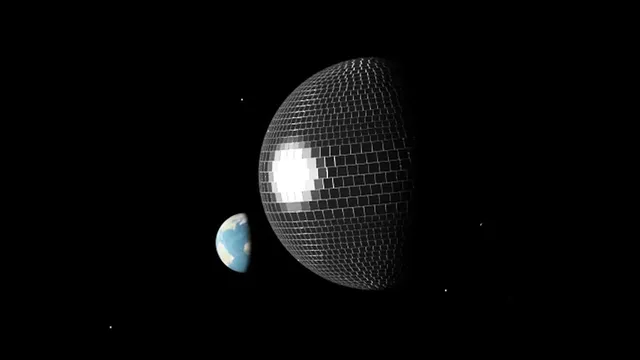
What if the Moon was a Disco Ball?
Based on Vsauce's video on YouTube. If you like this content, support the original creators by watching, liking and subscribing to their content.
A mirror-tiled Moon would reflect sunlight in narrow, specular beams, so most reflected light would miss Earth.
Briefing
Turning the Moon into a mirror-tiled disco ball would make it a spectacular but extremely rare source of sunlight flashes—not a steady “day-and-night” replacement for the real Sun. With mirror-like, specular reflection instead of the Moon’s usual diffuse glow, most of the reflected light would miss Earth entirely. Only a tiny fraction of sunlight beams would line up with observers, producing brief, infrequent streaks across the sky.
A model with 3,012 mirror tiles—each tile part of a Moon-sized structure roughly 100 to 150 kilometers across and about 10 kilometers thick—shows how narrow the geometry becomes. Reflected beams would intersect Earth only briefly and rarely, with “a few every month or so” racing past at over 20,000 kilometers per second. From the ground, those events would register as tiny flashes: about 0.1% as bright as the regular Sun and lasting only a fraction of a second. In other words, the sky would not fill with disco light; it would mostly be dark, punctuated by occasional glints.
The thought experiment also runs into two physical constraints that would sabotage the idea in real life. First, a disco-ball Moon placed too close to Earth would be torn apart by gravitational tidal forces. The transcript contrasts the real Moon’s distance of 384,000 kilometers with a hypothetical orbit closer than 450 kilometers—roughly the scale of the International Space Station—where tides would overwhelm the structure.
Second, the Moon’s rotation relative to Earth doesn’t behave like a convenient, controllable disco ball. The Moon doesn’t “rotate from our perspective” in a way that would reliably sweep reflections across the sky. To keep the investigation moving, the scenario temporarily relaxes these problems: the disco-ball Moon is assumed not to break apart and is allowed to spin in the sky.
With those assumptions, the reflections become more visually interesting. Observers would occasionally catch “glittery” flashes—dimmer images of the Sun—rather than a continuous illumination. The transcript even frames the experience as psychologically odd: seeing Earth reflected in the Moon’s mirror surface would feel like looking into a giant’s mirror, where the observer can see the giant but not themselves. That same geometry could enable “planetary selfies,” since Earth’s image could appear in the reflected beam.
Finally, the experiment scales up from Earth’s surface to low orbit. From higher vantage points, the Moon-as-a-rotating-mirror concept becomes more like a strobe effect, with the strobe-like edge reflections tied to a hypothetical mirror structure about 10 kilometers across. The closing takeaway is blunt: the Moon is a diffuse illuminator and likely never will be a true disco ball—but imagining the specular alternative makes the difference in lighting geometry feel immediate and real.
Cornell Notes
A mirror-tiled Moon would reflect sunlight specularly, so reflected beams would only occasionally line up with Earth. A model using 3,012 mirror tiles predicts that Earth would get just a few brief flashes per month, each lasting a fraction of a second and reaching about 0.1% of the Sun’s brightness. Putting such a Moon close to Earth (within roughly the scale of the International Space Station) would likely tear it apart via tidal forces, and the Moon’s real rotational behavior wouldn’t naturally sweep reflections like a disco ball. If those constraints are ignored and the Moon is allowed to spin, observers could sometimes see dim “glittery” Sun reflections and even Earth’s image in the mirror geometry—more like strobe-like effects from orbit than a constant light source.
Why would a disco-ball Moon produce mostly darkness instead of constant illumination?
What does the mirror-tile model predict for how often and how bright the flashes would be from Earth?
How do tidal forces limit where a disco-ball Moon could orbit?
Why doesn’t the Moon naturally behave like a disco ball that sweeps light across the sky?
What new visual possibilities appear if the disco-ball Moon is allowed to spin and survive?
Review Questions
- If mirror tiles reflect sunlight specularly, what geometric requirement must be met for an observer on Earth to see a flash?
- According to the model, how do the frequency, brightness, and duration of disco-ball Moon flashes compare to the regular Sun?
- What two physical issues—one gravitational and one rotational—make the disco-ball Moon idea difficult in reality?
Key Points
- 1
A mirror-tiled Moon would reflect sunlight in narrow, specular beams, so most reflected light would miss Earth.
- 2
Modeling 3,012 mirror tiles predicts only a few flashes per month, each lasting a fraction of a second and reaching about 0.1% of the Sun’s brightness.
- 3
Reflected beams would move extremely fast—over 20,000 km/s—so the sky events would be brief streaks rather than sustained lighting.
- 4
An orbit much closer than the real Moon (within roughly the International Space Station scale, under 450 km) would likely be destroyed by tidal forces.
- 5
The Moon’s real rotation relative to Earth doesn’t naturally create the sweeping reflection pattern associated with a disco ball.
- 6
If the scenario is allowed to spin and survive, observers could sometimes see dim “glittery” Sun reflections and even Earth’s image in the mirror geometry.
- 7
From low orbit, the effect would resemble strobe-like edge reflections more than a continuous glow.