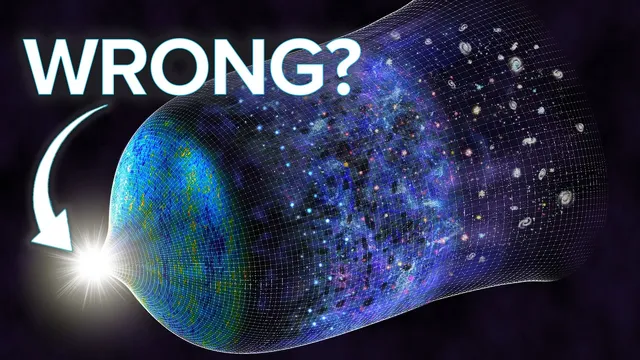
What If The Universe DID NOT Start With The Big Bang?
Based on PBS Space Time's video on YouTube. If you like this content, support the original creators by watching, liking and subscribing to their content.
A past boundary inferred from geodesic incompleteness is not automatically the same as a physical end of spacetime; coordinate artifacts can mimic infinities.
Briefing
The strongest takeaway is that modern cosmology still points toward a past boundary—often interpreted as a beginning of time—because geodesics in an expanding universe can’t be traced indefinitely into the past. Even when cosmic inflation and “eternal inflation” are included, many lines of reasoning converge on the idea that the universe’s history cannot extend infinitely backward.
Early big-bang cosmology, built from Einstein’s general relativity, suggested that rewinding the expansion makes all of space converge to a single point of infinite density at t = 0. That picture depended on simplifying assumptions, including a perfectly smooth universe. Real cosmology is lumpy, and inflation was introduced to explain why today’s universe looks so uniform: tiny early regions were stretched into a vast, smooth cosmos. Inflation itself can be patchy; if inflation continues in some regions while ending in others, “bubble universes” form inside a larger inflating spacetime. That raises a tempting question: if inflation can run forever into the future, could it also run forever into the past?
Answering that requires distinguishing coordinate artifacts from genuine spacetime endings. Black holes provide the template. The event horizon is a coordinate singularity: Schwarzschild coordinates blow up there, but a coordinate change (such as Eddington–Finkelstein) shows spacetime continues smoothly across the horizon. The central singularity, by contrast, is physical: curvature diverges and geodesics terminate, leaving no extension that light can traverse.
Cosmologists use similar diagnostics. One is geodesic incompleteness—when the shortest paths (geodesics) can’t be extended further into the past. In standard big-bang reasoning, all geodesics wind up at the same infinitesimal point, implying a past boundary. Another is curvature blow-up: if curvature becomes infinite in a coordinate-independent way, spacetime likely ends physically.
A major development came in 2003 with the Borde–Guth–Vilenkin (BGV) theorem. It argues that any universe with a positive average expansion rate throughout its history cannot have an infinite past; it must hit a past boundary. Notably, this result does not rely on the weak energy condition, which many earlier arguments used.
Still, “past boundary” doesn’t automatically mean “hard beginning.” A 2024 study by Geshnizjani, Ling, and Quintin applies curvature tests across different expansion histories and finds that not every scenario forces a curvature singularity. Universes that pass through phases like contraction-to-expansion or emerge from a prior static state may avoid a past singularity—though such histories can require violations of energy conditions and may be physically implausible.
There’s also an unusual loophole: in a special case involving exponential expansion, the BGV past boundary might be extendible into a larger de Sitter space, turning what looks like a beginning into something closer to a coordinate singularity. But this extension depends on the FLRW patch transitioning smoothly into de Sitter space, which in turn requires the cosmological-constant-like component to dominate over early density fluctuations. Since the early universe must have had fluctuations to seed galaxies, that smooth transition may fail, closing the door on an extendible past.
Overall, the balance of evidence still leans toward a beginning of time, but the final verdict is entangled with inflation’s details and the unknown physics of quantum gravity—because even if the universe approaches infinite density in the past, current theories break down before reaching it. The most striking implication is that deep questions about whether spacetime had a first moment can be attacked with mathematical consistency checks, not just speculation.
Cornell Notes
Cosmology’s central question is whether the universe’s history extends infinitely into the past or hits a boundary that functions like a beginning of time. Rewinding standard expanding-universe models leads to a past singularity, but that conclusion depends on assumptions like smoothness and on whether “singularities” are physical or just coordinate artifacts. The Borde–Guth–Vilenkin (BGV) theorem strengthens the case: any universe with positive average expansion cannot be past-eternal, implying geodesic past incompleteness and a past boundary. Newer curvature-based analyses find that some expansion histories can avoid a physical curvature singularity, and one special exponential-expansion case may be extendible into a larger de Sitter space—though early density fluctuations likely prevent that smooth extension. The upshot: a beginning is still the most likely interpretation, but the details hinge on inflation and quantum gravity.
Why does “singularity” not automatically mean spacetime ends, and what does the black hole example teach?
What is geodesic incompleteness, and how does it function as a test for a real beginning?
How does the Borde–Guth–Vilenkin (BGV) theorem constrain the universe’s past?
Why might a “past boundary” still fail to be a physical beginning?
What special case could challenge the BGV conclusion, and what condition makes it fragile?
Review Questions
- What criteria distinguish a coordinate singularity from a physical singularity, and how do black holes illustrate the difference?
- What assumptions does the BGV theorem use, and what does it guarantee about geodesics in an expanding universe?
- Under what circumstances can curvature tests suggest the universe avoids a past singularity, and why might those scenarios be difficult to realize physically?
Key Points
- 1
A past boundary inferred from geodesic incompleteness is not automatically the same as a physical end of spacetime; coordinate artifacts can mimic infinities.
- 2
Standard big-bang reasoning from general relativity leads to a past singularity, but it depends on assumptions like smoothness that inflation and later structure formation complicate.
- 3
Cosmic inflation and “eternal inflation” change the global picture of expansion, but many arguments still imply a finite past boundary.
- 4
The Borde–Guth–Vilenkin (BGV) theorem constrains past-eternity by showing that positive average expansion throughout history forbids an infinitely extendable past.
- 5
Curvature-based analyses indicate that some expansion histories can avoid a physical curvature singularity, though they may require energy-condition violations.
- 6
A special exponential-expansion scenario may allow extension into a larger de Sitter space, potentially reclassifying the boundary as coordinate-like rather than physically infinite—if early density fluctuations are sufficiently suppressed.
- 7
The final answer about a beginning likely depends on inflation’s detailed dynamics and on quantum gravity, since current physics breaks down near infinite density.