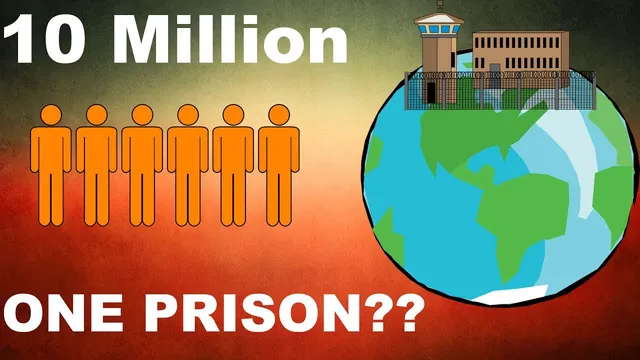
What if There Were Only One Prison on Earth?
Based on Second Thought's video on YouTube. If you like this content, support the original creators by watching, liking and subscribing to their content.
The US holds about 2.145 million prisoners out of a population of roughly 326 million, making it a per-capita outlier versus China’s ~1.6 million prisoners out of ~1.4 billion.
Briefing
The United States’ prison system stands out for scale and cost, and that contrast drives a provocative thought experiment: what would happen if every incarcerated person on Earth were housed in a single “mega prison”? Using global incarceration estimates of roughly 10.5 million people, the math turns an abstract policy debate into a concrete logistical problem—one that quickly becomes enormous in both land and staffing.
The comparison begins with incarceration rates across countries. With a total US population around 326 million, the US holds about 2.145 million prisoners. China, with nearly 1.4 billion people, has about 1.6 million prisoners—still huge, but far lower per capita than the US. Brazil follows with an estimated 69,000 prisoners, then Russia with about 622,000 and India with about 420,000. Together, the top five countries account for more than half of the world’s prison population.
Cost is the next pressure point. In 2015, the US Bureau of Prisons estimated an average annual cost of about $32,000 to hold one prisoner (around $88 per day). Some private or high-security facilities can reach close to or above $100,000 per prisoner per year. Overall, the US spends more than $80 billion annually to maintain its prison system, fueling calls for reform tied to overpopulation, racial bias, and runaway spending.
To estimate a worldwide mega facility, the thought experiment borrows space and staffing ratios from two US examples. Los Angeles County Jail—spread across seven facilities over 6,400 km—typically holds 17,000 to 20,000 inmates, implying roughly 0.33 square kilometers per inmate if land is divided by inmate count. By contrast, Louisiana State Penitentiary (“Alcatraz of the South”) holds about 6,300 prisoners and 18,800 staff but occupies about 72 square kilometers of land, which works out to about 0.01 square kilometers per inmate. Accounting for the fact that prisons need space not just for inmates but also for staff and support functions, the calculation averages these allowances to about 0.16 square kilometers per inmate.
Scaled to 10.5 million prisoners, that yields a required land area of about 1,680,000 square kilometers—described as roughly the combined size of Alaska and Minnesota. Staffing becomes even more striking: the inmate-to-staff ratio from the two examples averages to about 5.5 prisoners per staff member. Applying that ratio to 10.5 million inmates implies a workforce of about 1.91 million people.
The population mix would largely mirror current incarceration patterns: the largest shares would come from the US (about 20%), China (nearly 16%), and Brazil and Russia (about 6% each). Canada contributes about 0.4%, while England and Wales contribute about 8% and Australia about 4%. At the low end, Liechtenstein and San Marino are estimated at 10 and 2 prisoners respectively.
Finally, the cost projection compounds the scale problem. If the mega prison spent the US average annual housing cost per inmate, the yearly bill would be around $336 trillion. The premise is intentionally unrealistic, but it points toward what a global system would have to prioritize—less punishment and more rehabilitation—if it were ever to function at all.
Cornell Notes
The US’s incarceration footprint is unusually large and expensive, which motivates a “mega prison” thought experiment. Starting from a global prison population of about 10.5 million, the calculation scales land use and staffing needs using two US facilities as benchmarks. Averaging inmate space requirements from Los Angeles County Jail and Louisiana State Penitentiary yields about 0.16 square kilometers per inmate, implying roughly 1,680,000 square kilometers of land—about the size of Alaska plus Minnesota. Using an average inmate-to-staff ratio of about 5.5 to 1 produces a workforce of about 1.91 million. Applying US per-inmate annual housing costs suggests an annual price tag near $336 trillion, making the concept impractical but revealing the scale of incarceration systems.
Why does the US look like an outlier in incarceration compared with other countries?
How does the land-area estimate for a “world mega prison” get built from real facilities?
What staffing level does the mega prison require, and where does that ratio come from?
How would the inmate population be distributed across countries in this scenario?
Why does the cost estimate become so extreme?
Review Questions
- If global incarceration is about 10.5 million, what two inputs determine the mega prison’s land estimate in this model?
- Which country comparisons are used to justify that the US incarceration rate is unusually high, and what are the approximate prisoner counts?
- How does changing the inmate-to-staff ratio affect the workforce estimate for the mega prison?
Key Points
- 1
The US holds about 2.145 million prisoners out of a population of roughly 326 million, making it a per-capita outlier versus China’s ~1.6 million prisoners out of ~1.4 billion.
- 2
US prison costs are high: the Bureau of Prisons estimated about $32,000 per prisoner per year in 2015, with some facilities near or above $100,000.
- 3
A “mega prison” land estimate uses averaged space allowances derived from Los Angeles County Jail (~0.33 square km per inmate) and Louisiana State Penitentiary (~0.01 square km per inmate), producing ~0.16 square km per inmate.
- 4
Scaling ~0.16 square km per inmate to ~10.5 million prisoners implies about 1,680,000 square km of land—roughly the size of Alaska plus Minnesota.
- 5
Staffing scales from an average inmate-to-staff ratio of about 5.5 prisoners per staff member, implying a workforce of about 1.91 million.
- 6
The projected inmate mix would mirror current incarceration shares, led by the US (~20%) and China (nearly 16%), with smaller contributions from countries like Canada (~0.4%) and tiny shares from Liechtenstein and San Marino.
- 7
Using US per-inmate annual housing costs for all ~10.5 million prisoners yields an annual price tag around $336 trillion, underscoring the impracticality of the concept.