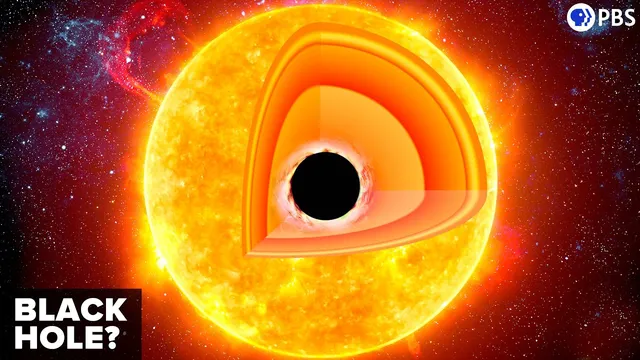
What If There's A Black Hole Inside The Sun? | Hawking Stars
Based on PBS Space Time's video on YouTube. If you like this content, support the original creators by watching, liking and subscribing to their content.
A primordial black hole captured inside a star can grow slowly, first creating a small convective region near the center and later taking over the star’s energy production.
Briefing
A captured primordial black hole inside a star would quietly change the star’s internal physics for billions of years—eventually forcing it into a “giant” phase early and in a distinctive way that could be detected through stellar vibrations. The payoff is bigger than one spooky scenario: if such Hawking stars exist, they could help pin down whether primordial black holes make up some or all of dark matter.
The idea traces back to Stephen Hawking’s 1971 work, which noted that a black hole with mass up to about 10^14 kg could hide in the Sun’s core without obvious immediate signatures. Hawking also raised the possibility that the early universe could have produced far smaller black holes—primordial black holes (PBHs). While a random black hole wandering into the solar system is extremely unlikely, a PBH already present in a star’s formation environment could be captured and then grow slowly from the inside.
The motivation for taking the scenario seriously comes from two longstanding puzzles. First, the “solar neutrino problem” once seemed to suggest the Sun might not be powered purely by fusion. A black hole engine was proposed as an alternative energy source: matter falling toward a black hole heats up and radiates, potentially reducing the need for fusion and therefore lowering neutrino production. That hypothesis lost its footing when neutrino oscillations were accounted for—detectors were only sensitive to one neutrino flavor—so the Sun’s neutrino output matches fusion expectations.
Second, dark matter remains unresolved. PBHs are one candidate class of dark matter, though observations rule out most PBH masses. A remaining window is roughly 10^14–10^20 kg (asteroid to medium-asteroid scale), where PBHs could still plausibly contribute. Gravitational-wave observations of black hole mergers also include features that some researchers have tried to interpret as possible PBH contributions.
New simulations—reported via two arXiv papers led by Earl Bellinger (Yale and the Max Planck Institute) and Matt Caplan (Illinois State)—model Sun-like stars that form around, or later capture, an asteroid-mass PBH. Because such a black hole is tiny (atom-sized in the model) with limited gravitational reach, it barely affects the star’s birth and early evolution. The PBH sinks to the center and begins feeding, heating a small central region (about 1% of the star’s radius, roughly Earth-sized). That region becomes convective and grows as the black hole grows.
Growth is throttled by feedback: energy radiated from the infalling material pushes back against new matter, and the black hole’s small “choke point” limits how quickly mass can be delivered. Over billions of years, the PBH can reach a size around 10 cm with a mass comparable to Uranus. A key transition follows when black hole power rivals fusion power in the rest of the core. The added energy disrupts the balance that normally keeps the core compact, causing the star’s outer layers to bloat and the core to expand and cool—shutting down fusion. The star then runs on black hole accretion rather than fusion.
The result is a Hawking star that can spend up to ~10 billion years looking like a rare “sub-subgiant” or “red straggler,” but with a maximum radius only about 4–5 times the Sun’s—smaller than the Sun’s typical red-giant expansion. Detection prospects hinge on asteroseismology: global oscillations depend on internal structure. A Hawking star’s deep convective motion would shift the harmonics compared with visually similar stars that have layered interiors. Current Sun observations don’t probe the deepest core well enough to rule out extremely small PBHs (down to around a millionth the Sun’s mass), but the team argues that any PBH large enough to matter would have altered neutrino production or core conditions beyond observational allowances.
Even if the Sun is almost certainly safe, the Milky Way’s hundreds of billions of stars make the broader test compelling. If PBHs exist in the allowed mass range, some stars should already be in the bloated Hawking phase. Finding them—or failing to—would tighten constraints on PBHs as dark matter, turning stars into detectors of warped spacetime.
Cornell Notes
Captured primordial black holes could form “Hawking stars” by growing slowly at a star’s center and eventually taking over the star’s energy budget. Simulations of Sun-like stars show that an asteroid-mass PBH initially has little effect, then creates a convective core region that expands as the black hole feeds. When black hole power matches fusion power, the star’s core expands, fusion shuts off, and the star enters a long-lived bloated phase (up to ~10 billion years) with a maximum radius only ~4–5 times the Sun’s. The key observational strategy is asteroseismology: the star’s vibrational harmonics would differ from visually similar giants because the interior structure is fundamentally altered. Non-detection would further limit how many primordial black holes could exist, including as a dark matter candidate.
Why did Hawking’s black-hole-in-a-star idea gain attention even though it was initially speculative?
How do the simulations describe the early life of a star that forms around, or captures, an asteroid-mass primordial black hole?
What limits how fast the black hole can grow inside the star?
What triggers the dramatic change into the Hawking-star bloated phase?
How would astronomers distinguish a Hawking star from a normal giant that looks similar?
What observational constraints apply specifically to the Sun?
Review Questions
- What physical mechanism causes fusion to shut off in a Hawking star, and when does that happen relative to the black hole’s growth?
- Why does asteroseismology provide a stronger detection route than relying only on a star’s color and radius?
- Which two observational puzzles—solar neutrinos and dark matter—help motivate the search for primordial black holes inside stars?
Key Points
- 1
A primordial black hole captured inside a star can grow slowly, first creating a small convective region near the center and later taking over the star’s energy production.
- 2
Accretion growth is self-limiting: feedback from radiation and a small “choke point” restrict how quickly matter can fall into an atom-sized black hole.
- 3
When black hole power matches fusion power, the star’s core expands, fusion stops, and the star enters a long-lived bloated phase powered by accretion.
- 4
Hawking stars should be detectable through asteroseismology because their internal structure changes the star’s global oscillation harmonics.
- 5
Neutrino observations constrain any black hole inside the Sun: a PBH massive enough to matter would likely have altered the Sun’s neutrino output beyond measurement uncertainties.
- 6
If primordial black holes make up dark matter in the remaining allowed mass window, some Milky Way stars should already be in the Hawking-star phase, enabling population-level tests.