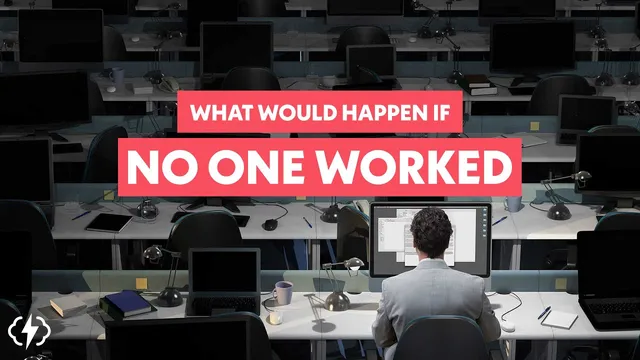
What If We Just...Stopped Working?
Based on Second Thought's video on YouTube. If you like this content, support the original creators by watching, liking and subscribing to their content.
Short-term “stop working” scenarios would cause immediate breakdowns, but the more actionable question is how much work can be reduced while preserving essentials.
Briefing
Stopping work tomorrow would trigger immediate chaos—empty shelves, idle cities, and a rapid collapse of services. But the more consequential question lurking behind that thought experiment is how far society could go toward *reducing* work without breaking the essentials. The answer depends less on whether work is necessary and more on how much of today’s labor is genuinely required versus socially enforced, poorly designed, or made meaningless by the way work is organized.
Several countries have tested shorter work weeks to see what happens when time on the job shrinks. Iceland’s experiments from 2015 to 2019 reduced working time for about 2,500 people from roughly 40 hours to around 35 hours per week, without salary cuts. Reported outcomes included higher happiness, lower burnout, and better overall health. The results helped drive broader change: more than 80% of people in Iceland either shortened their hours or gained the right to do so, with unions playing a central role. The underlying economic logic is also familiar—productivity tends to show diminishing returns the longer people work, so trimming hours can remove low-value labor rather than destroy output.
The transcript then pivots to why such reforms remain politically difficult, especially in the United States. Neither major party is pushing for a major reduction in working hours. “Work” is treated as dignity, respect, and community membership, not just a means to a paycheck. Even when people dislike their jobs, mainstream politics tends to defend the coercive structure that ties survival to employment: under capitalism, food, shelter, and healthcare generally require wages, so refusing work can mean starvation. That pressure is reinforced by ideology—phrases like “no pain, no gain” and “there’s no such thing as a free lunch”—which frames necessity as virtue.
A key claim is that many jobs feel alienating or pointless. Around a quarter of workers in the U.S. and U.K. report their jobs are completely meaningless, and many others can’t clearly identify any purpose. Beyond meaning, a large share of time at work is neither productive labor nor genuine downtime: private activities, “time theft” of various kinds, and busywork like spreadsheet shuffling, email responses, and reports that get filed away. The result is a “tremendous” waste of human time—people stuck at desks, performing the appearance of productivity to satisfy bosses and pad profits.
The transcript argues that this waste is not inevitable. Automation and industrialization have already removed many labor-heavy tasks, yet the 40-hour work week has barely changed for decades. The problem isn’t a lack of efficiency; it’s the absence of mechanisms to distribute work and protect those without jobs. With better allocation—deciding collectively how much labor is necessary and how much leisure society can afford—work could be smaller, fairer, and more meaningful.
To estimate how close society could get to reducing work, the transcript uses rough calculations: if 25% of work is meaningless, cutting those hours could move a 40-hour week toward about 32 hours. If 1.5 to 3 hours per day are wasted, that implies a work week in the neighborhood of 27 to 33 hours. The point isn’t precision; it’s that today’s work schedule is set by bargaining power and corporate preference rather than necessity and desire. The proposed end state isn’t “no work at all,” but a society where work is rewarding, fair, and no longer the gatekeeper to basic survival—freeing people for art, education, friendships, travel, volunteering, and even doing nothing.
Cornell Notes
The transcript argues that while work is necessary to keep society running, a large portion of modern employment is either meaningless, alienating, or wasted—so society could reduce working hours substantially without collapsing essential services. It cites international experiments, especially Iceland’s 2015–2019 trials, where shortening the work week improved happiness, health, and reduced burnout without pay cuts or productivity loss. It then connects the persistence of long hours to coercive economic conditions under capitalism and to ideology that treats work as dignity. Finally, it proposes that better collective decision-making about necessity and resource allocation—rather than employer-driven schedules—could move the typical work week toward roughly 32 hours (or even 27–33 hours) based on estimates of meaningless and wasted time.
Why does the transcript treat “stopping work” as a misleading question, and what question replaces it?
What evidence is offered that shorter work weeks can work in practice?
What keeps major political parties from pushing for shorter hours, even when many people dislike their jobs?
How does the transcript define “work” and “anti-work,” and what does it say the goal should be?
What kinds of time at work are described as wasted or misdirected?
How does the transcript estimate how much the work week could shrink?
Review Questions
- What mechanisms does the transcript claim prevent productivity gains from translating into shorter work weeks?
- How does the transcript connect job meaning (or lack of it) to alienation and reduced willingness to work?
- What collective decision-making changes does the transcript propose to disentangle work from survival necessity?
Key Points
- 1
Short-term “stop working” scenarios would cause immediate breakdowns, but the more actionable question is how much work can be reduced while preserving essentials.
- 2
Iceland’s 2015–2019 trials reduced working time for about 2,500 people without pay cuts and reported improvements in happiness, health, and burnout.
- 3
U.S. politics largely avoids major hour reductions because work is framed as dignity and because survival under capitalism depends on wages.
- 4
A substantial share of paid time is described as meaningless, alienating, or busywork—such as spreadsheet shuffling, email handling, and reports that go unused.
- 5
Automation has increased productivity, yet the 40-hour work week has barely changed, implying the bottleneck is distribution and governance, not human capacity.
- 6
The transcript argues for collective, democratic decisions about necessary labor and leisure, rather than employer-set schedules driven by top-down preferences.
- 7
Using rough estimates of meaningless and wasted time, the transcript suggests the work week could plausibly move toward about 32 hours, or even 27–33 hours.