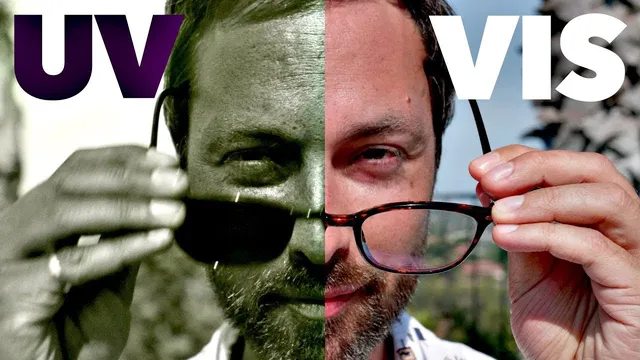
What if you could only see the world in UV?
Based on Veritasium's video on YouTube. If you like this content, support the original creators by watching, liking and subscribing to their content.
UV cameras expose different material behavior because ultraviolet light interacts with matter through different molecular and electronic transitions than visible light.
Briefing
Ultraviolet (UV) vision turns everyday objects into a high-contrast map of chemistry—revealing hidden pigments, fluorescence, and biological protection mechanisms that ordinary eyesight can’t detect. In visible light, many materials look uniform; in UV, they can flip from transparent to opaque, from dark to glowing, and from indistinct to sharply detailed. That shift matters because UV light interacts with matter in ways that directly relate to molecular structure and DNA risk, making UV cameras both a scientific tool and a practical guide for understanding skin damage and protection.
A first surprise comes from how “normal” transparency can fail under UV. UV-blocking glasses appear almost black in UV because they absorb ultraviolet wavelengths that pass through in visible light. The reverse happens with a UV pass filter: it looks black in visible light because it blocks visible wavelengths, yet it becomes translucent in UV because it allows UV through. These examples show that UV is not just “visible light with shorter wavelengths”—it probes different electronic transitions in materials.
The next shock is fluorescence. Tonic water glows under UV because it contains quinine, a molecule that absorbs UV and re-emits energy as visible light. Soda water, lacking quinine, stays dark in the UV view. Laundry detergents often rely on similar fluorescent additives: they absorb UV (a wavelength you can’t see) and re-radiate it as visible light, which can make clothes look brighter to human eyes while making them appear darker in UV because the UV energy is being consumed and converted.
Plants and animals add another layer. Many flowers contain UV-absorbing pigments that look nearly black in UV but are invisible in visible light—an adaptation tied to pollinators like bees that can see UV. Human skin shows an even more consequential version of the same principle: melanin absorbs UV strongly, so skin appears darker in UV cameras than in visible cameras. Melanin is produced by melanocytes after UV exposure and is transported into the cell nucleus as a protective cap, reducing UV penetration where DNA sits.
UV imaging also has real-world applications beyond biology. In Arctic wildlife surveys, harp seal pups can be difficult to spot in visible light because their white fur blends with snow, but they absorb UV and become easier to distinguish from adults in UV photographs. Similar logic applies to detecting other UV-absorbing animals like arctic foxes and polar bears.
Finally, the hazy “fog” effect in UV isn’t caused by UV-absorbing pollution. Atmospheric absorption is minimal in the UV; instead, Rayleigh scattering dominates. Because scattering increases sharply as wavelength decreases (roughly proportional to 1/λ⁴), UV light is scattered much more than visible light, producing a blue haze-like veil when viewed from the ground.
The practical takeaway is protection: UV can damage DNA and drive cancers and other diseases, so sunscreen acts as a functional barrier by absorbing or reflecting UV and converting it into heat. Seeing the world in UV doesn’t just change colors—it exposes the molecular and atmospheric processes that shape what’s safe, what’s hidden, and what’s alive.
Cornell Notes
Ultraviolet cameras reveal how materials respond to UV light, often in ways that invert what people expect from visible light. UV pass and UV-blocking optics can swap roles because UV interacts with different electronic transitions than visible light. Fluorescent substances such as quinine in tonic water and optical brighteners in laundry detergents absorb UV and re-emit visible light, producing “glow” effects. Melanin absorbs UV most strongly, darkening skin in UV images and helping protect DNA by limiting UV penetration into the nucleus. Even the UV haze in the sky comes largely from Rayleigh scattering, which increases dramatically at shorter wavelengths, not from UV-absorbing pollution.
Why can UV-blocking glasses look almost black in UV while appearing transparent in visible light?
How does tonic water end up bright in UV while soda water stays dark?
What role do fluorescent additives in laundry detergents play in UV images?
Why does skin look darker in UV cameras, and how does melanin protect DNA?
What makes the sky look hazy in UV—absorption by the atmosphere or something else?
How does UV photography help with counting Arctic harp seals?
Review Questions
- Give two examples of objects whose appearance flips between visible and UV, and explain the physical reason for each.
- Describe how fluorescence changes what a UV camera records, using quinine and laundry detergents as examples.
- Explain why UV visibility in the atmosphere drops, and connect it to Rayleigh scattering’s wavelength dependence.
Key Points
- 1
UV cameras expose different material behavior because ultraviolet light interacts with matter through different molecular and electronic transitions than visible light.
- 2
UV-blocking and UV-pass filters can appear to swap “black” and “transparent” roles depending on which wavelength band they transmit or absorb.
- 3
Fluorescent molecules convert absorbed UV into visible light, producing bright “glow” effects such as quinine in tonic water.
- 4
Melanin absorbs ultraviolet strongly and is transported to the nucleus to help shield DNA from UV penetration.
- 5
UV imaging can improve wildlife surveys by exploiting UV-absorbing camouflage differences, such as harp seal pups against snow.
- 6
The hazy UV look of the sky is driven largely by Rayleigh scattering, which increases sharply at shorter wavelengths.
- 7
Sunscreen reduces UV damage by absorbing and/or reflecting UV and converting it into heat, functioning as a protective barrier similar in effect to melanin’s UV absorption.