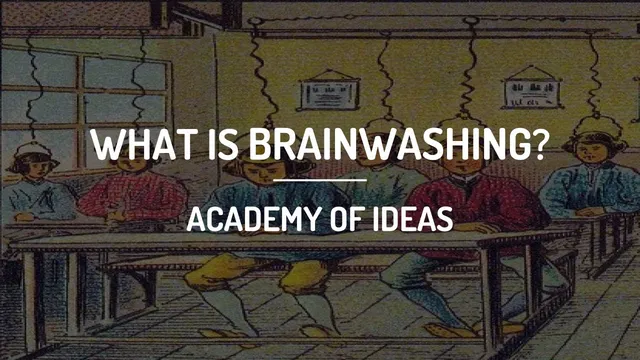
What is Brainwashing?
Based on Academy of Ideas's video on YouTube. If you like this content, support the original creators by watching, liking and subscribing to their content.
“Brainwashing” is framed as an extreme, rapid replacement of established beliefs, not ordinary persuasion.
Briefing
Brainwashing is portrayed as an extreme, rapid form of thought control—less about persuasion and more about breaking a person’s mental stability so new beliefs can be installed quickly. The account traces the term’s origin to the Korean War, when American prisoners of war returned preaching Communist virtues instead of recounting abuses. U.S. officials brought in CIA operative Edward Hunter to investigate, and Hunter coined “brainwashing” to describe a process attributed to Chinese captors: radically changing a captive’s mind so the person becomes a “living puppet,” with new thought patterns and beliefs inserted into the body.
From there, the discussion sharpens what makes brainwashing distinct from ordinary influence. A working definition is offered via the Oxford English Dictionary: systematic, often forceable elimination of established ideas so another set can replace them. Because people are constantly exposed to attempts to shape beliefs, brainwashing is framed as the radical end of that spectrum—distinguished by two features of victims. First, the new beliefs are drastically different from prior convictions, sometimes directly opposite. Second, the shift happens not gradually over months or years but in a short time span, even instantaneously.
To explain how such sudden conversions might occur, the narrative leans on William Sergeant’s hypothesis that political brainwashing is not fundamentally different from religious conversion or psychotherapy—each involves a rapid “conversion” of identity and deeply held attitudes. Sergeant’s key insight is that the mechanism may be physiological and psychological rather than purely rhetorical. That leads to Ivan Pavlov’s experiments on dogs under extreme physical and emotional stress. Pavlov observed that heavy stress could produce a hysterical breakdown: conditioned behaviors could disappear, and newly conditioned behaviors could become deeply embedded and hard to remove. The implication drawn is stark—under overload, a “dog-like man” can be conditioned to hate what was once loved and love what was once hated, not only through indoctrination but by inducing intolerable strain that leaves the person highly suggestible.
The account then connects intense emotion to conversion. William James is cited for the idea that explosive emotional experiences—love, jealousy, guilt, fear, remorse, anger—can trigger mental rearrangements that rarely return to the prior state. Historical religious practice is used as an example: John Wesley’s sermons are described as deliberately provoking fear and anxiety about eternal hellfire until listeners collapsed from emotional exhaustion, after which they were offered salvation and comfort. The same emotional-collapse logic is extended to psychiatry, where Sergeant is said to have used anger and anxiety to erase neurotic thoughts—while warning that the same tools, in the wrong hands, can become instruments of manipulation.
Finally, fear is treated as a primary engine of mass control. The narrative points to Nazi propaganda and modern government threat reporting as ways to keep populations in continual alarm, making citizens more suggestible and more willing to accept policies framed as safety. It closes with Sergeant’s recommended countermeasure: not fear or indignation, but indifference mixed with amusement—humor as a stabilizer that resists emotional overload and undermines attempts to “break down” judgment. In this framing, the safety of a free society depends less on courage alone than on the ability to laugh at the ridiculousness of fear-based coercion.
Cornell Notes
Brainwashing is defined as an extreme, rapid attempt to replace a person’s established beliefs—often by forceful removal—rather than ordinary persuasion. The discussion argues that sudden political or religious “conversion” can be understood through shared psychological mechanisms: intense emotional stress can overload the mind, produce a breakdown, and leave the person highly suggestible. Pavlov’s dog experiments under extreme stress are used to illustrate how conditioned responses can vanish and new ones can become deeply embedded. Historical examples (like John Wesley’s hellfire sermons) and parallels to psychotherapy (anger/anxiety used to disrupt neurotic patterns) show how emotional collapse can be used either therapeutically or manipulatively. The antidote offered is emotional detachment—indifference and humor—to resist fear-driven control.
How does the account distinguish brainwashing from everyday attempts to influence beliefs?
Why does the narrative connect political brainwashing to religious conversion and psychotherapy?
What role do Pavlov’s stress experiments play in the explanation?
How are intense emotions portrayed as a mechanism for rapid belief change?
What warning does the account give about using emotional breakdown techniques?
What counter-strategy does the narrative recommend against fear-based control?
Review Questions
- What two features of victims are used to define brainwashing as an extreme form of belief change?
- How do Pavlov’s observations about stress-induced breakdown and re-conditioning support the explanation of sudden conversion?
- Why does the account treat humor and indifference as protective, and how does that relate to fear-based political messaging?
Key Points
- 1
“Brainwashing” is framed as an extreme, rapid replacement of established beliefs, not ordinary persuasion.
- 2
The account distinguishes brainwashing by two victim traits: antithetical new beliefs and a fast—sometimes instantaneous—shift.
- 3
Sergeant’s conversion framework treats political, religious, and therapeutic belief changes as sharing underlying psychological mechanisms.
- 4
Pavlov’s dog experiments under extreme stress are used to argue that overload can erase prior conditioned behaviors and make new ones hard to remove.
- 5
Intense, explosive emotions are presented as a practical lever for triggering sudden mental rearrangements.
- 6
Emotional-collapse techniques can be therapeutic in controlled settings but become dangerous when used for manipulation or mass control.
- 7
Fear-based threat messaging is described as a method for keeping populations suggestible, with humor offered as a resistance strategy.