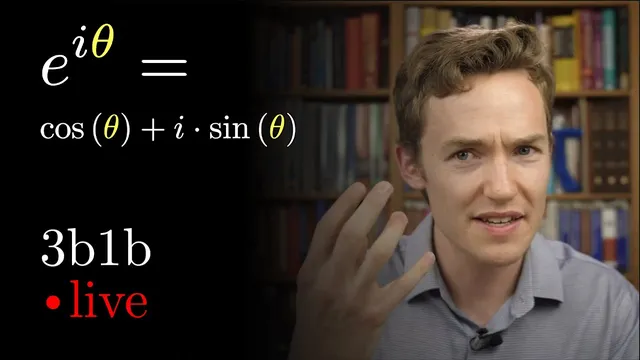
What is Euler's formula actually saying? | Ep. 4 Lockdown live math
Based on 3Blue1Brown's video on YouTube. If you like this content, support the original creators by watching, liking and subscribing to their content.
Treat e^{x} as the exp function defined by the power series 1 + x + x^2/2! + x^3/3! + …, not as repeated multiplication of the constant e.
Briefing
Euler’s formula stops being a mysterious “imaginary exponent” once the exponential function is treated as a specific power series (exp), not as repeated multiplication of the constant e. With that shift, the identity e^{iθ} = cos(θ) + i sin(θ) becomes a concrete claim about what the series does in the complex plane: the terms rotate by powers of i (quarter-turn steps) while their lengths shrink according to θ^n/n!, and the infinite vector sum lands exactly on the unit circle at angle θ.
The lesson begins by anchoring complex numbers on the unit circle: a complex number one unit from the origin at angle θ has real part cos(θ) and imaginary part i sin(θ), which is why cos(θ) + i sin(θ) is the natural “polar-to-Cartesian” form. The familiar shorthand e^{iθ} is then introduced—but immediately challenged. Many people interpret e^{x} as “multiply e by itself x times,” which breaks down for non-integer and especially imaginary inputs. Instead, exp(x) is defined as the infinite series 1 + x + x^2/2! + x^3/3! + …, where the factorial in the denominator makes the series converge and gives exp(x) a precise meaning for all real x.
From that series, a key structural property emerges: exp(a+b) = exp(a)·exp(b). This isn’t obvious from the notation “e^{x},” but it follows from how the factorial-weighted terms expand and recombine. The instructor uses a live multiple-choice reasoning exercise to show that this functional equation forces strong consequences—such as exp(5) = exp(1)^5 and exp(1/2)^2 = exp(1)—and highlights a subtle point: the value exp(0) = 1 is not automatic for every function satisfying exp(a+b)=exp(a)exp(b); it’s a specific feature of the exp function defined by the series.
Only after that foundation is laid does the discussion move to complex inputs. Powers of i cycle every four steps: i^1 = i, i^2 = −1, i^3 = −i, i^4 = 1, and then repeat. Plugging iθ into the exp series produces a sum of vectors whose directions follow that four-step rotation pattern, while magnitudes are governed by θ^n/n!. A visualization for θ = 1 (i.e., exp(i)) and a computational check in Python illustrate that the real and imaginary parts land where cos(θ) and sin(θ) predict.
The famous special case θ = π yields e^{iπ} = −1. The explanation emphasizes why this is less about the constant 2.71828 “showing up” directly and more about exp’s defining series: the computation of exp(iπ) never needs to insert 2.71828 explicitly. What matters is that exp(x) behaves like a function whose real inputs match the conventional e^{x} shorthand, while complex inputs trace circles. The takeaway is that Euler’s formula is a statement about exp’s geometry—its complex values move around the unit circle with angle θ—setting up the next lecture’s deeper reason for the circular motion.
Cornell Notes
Euler’s formula becomes understandable once “e^{x}” is treated as the exp function defined by the power series 1 + x + x^2/2! + x^3/3! + … . That series implies a crucial functional identity: exp(a+b) = exp(a)·exp(b), which explains why exponent notation works for real inputs and why it’s not really about repeated multiplication of the constant e. In the complex plane, plugging in iθ makes each term rotate by powers of i (cycling every four steps) while its length shrinks by θ^n/n!. The infinite vector sum therefore lands on the unit circle at angle θ, giving e^{iθ} = cos(θ) + i sin(θ) and in particular e^{iπ} = −1. This matters because it turns a “convention” into a precise geometric consequence of the exp series.
Why is it misleading to think of e^{x} as “e multiplied by itself x times,” especially for imaginary x?
What property does exp(x) satisfy that makes exponent rules feel inevitable?
Does exp(a+b)=exp(a)exp(b) automatically force exp(0)=1?
How do powers of i control the directions of terms in exp(iθ)?
Why does the infinite sum stay on the unit circle rather than wandering off?
What’s the conceptual meaning of e^{iπ} = −1 in this framework?
Review Questions
- If exp(a+b)=exp(a)exp(b) holds, what must be true about exp(3) in terms of exp(1)? What about exp(−1) in terms of exp(1)?
- Using the cycle of i^n, list i^n for n=0,1,2,3,4 and describe how this would affect the direction of terms in exp(iθ).
- Explain, in terms of θ^n/n! and i^n, why the terms in exp(iθ) should converge and why the result should have magnitude 1.
Key Points
- 1
Treat e^{x} as the exp function defined by the power series 1 + x + x^2/2! + x^3/3! + …, not as repeated multiplication of the constant e.
- 2
The series definition yields the functional equation exp(a+b)=exp(a)exp(b), which underpins standard exponential rules.
- 3
The value exp(0)=1 is specific to the exp series; the functional equation alone does not force every function with that property to satisfy it.
- 4
In exp(iθ), each term’s direction is controlled by i^n, which cycles every four powers: i, −1, −i, 1.
- 5
Each term’s length is scaled by θ^n/n!, and the factorial growth makes the infinite sum converge.
- 6
Euler’s formula e^{iθ}=cos(θ)+i sin(θ) follows as the real and imaginary parts of the convergent vector sum on the unit circle.
- 7
The famous identity e^{iπ} = −1 is best understood as a geometric consequence of exp’s series behavior, not as a direct computation involving 2.71828.