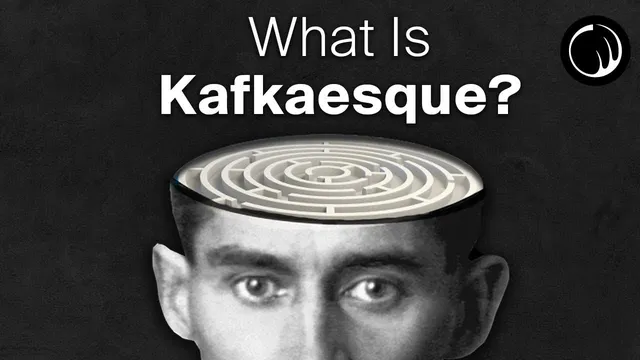
What Is Kafkaesque? - The 'Philosophy' of Franz Kafka
Based on Pursuit of Wonder's video on YouTube. If you like this content, support the original creators by watching, liking and subscribing to their content.
Kafkaesque describes an experience of opaque, arbitrary systems, not just the presence of bureaucracy.
Briefing
Kafkaesque is more than a shorthand for oppressive bureaucracy: it’s a lived feeling—sudden, unexplained powerlessness inside systems that don’t explain themselves, where people keep trying even after success becomes impossible. The term is rooted in Franz Kafka’s fiction, but the emotional logic behind it traces back to his life: a childhood shaped by an exacting father, a compulsion to write as anxiety management, and years spent trapped in paperwork-heavy work that mirrored the senseless machinery his characters later faced.
Kafka was born in Prague in 1883 to Hermann and Julie Kafka. Hermann, a self-made businessman who rose into higher middle society, wanted a son who matched his ideal. Franz arrived small, anxious, and sickly—an outcome that made him a “disappointment” and a psychological target. As adolescence deepened, Kafka turned to writing to cope with mounting guilt, anxiety, and self-hatred. His father blocked that path, pushing him into law. Even so, Kafka kept writing while studying and later met Max Brod, one of his few close friends. Brod encouraged him to publish early collections, which sold poorly and went largely unnoticed.
After college, Kafka worked in a law office and then at an insurance company. The job brought long hours, unpaid overtime, mountains of paperwork, and labyrinthine bureaucratic procedures—conditions that left him miserable. Yet he continued writing on the side, producing major works such as The Trial, The Castle, and America. He did not seek publication for these novels and often left drafts unfinished, convinced they were unworthy. He died in 1924 at age 41 of tuberculosis, still believing his work was not good enough. In a final instruction, he told Brod to burn his unpublished manuscripts; Brod ignored that request, organized the papers, and helped bring Kafka’s writing to the world. Over the following decade, Kafka became a defining literary and philosophical figure of the 20th century.
Kafkaesque writing crystallizes in stories like The Trial and Metamorphosis. In The Trial, Joseph K. is arrested without explanation and dragged through a disorderly process where the logic never arrives; by the end, he remains convicted without ever learning why. In Metamorphosis, Gregor Samsa wakes transformed into an insect and still must confront the practical demands of work, a boss, and a family that depends on him—demands he cannot meet. Both narratives hinge on abrupt absurdity, missing explanations, and obstacles that can’t be understood or controlled. The core conflict becomes an encounter between human reasoning and senseless constraints: people strive to make sense of the world, but their efforts can’t resolve the underlying absurdity.
One interpretation frames Kafka’s work as a portrait of the human condition under existential pressure—an insistence on answers paired with an inability to gain mastery over the source of suffering. Yet Kafka’s characters often don’t quit at first. They keep reasoning, fighting, and trying to work their way out, even when the outcome is predetermined. That tension—between the urge to struggle and the likelihood of failure—helps explain why Kafka’s influence endures. His writing doesn’t offer comfort through easy remedies; it forces direct confrontation with darker self-knowledge, giving readers a way to recognize their own “Kafkaesque” moments and feel less alone.
Cornell Notes
Kafkaesque describes more than bureaucracy; it captures the emotional experience of being trapped in systems that are arbitrary, opaque, and indifferent to explanation. Franz Kafka’s life—an anxious childhood under Hermann Kafka’s pressure, blocked ambitions, and years in paperwork-heavy work—fed the themes that later surfaced in The Trial and Metamorphosis. Joseph K. faces an arrest with no reason and a trial that never clarifies guilt, while Gregor Samsa wakes as an insect and still must meet work and family obligations he can’t possibly satisfy. Across both stories, characters confront absurd constraints they can’t understand or control, and their efforts to reason their way out often fail. The lasting impact lies in how this bleak logic resonates with ordinary, widely shared anxieties about guilt, anxiety, and powerlessness.
How does Kafkaesque differ from a simple description of “bad bureaucracy”?
What do The Trial and Metamorphosis have in common structurally?
Why does Kafka’s personal biography matter to the themes in his writing?
What role does Max Brod play in Kafka’s legacy?
What is one interpretation of why Kafka’s characters keep trying?
How does Anne Rice’s quoted perspective connect to Kafka’s effect on readers?
Review Questions
- In The Trial, what does Joseph K. never receive, and how does that absence shape the meaning of the conviction?
- How do Gregor Samsa’s responsibilities (work, boss, family support) intensify the absurdity of his transformation in Metamorphosis?
- Which parts of Kafka’s life—family dynamics, blocked ambitions, or bureaucratic work—most plausibly feed the emotional logic of Kafkaesque?
Key Points
- 1
Kafkaesque describes an experience of opaque, arbitrary systems, not just the presence of bureaucracy.
- 2
Franz Kafka’s anxiety and guilt were shaped early by Hermann Kafka’s pressure and disappointment, while writing became his coping mechanism.
- 3
Kafka’s insurance-company work—long hours, unpaid overtime, and complex paperwork—mirrored the procedural entrapment central to his fiction.
- 4
The Trial uses an unexplained arrest and an incomprehensible process to leave Joseph K. convicted without ever learning why.
- 5
Metamorphosis turns an unexplained transformation into a continuing trap by forcing Gregor Samsa to face work and family obligations he cannot meet.
- 6
Kafka’s deathbed instruction to burn unpublished manuscripts was ignored by Max Brod, enabling Kafka’s posthumous rise.
- 7
A common interpretation of Kafkaesque is that the urge to seek answers and struggle persists even when resolution is impossible.