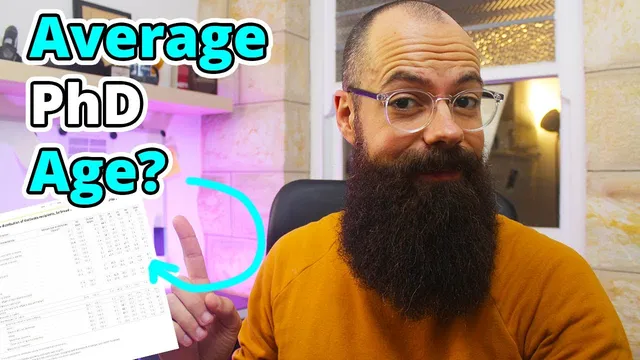
What is the average age of PhD graduates by discipline? (US data)
Based on Andy Stapleton's video on YouTube. If you like this content, support the original creators by watching, liking and subscribing to their content.
U.S. discipline data show PhD graduation age varies widely, with physical/earth sciences lowest (29.6) and education highest (38.2).
Briefing
PhD graduation age varies sharply by discipline in U.S. data—ranging from the late 20s in physical and earth sciences to the late 30s in education—challenging the common assumption that “a PhD is usually earned around the same age.” The data cited from the National Center for Science and Engineering Statistics puts the youngest discipline-specific graduation group at 29.6 years for physical sciences and earth sciences. From there, ages rise across fields, with education topping out at 38.2. Chemistry sits in the younger end of the spread (the narrator’s own experience is described as graduating around 25, which is framed as unusually young compared with the discipline averages).
The discipline gap is tied to career pathways. Education, in particular, often attracts people who spend years teaching first and then pursue a doctorate later to shift toward policy, leadership, or broader impact beyond the classroom. That pattern helps explain why education PhDs cluster at older ages: many candidates are already established in professional roles and return to graduate study with different motivations and constraints than someone moving straight from undergraduate.
The discussion then pivots to whether older candidates should worry about timing. There’s a clear message: age alone isn’t a barrier, and “right reasons” matter more than “right age.” The “right reasons” include using a PhD to access higher levels of pay, management, or promotion that require advanced credentials, or to go deep on a topic that genuinely matters. The transcript also warns against a “wrong reason” framing—treating a PhD as an escape from a bad job or situation.
A major theme is realism about academia’s incentives. Attempts to “rock the system” from inside academia are portrayed as largely incompatible with how universities operate day-to-day. The process is described as a political, rules-driven game where supervisors and institutions expect candidates to follow established norms; pushing too hard against those norms can backfire, including through stalled progress or damaged professional relationships. The transcript distinguishes between contributing genuinely new and novel knowledge to a field—which can change it—and trying to dismantle systems from within.
For mature-age applicants, several practical strategies are offered. Part-time study is presented as a viable entry point, especially for research-based degrees, allowing candidates to test commitment before moving full-time. A “professional PhD” model is also highlighted, where work continues while university research runs alongside it, often extending timelines but preserving financial and life stability.
The transcript also emphasizes mindset and support. Older candidates may need to adopt an “apprentice mindset,” even when real-world experience makes critique feel obvious; supervisors can become institutionally focused and may offer feedback that doesn’t match outside experience. Finally, mature students are urged to secure support networks—partners, family, work—because a PhD is portrayed less as a series of inspirational breakthroughs and more as a stressful, emotionally draining job that can affect identity and confidence when things go wrong. Financial planning is treated as essential, particularly for those with mortgages and family responsibilities, since reduced earnings can last for years.
Cornell Notes
U.S. data show that the average age at which PhD graduates finish depends strongly on discipline, with physical and earth sciences lowest (29.6) and education highest (38.2). The differences are linked to career pathways, especially in education where many candidates teach first and return later for policy or leadership goals. Age itself isn’t treated as a disqualifier; the more important factor is pursuing a PhD for the right reasons, such as deep interest or credential-driven career advancement. Mature students are advised to consider part-time or professional PhD options, adopt an apprentice mindset with supervisors, and build strong personal and financial support because a PhD is a demanding, emotionally taxing job over an extended period.
How do discipline-specific graduation ages differ in the U.S. data, and what are the extremes?
Why does education tend to produce older PhD graduates than many other fields?
What counts as a “right reason” to pursue a PhD, and what counts as a “wrong reason”?
Why does the transcript discourage trying to “rock the system” from inside academia?
What practical options are suggested for mature-age candidates who aren’t ready for full-time commitment?
What support and mindset changes are emphasized for older PhD students?
Review Questions
- Which disciplines are identified as having the youngest and oldest PhD graduation ages in the cited U.S. data, and what does that imply about typical timelines?
- What strategies does the transcript recommend for mature-age candidates who want flexibility (e.g., part-time or professional PhD models)?
- How does the transcript connect supervisor feedback and institutional expectations to the “apprentice mindset” mature students may need?
Key Points
- 1
U.S. discipline data show PhD graduation age varies widely, with physical/earth sciences lowest (29.6) and education highest (38.2).
- 2
Career pathways help explain the gap: education often attracts candidates who teach first and return later for policy or leadership goals.
- 3
Age alone isn’t the deciding factor; choosing a PhD for purposeful reasons matters more than worrying about being older than the “typical” cohort.
- 4
Academia is described as a political, rules-driven environment where trying to dismantle systems from inside can backfire.
- 5
Part-time study and professional PhD models are practical options for mature candidates who want to test commitment or maintain employment.
- 6
Mature students may need to adopt an apprentice mindset to work effectively with institutional supervisors and feedback.
- 7
Strong personal and financial support networks are essential because a PhD is portrayed as a demanding, emotionally draining job over an extended period.