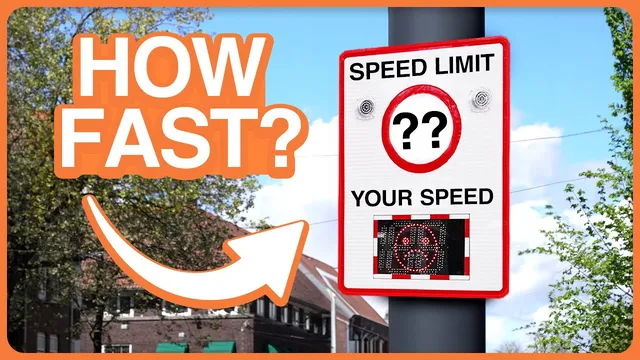
What is the "Correct" Speed Limit?
Based on Not Just Bikes's video on YouTube. If you like this content, support the original creators by watching, liking and subscribing to their content.
Amsterdam’s 30 km/h street-limit rollout is presented as a safety and public-health strategy, not just a signage change.
Briefing
Amsterdam’s shift to a citywide 30 km/h speed limit on many streets is being framed as a practical safety and health move: lower speeds sharply reduce the odds of death, cut noise, and make street design work better for walking and cycling. The change matters because it tackles multiple harms at once—crashes, exposure to traffic noise, and the broader friction that discourages people from using space on foot or by bike.
The most immediate justification is safety for people outside vehicles. At 30 km/h, a person struck by a car has a roughly 95% chance of survival, while fatality risk rises quickly as speed increases. The physics behind that jump is “kinetic energy,” which scales with the square of speed—so even modest increases in speed translate into much larger impact energy. The argument also points to vehicle mass: modern cars and trucks have become heavier, meaning the same kinetic-energy logic can produce worse outcomes when speed limits remain high. Lowering limits from 50 to 30 km/h is presented as reducing impact energy by about two-thirds, which aligns with observed differences in fatality rates between 30 and 50.
Noise is the second pillar. Vehicle sound is split into driving noise (engine, exhaust, drivetrain, braking) and rolling noise (tire–road friction). Rolling noise grows with speed and can overtake driving noise around 30 km/h. The result is that switching many streets to 30 km/h is expected to cut noise roughly in half on those segments—an outcome that matters for public health and quality of life.
Beyond crash severity and noise, the case extends to how traffic actually moves in dense areas. Higher speed limits don’t necessarily produce higher average speeds because urban travel is dominated by stops—especially red lights, turning conflicts, and merging. A comparison from Breanard, Minnesota (population under 15,000) illustrates the point: a road posted at 35 mph (56 km/h) produced an average speed around 10 mph (16 km/h) due to frequent red lights. The argument is that slower speeds allow safer intersection control—like yielding rules and simpler priority schemes—often reducing the need for signalized control.
The discussion also addresses common objections. One claim is that lower limits cause gridlock; the counter is that street efficiency in cities should prioritize moving people safely rather than maximizing vehicle throughput. Another objection is fuel economy: while some cars run efficiently near 60 km/h, the broader environmental cost falls on everyone. The proposed remedy is to reduce the number of car trips in city centers—using park-and-ride facilities at the edge—so more trips shift to walking, cycling, and public transit.
Finally, the transcript cites international results to support the policy direction: Brussels reported 25% fewer serious injuries and deaths after lowering many streets to 30 km/h; Edinburgh saw about a 40% drop in crashes and reductions in deaths and serious injuries after moving to 20 mph (32 km/h). Even New York’s partial reduction to 25 mph (40 km/h) was linked to a 22% drop in traffic deaths and a 25% drop in pedestrian deaths. The overall takeaway is that 30 km/h should be a starting point, with some residential zones potentially needing even lower limits (like 20 km/h), while certain protected or pedestrian-free corridors can remain higher.
The closing section adds a media-literacy angle, arguing that resistance to speed-limit changes can be amplified by interests tied to cars, insurance, and oil, and recommending Ground News as a way to compare coverage and detect bias.
Cornell Notes
Amsterdam’s move to lower many urban street limits to 30 km/h is presented as a multi-benefit policy grounded in crash physics, noise science, and real-world traffic behavior. Safety is emphasized: at 30 km/h, struck pedestrians have about a 95% survival chance, and fatality risk rises steeply with speed because kinetic energy increases with the square of velocity. Noise is also expected to drop because rolling tire noise grows with speed and becomes dominant around 30 km/h. The transcript argues that slower limits can improve “average” travel time in cities by reducing conflict speeds and enabling intersection designs that rely less on signals. International case studies (Brussels, Edinburgh, and New York) are cited to support reductions in crashes, deaths, and serious injuries.
Why does reducing speed from 50 km/h to 30 km/h get treated as a major safety lever?
How does noise change with speed, and why does 30 km/h show up as a threshold?
Why might lower speed limits improve traffic flow rather than worsen it?
What is the argument against the idea that “cars are more fuel-efficient at some speeds,” and what alternative is proposed?
How does the policy handle different street types—arterials versus residential areas?
What evidence is cited from other cities to support the speed-limit reductions?
Review Questions
- What physical relationship between speed and crash impact severity is used to justify lower urban limits?
- How does the transcript connect rolling tire noise to the choice of 30 km/h?
- Why does the transcript claim that higher posted speed limits may not increase average travel speed in city centers?
Key Points
- 1
Amsterdam’s 30 km/h street-limit rollout is presented as a safety and public-health strategy, not just a signage change.
- 2
Crash fatality risk rises steeply with speed because kinetic energy scales with the square of velocity.
- 3
Rolling tire noise grows with speed and can dominate around 30 km/h, supporting expected noise reductions.
- 4
Lower limits can improve real-world urban movement by enabling safer intersection designs that reduce stop-and-go delays.
- 5
City street design should prioritize moving people safely (walking, cycling, transit) rather than maximizing vehicle throughput.
- 6
Fuel-economy arguments are countered by shifting trips away from city centers using park-and-ride and mode shift.
- 7
International results from Brussels, Edinburgh, and New York are cited to show reductions in crashes, deaths, and serious injuries after lowering speed limits.