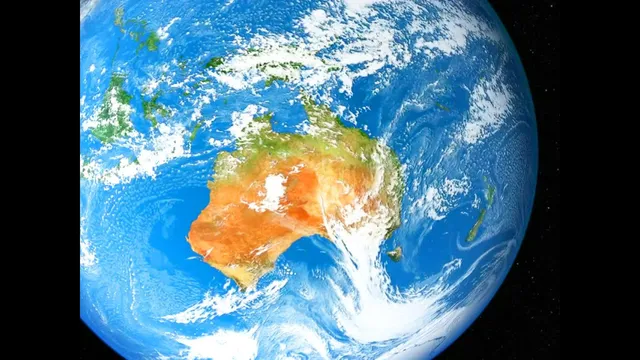
What Is The Earth Worth?
Based on Vsauce's video on YouTube. If you like this content, support the original creators by watching, liking and subscribing to their content.
Earth’s “Moon” status is definition-dependent: 2006 RH120 temporarily became a second natural satellite of Earth from September 2006 to June 2007.
Briefing
Earth’s “price tag” depends less on how much stuff the planet contains and more on whether anyone would ever want to buy it—and on what “ownership” even means across species. The transcript starts by challenging quick, literal answers: Earth doesn’t have just one “Moon.” In addition to the Moon, a near-Earth asteroid, 2006 RH120, temporarily fell into Earth orbit from September 2006 to June 2007, becoming a second natural satellite for about 13 months. That detail sets up a broader theme: categories like “Moon” and even “planet value” are fuzzier than they sound.
From there, the discussion pivots to valuation. One approach, credited to astrophysicist Greg Loughman of the University of California, Santa Cruz, uses an equation for exoplanets that weighs habitability, how easily a planet can be studied, and how much money has already been spent searching for similar worlds. Solving for Earth lands at roughly five quadrillion dollars—an estimate framed as relative to the search effort and what is known about exoplanets. A separate “resource accounting” method, associated with The History Channel, totals Earth’s materials—water, lumber, granite—at about seven quadrillion dollars using current market prices.
Other calculations go even more granular. If Earth’s elements were isolated and priced individually, the transcript cites an estimate of about two thousand dollars for the material in a human body. A Reddit user, Shady Potato, then applies a similar “mine everything” logic to Earth, arriving at 15.8 sextillion dollars, assuming prices don’t change and supply constraints don’t matter. These figures share a common weakness: they ignore supply and demand. If interstellar buyers had quadrillions or sextillions to spend, they’d be shopping in a vastly larger market, not competing with Earth’s limited local scarcity.
So the transcript shifts from “what is Earth worth on Earth?” to “what is Earth worth in a galactic marketplace?” The Milky Way likely contains on the order of 100 to 400 billion planets, with Kepler data suggesting tens of billions of Earth-sized worlds in habitable zones. Raw materials and habitability may not make Earth rare. Instead, Earth’s potential “unique selling points” are its location—possibly the only close Earth-like planet within about 12 light years—and the particular form of life it hosts. Even if alien visitors don’t care about jaguars, palm trees, or human art, Earth could still be valuable as a museum or zoo: a one-of-a-kind biosphere and cultural experiment.
But demand is the real bottleneck. Despite the logic of the Fermi Paradox—why intelligent life hasn’t visited or contacted us—there have been “0 offers.” Even if visitors existed, the transcript argues, they might not share human assumptions about buying and selling. Humans treat ownership as a socially enforced system backed by communication and enforcement; many animals can trade services but don’t build the legal-economic machinery for goods and long-term transactional histories. The discussion then uses a legal example: after a monkey stole photojournalist David Slater’s camera in Indonesia, U.S. federal regulators ruled the resulting images are in the public domain because a non-human animal created them. Similar rulings apply to other animal-made images, including those involving Musa, an otter.
The closing takeaway is blunt: pricing Earth is speculation. Humans don’t actually hold a deed; they “own” it through social and legal conventions. And if Earth is ever “sold,” the transcript suggests it would be less like a parent-child transaction and more like a grotesquely honest metaphor—humans as Earth’s first willful effluvia—before ending on the idea that any valuation is ultimately a projection of human concepts onto an alien universe.
Cornell Notes
Earth’s “value” can be estimated in wildly different ways—from exoplanet-style valuation to raw-material accounting—but the transcript argues that demand and the meaning of ownership matter more than the math. Estimates include about five quadrillion dollars from an exoplanet valuation equation (habitability, observability, and search spending) and about seven quadrillion dollars from pricing Earth’s resources at current market rates. Even higher figures (like 15.8 sextillion dollars) appear when Earth is treated as a mineable bundle of priced elements, though such totals ignore supply and demand. In a galactic marketplace, Earth may not be rare in habitability, so its strongest “selling points” would be proximity to other Earth-like worlds and the specific uniqueness of life and culture. Finally, the transcript highlights that humans enforce ownership through communication and power—assumptions other intelligences might not share—illustrated by U.S. rulings that animal-created photos are public domain.
Why does the transcript start with Earth’s “extra Moon,” and what does it signal about categories like “Moon” and “planet value”?
How do the transcript’s valuation methods differ, and what numbers do they produce?
Why does the transcript argue that raw-material totals may be misleading?
What would make Earth valuable in a “galactic marketplace,” even if many Earth-like planets exist?
How does the Fermi Paradox connect to the idea of Earth’s “demand”?
Why does the transcript claim ownership and buying/selling may not translate across species?
Review Questions
- Which valuation inputs (habitability, observability, prior search spending) lead to the approximate five quadrillion dollar estimate, and how does that differ from resource-pricing totals?
- What role do supply and demand play in making fixed “mine everything” estimates like 15.8 sextillion dollars questionable?
- How do communication and enforcement underpin human ownership, and what legal example is used to show limits on ownership claims for non-human creators?
Key Points
- 1
Earth’s “Moon” status is definition-dependent: 2006 RH120 temporarily became a second natural satellite of Earth from September 2006 to June 2007.
- 2
Exoplanet-style valuation for Earth is estimated at about five quadrillion dollars using habitability, observability, and prior search spending as inputs.
- 3
Resource-pricing methods produce different totals, including about seven quadrillion dollars from pricing Earth’s materials at current market rates.
- 4
Fixed-price “mine everything” calculations can reach 15.8 sextillion dollars, but they ignore supply and demand and the existence of other valuable bodies like 433 Eros.
- 5
In a galactic marketplace, Earth may not be rare in habitability, so its strongest “selling points” would be proximity (within ~12 light years) and the particular uniqueness of its life and culture.
- 6
Demand is the missing variable: despite the Fermi Paradox, there have been no offers from intelligent life, and even visitors might not share human concepts of ownership.
- 7
Human ownership relies on communication and enforcement; legal rulings that animal-created images are public domain (including cases involving David Slater and Musa) show how ownership assumptions can fail even among humans.