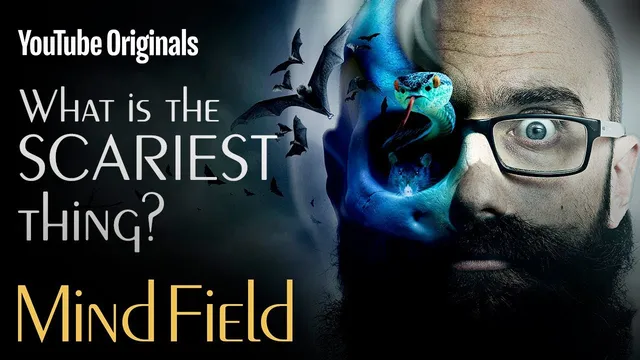
What Is The Scariest Thing?
Based on Vsauce's video on YouTube. If you like this content, support the original creators by watching, liking and subscribing to their content.
Fear can be learned quickly by pairing a neutral cue with an aversive outcome, producing involuntary physiological fear responses to the cue alone.
Briefing
The most reliable way to trigger panic in humans isn’t a particular monster, object, or phobia—it’s a physiological alarm: a rise in blood carbon dioxide (CO2) interpreted as suffocation, especially when paired with an external threat that makes the body treat the internal change as uncontrollable. The argument builds from fear-conditioning experiments to brain circuitry, then narrows to a single internal trigger that can produce terror even in people who cannot form fear normally.
The starting point is a “fear-conditioning” demonstration. Michael undergoes a protocol where a mundane purple square appears on a screen while he receives an electrical shock and a startling scream. Bioelectric sensors track involuntary physiological reactions such as perspiration. After repeated pairings, his body responds to the purple square alone—sweating and heightened fear—despite the shape being harmless. That result becomes the foundation for a broader claim: fear can be learned quickly by linking a neutral stimulus to an aversive outcome.
Neurologically, the amygdala is presented as the hub that assigns danger value and drives learning. The amygdala sits near memory systems and helps determine what should be remembered as threatening. The transcript uses a “spider web” metaphor: the web is preloaded with innate aversions—evolutionarily selected triggers like pain, isolation, the unknown/abnormal, disease, sudden movement, suffocation, falling, and incapacitation. When new experiences get associated with one of these innate aversions, they become new entries in a personal library of fears. Over time, learned fears can multiply and combine; seeing two conditioned cues together can produce an expectation of a worse outcome than either cue alone.
From there, the search for a universal “scariest thing” turns into a process of elimination. Death is discussed but rejected as the single answer because courage, readiness to die, and suicide complicate whether death is universally terrifying. Isolation is then highlighted as a major fear driver: social disconnection is tied to survival and is associated with worse health outcomes, and it can also feed into secondary fears like public speaking via rejection. Fear of the dark is treated as non-universal, varying with age and sensory experience (e.g., blind people). Sound is emphasized as a fast route into the amygdala, and music is described as capable of conditioning fear through dissonance and context.
Yet the transcript ultimately argues that the “one true” trigger must work across people and even across brains that don’t normally generate fear. That pivot comes with Patient SM, a rare case where the amygdala was destroyed by a genetic disorder. SM shows little or no fear response to classic scary stimuli like spiders, snakes, haunted houses, and horror films. But when SM inhales concentrated CO2—elevating blood CO2 levels that the body interprets as suffocation—she experiences “sheer and utter panic.” Follow-up testing in other amygdala-damaged patients in Germany shows the same panic response.
The conclusion is sharpened by a control finding: people with functioning amygdalae show a lower fear reaction to CO2 when the experiment is clearly safe and voluntary. The amygdala appears to help calibrate fear to external threats; when CO2 rises but there’s no believable external cause, fear can be dampened. For maximum panic, the transcript claims, it’s enough to combine two ingredients: (1) elevated blood CO2 and (2) an external threat that makes the CO2 feel like uncontrollable suffocation. The “scariest thing,” then, is not a specific image or story—it’s the body’s internal suffocation signal, amplified by an external context that removes control.
The final framing ties together drowning, waterboarding, and coerced CO2 inhalation as variations on the same mechanism: elevation of carbon dioxide in the blood caused by an uncontrollable external threat.
Cornell Notes
Fear can be learned rapidly when a neutral cue is paired with an aversive outcome, as shown by conditioning Michael to fear a purple square after shocks and screams. The amygdala is central to this learning, acting as a danger-assignment system that links experiences to innate aversions (like pain, isolation, and suffocation). The search for a universal “scariest thing” narrows when Patient SM—missing a functional amygdala—still experiences intense panic after inhaling concentrated CO2, because the body interprets elevated CO2 as suffocation. Controls show that when CO2 exposure is clearly safe and voluntary, fear is reduced, suggesting the amygdala helps calibrate internal alarm signals to external threat. The transcript’s bottom line: the most dependable panic trigger is elevated blood CO2 interpreted as uncontrollable suffocation.
How does fear conditioning demonstrate that fear can be attached to an otherwise harmless stimulus?
What role does the amygdala play in learning and producing fear?
Why isn’t death treated as the single scariest thing?
How does the transcript connect social isolation to fear and survival?
What makes Patient SM’s CO2 experiment decisive for identifying the “scariest thing”?
Why do people with functioning amygdalae show a lower fear reaction to CO2 in the control group?
Review Questions
- What evidence shows that fear conditioning can turn a neutral cue (like the purple square) into a fear trigger?
- How does the transcript use Patient SM to argue that the “scariest thing” is not dependent on classic fear learning?
- According to the transcript, what two factors together maximize panic, and why does each factor matter?
Key Points
- 1
Fear can be learned quickly by pairing a neutral cue with an aversive outcome, producing involuntary physiological fear responses to the cue alone.
- 2
The amygdala is portrayed as a central danger-learning and fear-arousal system that links experiences to innate aversions.
- 3
Innate aversions include triggers such as pain, isolation, the unknown/abnormal, disease, sudden movement, suffocation, falling, and incapacitation, and they form the “inner ring” of fear networks.
- 4
Death is discussed but rejected as a universal scariest target because human behavior includes courage, readiness to die, and cases where something else is more terrifying than death.
- 5
Social isolation is framed as a survival-linked fear that can generate secondary anxieties like fear of rejection during public speaking.
- 6
Patient SM’s lack of amygdala function does not prevent panic when blood CO2 rises, indicating an internal suffocation alarm can drive fear even without typical threat learning.
- 7
The strongest panic is predicted by combining elevated blood CO2 with an external threat that makes the internal change feel uncontrollable (variations include drowning and waterboarding).