What Is The Shape of Space? (ft. PhD Comics)
Based on minutephysics's video on YouTube. If you like this content, support the original creators by watching, liking and subscribing to their content.
General Relativity treats spacetime geometry as dynamic, shaped by matter and energy rather than fixed emptiness.
Briefing
General Relativity treats space not as empty background but as a dynamic, physical geometry that bends, ripples, and expands in response to matter and energy. Locally, that curvature has clear signatures: near massive objects, parallel paths converge; in regions with negative curvature, they diverge. Curvature also shows up in large-scale behavior—space can expand, increasing the distance between objects, and gravitational waves can ripple through spacetime.
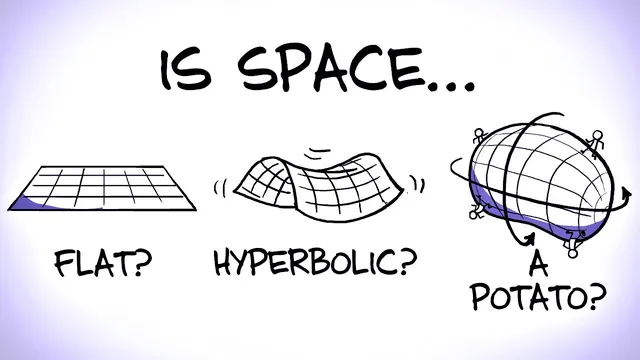
The central question becomes what spacetime’s overall “shape” looks like when viewed on the largest scales. If the universe were positively curved everywhere, the geometry would resemble a closed, finite manifold—described in the transcript as a “giant hyper-potato”—where traveling far enough eventually brings you back to your starting point. If spacetime were flat everywhere, it would extend outward without intrinsic curvature, either stretching to infinity or looping periodically like certain game worlds. If it were negatively curved everywhere, the geometry would be open and would imply extreme behavior: the transcript notes that “sports would be impossible,” a playful way to say that parallel lines would diverge so strongly that familiar large-scale geometry would break down.
Two complementary strategies measure the universe’s large-scale curvature. One uses geometry itself: by examining the angles in triangles. In flat space, triangle angles sum to exactly 180 degrees; curvature shifts that total above or below 180 degrees depending on whether the geometry is positively or negatively curved. The other strategy measures what drives curvature: the average density of energy and matter across the cosmos. Cosmologists can infer both the geometry and the matter-energy content by studying the early universe—effectively using the “spatial relationships between different points” in a snapshot of the young cosmos.
Those measurements converge on a striking result: the universe appears “pretty much flat,” with curvature constrained to within about 0.4% uncertainty. That rules out the most extreme versions of a strongly curved closed or open universe, at least within current observational limits.
Yet the near-flatness comes with a major conceptual headache. The transcript highlights a “cosmic-level coincidence”: if the universe’s total mass-energy density were even slightly higher, spacetime would curve in one direction; if slightly lower, it would curve the other. Instead, observations suggest the universe sits extremely close to the boundary between positive and negative curvature. The implied “perfect amount” is given as roughly five hydrogen atoms per cubic meter on average. Shifting that average to something like six or four hydrogen atoms per cubic meter would have produced a noticeably more curved universe. Cosmologists still lack a convincing explanation for why the universe’s density lands so precisely on the value that makes it nearly flat—leaving the problem of curvature as an open mystery where current knowledge “falls flat.”
Cornell Notes
The transcript explains that spacetime geometry is shaped by matter and energy: locally it bends, causes parallel paths to converge or diverge, and can expand or ripple via gravitational waves. To determine the universe’s overall shape, cosmologists use two methods: (1) measure triangle angle sums to infer whether space is flat, positively curved, or negatively curved; and (2) measure the universe’s average energy and matter density, since that density determines curvature. Observations from the early universe indicate the cosmos is nearly flat, within about 0.4% error. The unresolved issue is that near-flatness looks like an extreme coincidence: small changes in density would have produced a much more curved universe. The transcript quantifies the near-flat density as about five hydrogen atoms per cubic meter on average.
How does curvature of spacetime show up in everyday motion, at least in local regions?
What would a universe with constant positive curvature, constant flatness, or constant negative curvature imply for global geometry?
How do cosmologists use triangle angles to measure curvature?
How does measuring matter-energy density provide an independent curvature test?
Why is the observed near-flatness considered a “cosmic-level coincidence”?
Review Questions
- What observational signatures distinguish positive, negative, and zero curvature using the behavior of parallel paths?
- Explain the two independent approaches cosmologists use to infer the universe’s large-scale curvature and how they relate to triangle angles and matter-energy density.
- Why does a nearly flat universe create a theoretical puzzle, and what density value is cited as the near-flat benchmark?
Key Points
- 1
General Relativity treats spacetime geometry as dynamic, shaped by matter and energy rather than fixed emptiness.
- 2
Local curvature determines whether parallel paths converge (positive curvature), diverge (negative curvature), or stay parallel (flat).
- 3
The universe’s large-scale shape can be tested by measuring triangle angle sums and by measuring the average energy-matter density that drives curvature.
- 4
Cosmological measurements indicate the universe is nearly flat, constrained to about a 0.4% margin of error.
- 5
Near-flatness appears highly fine-tuned: small changes in the universe’s average density would have produced noticeably different curvature.
- 6
The transcript quantifies the near-flat density as roughly five hydrogen atoms per cubic meter on average, with nearby values (four or six) implying much stronger curvature.
- 7
The lack of a clear explanation for why the density lands so close to the flat case remains an open problem.