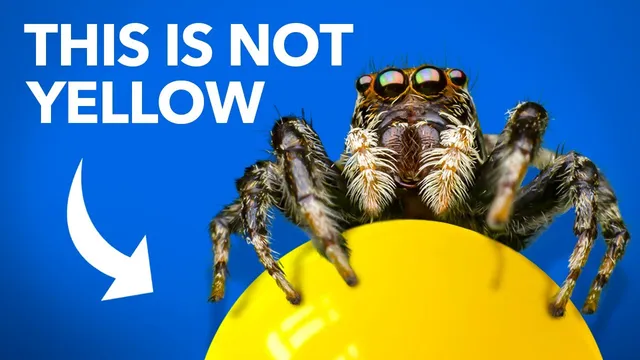
What Jumping Spiders Teach Us About Color
Based on Veritasium's video on YouTube. If you like this content, support the original creators by watching, liking and subscribing to their content.
Human “yellow” perception arises from combining signals from red- and green-sensitive cones, not from detecting a yellow wavelength directly.
Briefing
Color isn’t a simple property of objects—it’s a moving target shaped by anatomy, behavior, and evolution. Human eyes and screens make this clear: a “yellow” ball can be rendered using only red and green light, because the brain infers color by combining signals from just three cone types. The same ball can look yellow to a human even when the retina never directly measures “yellow” wavelengths. That mismatch between what light carries and what perception produces sets up the central question: what does color mean in other animals, and why did different species evolve different color systems?
Jumping spiders provide a striking answer because their color vision varies widely—even among closely related species. Most jumping spiders are dichromats, with two cone types, giving a coarse color sense. Others are trichromats or tetrachromats, expanding the range of detectable wavelengths. Their ability to see color also depends on how their eyes are built. The principal eyes use a Galilean-telescope-like design: two lenses separated by a long fluid-filled tube, with a second lens magnifying the image onto a retina beneath. That setup supports exceptional detail, but only across a narrow “thumb-at-arm’s-length” slice of the world. Secondary eyes provide a 360-degree view in mostly black-and-white, letting the spider swivel and “paint” color and detail moment by moment as the principal eyes sweep.
Evolution has repeatedly reinvented expanded color vision in jumping spiders. After measuring 45 species across the evolutionary tree, researchers found up to 12 independent changes in color vision. Red sensitivity, in particular, evolved multiple times through different genetic routes. In some species, a green-sensitive opsin gene duplicates and the new copy shifts toward longer wavelengths, producing red sensitivity. In others, the spider keeps the same pigment but adds an internal optical filter to certain green-sensitive cells, forcing them to respond only to longer wavelengths. The result is that “seeing red” can arise from distinct biological mechanisms.
Why evolve richer color vision? For a visual predator, color can function as a warning system and a hunting tool. Researchers trained spiders using termite prey painted red or gray, then manipulated taste by treating red termites with Bitrex (extremely bitter) while gray termites remained tasty. Spiders with access to red-related color cues learned faster and performed better: they laid eggs sooner and ended up heavier in the treatment group. That supports the idea that color helps spiders avoid harmful, toxic-looking prey—especially long-wavelength cues like red and orange.
But color’s value may extend beyond food. Some male jumping spiders display bright red courtship signals that females may not actually see as red. Measurements suggest certain species lack red-sensitive cones, yet their layered retinas and focus mechanics can turn color into a depth illusion via chromatic aberration and focus differences across retinal layers. If a female perceives a male as closer than he is, her aggressive response could change—sometimes with direct reproductive consequences for the male.
To test these links between focus, depth, and color, researchers are pursuing high-resolution X-ray imaging using the Advanced Photon Source to watch eye-tube and retinal movements through the exoskeleton. The facility shut down for upgrades after initial trials, delaying results, but the goal is clear: connect live anatomy and motion to how color and distance are actually perceived. In the end, color emerges as an evolutionary “dance” between what eyes can sense and how animals use those signals in a three-dimensional world.
Cornell Notes
Color perception depends on the observer, not just the object. Humans infer “yellow” by combining red- and green-sensitive cone signals, even though neither the retina nor a camera sensor directly measures “yellow.” Jumping spiders show even more variation: most are dichromats, while some are trichromats or tetrachromats, and their principal eyes use a telescope-like optical system that trades a narrow high-detail view for a wider black-and-white scan. Expanded color vision has evolved repeatedly—up to 12 independent changes across 45 species—often via different opsin-gene duplications or via internal filters that reshape which wavelengths trigger cones. Experiments with red-painted, Bitrex-treated termites suggest color cues help spiders learn to avoid toxic prey, and other work hints that “red” signals may work through depth illusions rather than true red sensitivity.
Why can a screen make a “yellow” ball without ever emitting yellow light?
How do jumping spiders’ eyes let them see both detail and a wide scene?
What evidence shows expanded color vision evolved many times in jumping spiders?
How can “red sensitivity” evolve in different jumping spider species?
How did researchers test whether color cues help spiders avoid bad prey?
If a female can’t see red, how might red courtship still work?
Review Questions
- What specific biological steps allow humans to perceive “yellow” even when only red and green light stimulate the retina?
- What two different evolutionary mechanisms can produce red sensitivity in jumping spiders, and how do they differ?
- In the termite experiment, how were color and taste manipulated independently, and what behavioral outcomes indicated a benefit from color cues?
Key Points
- 1
Human “yellow” perception arises from combining signals from red- and green-sensitive cones, not from detecting a yellow wavelength directly.
- 2
Jumping spiders’ principal eyes use a telescope-like optical design that enables high detail in a narrow field, while secondary eyes provide a wide black-and-white scan.
- 3
Expanded color vision in jumping spiders has multiple independent evolutionary origins, with researchers finding up to 12 changes across 45 species.
- 4
Red sensitivity can evolve through opsin gene duplication (shifting pigment sensitivity) or through internal optical filtering (changing which wavelengths certain cones respond to).
- 5
Color cues can function as learned warning signals: spiders trained to associate red with Bitrex bitterness avoided harmful prey better and showed reproductive benefits.
- 6
Some red-looking courtship signals may work through depth illusions created by retinal layering and chromatic focus effects, even when red-sensitive cones are absent.
- 7
Linking how spiders perceive color to how their eyes move in real time requires high-resolution imaging, including X-ray methods through the exoskeleton.