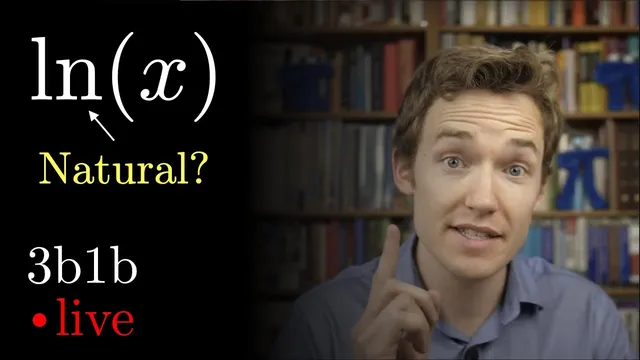
What makes the natural log "natural"? | Ep. 7 Lockdown live math
Based on 3Blue1Brown's video on YouTube. If you like this content, support the original creators by watching, liking and subscribing to their content.
There are 37 primes among the 1,000 integers from 10^12 to 10^12+1,000, giving a density of about one prime per 27 numbers.
Briefing
Prime numbers turn out to be far less rare near a trillion than most people guess—and that “surprise frequency” is tightly linked to the natural logarithm. In a live quiz, participants estimated how many primes lie among the 1,000 integers from 10^12 to 10^12+1,000. A quick computation finds 37 primes in that interval, meaning the density is 37/1000 ≈ 0.037, or about one prime in 27. The winning intuition comes from a classic approximation: the prime density near a large number N is about 1/ln(N). Plugging in ln(10^12)=ln(10)*12≈27 lands almost exactly on the observed scale, explaining why the answer clusters around “one in the high twenties” without brute-force factoring.
That connection becomes the lesson’s gateway to a deeper question: why is the logarithm with base e (“natural log”) so central to both prime patterns and the behavior of exponential functions. The discussion first revisits the meaning of ln(x): it is the inverse of e^y, so ln(x)=y exactly when e^y=x. From there, the talk connects primes to ln in a more structural way by introducing “prime-filtered” series. Starting from the Basel sum Σ 1/n^2 = π^2/6, the series is modified to keep only prime-related terms—prime powers are down-weighted by their exponent—and the resulting value becomes ln(π^2/6). Similar prime-keeping games applied to alternating rational series yield expressions involving ln(π/4) and ln(π/4) again, depending on how the terms are filtered. The punchline is not just that primes and π appear together, but that inserting ln base e into the algebra is what makes the identities come out cleanly.
The talk then pivots to where ln and e truly come from: calculus and rates of change. The natural logarithm’s derivative is derived using the fact that e^t differentiates to itself. If y=ln(x), then e^y=x. Differentiating implicitly gives dy/dx=1/x, matching the familiar “slope of ln” curve that flattens as x grows. This derivative also explains why harmonic sums grow like ln(n): the sum 1+1/2+…+1/n is approximated by the area under 1/x, so it behaves like ln(n) plus a constant. That constant is identified as the Euler–Mascheroni constant (≈0.577), capturing the gap between the discrete sum and the continuous integral.
Finally, the lesson ties the alternating harmonic series to ln(2) using a clever generalization. By inserting a parameter x into an alternating power series, differentiating to simplify it into a geometric series, and then integrating back, the argument produces the classic identity 1−1/2+1/3−1/4+… = ln(2). Throughout, e is framed less as a mysterious constant and more as the base that makes exponential families behave especially well under differentiation—turning “natural” into a practical description of why ln and e keep reappearing in primes, areas, and series.
Cornell Notes
Near 10^12, primes appear with density about 1/ln(N), and that estimate matches a direct count: there are 37 primes among the 1,000 integers from 10^12 to 10^12+1,000 (about one in 27). The natural logarithm’s special role comes from calculus: if y=ln(x), then e^y=x, and implicit differentiation yields d/dx ln(x)=1/x. That derivative explains why the harmonic sum 1+1/2+…+1/n grows like ln(n), with a constant offset given by the Euler–Mascheroni constant (~0.577). The same ln(·) machinery also supports the alternating harmonic identity 1−1/2+1/3−1/4+…=ln(2) via a parameterized series, geometric-series simplification, and integration back.
How many primes are in the interval from 10^12 to 10^12+1,000, and how does that compare to common intuition?
What approximation lets mathematicians estimate prime density near a trillion without checking every number?
Why does the derivative of ln(x) equal 1/x?
How does the derivative of ln(x) explain why 1+1/2+…+1/n grows like ln(n)?
How does the alternating harmonic series end up equaling ln(2)?
Review Questions
- What numerical evidence supports the claim that prime density near 10^12 is about 1/ln(10^12)?
- Show how y=ln(x) leads to dy/dx=1/x using e^y=x and implicit differentiation.
- Why does the harmonic sum differ from ln(n) by a constant, and what is that constant called?
Key Points
- 1
There are 37 primes among the 1,000 integers from 10^12 to 10^12+1,000, giving a density of about one prime per 27 numbers.
- 2
Prime density near a large N is well-approximated by 1/ln(N), so ln(10^12)≈27 predicts the observed scale.
- 3
The natural logarithm is defined as the inverse of e^x: ln(x)=y exactly when e^y=x.
- 4
Using implicit differentiation with e^y=x yields d/dx ln(x)=1/x, explaining why ln(x) describes slopes and areas.
- 5
The harmonic sum 1+1/2+…+1/n grows like ln(n) because it tracks the area under 1/x, with a limiting offset equal to the Euler–Mascheroni constant (~0.577).
- 6
A parameterized alternating series, after differentiation, collapses into a geometric series; integrating back produces the identity 1−1/2+1/3−1/4+…=ln(2).
- 7
Prime-related “filtering” of classic series (like the Basel sum) produces expressions involving ln(·), highlighting why base-e logarithms recur in number theory identities.