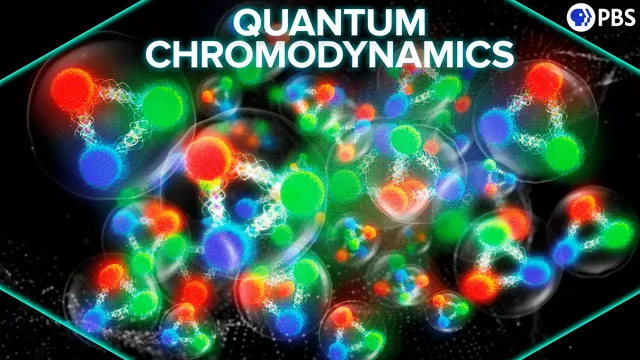
What Makes The Strong Force Strong?
Based on PBS Space Time's video on YouTube. If you like this content, support the original creators by watching, liking and subscribing to their content.
The strong force confines quarks because the gluon field forms a flux tube whose energy increases with separation, leading to quark-pair creation instead of free quarks.
Briefing
The strong nuclear force stays confined inside atomic nuclei because quarks and gluons behave in ways that make “color” charge impossible to isolate. Instead of weakening with distance like electromagnetism, the strong force pulls quarks together through a gluon field that forms a stretched “flux tube.” Try to separate quarks far enough and the energy doesn’t dissipate—it accumulates until it becomes energetically favorable to create new quark–antiquark pairs. The result is that quarks almost never appear alone; they show up only inside hadrons (groups of quarks), and the strong interaction effectively shuts off outside nuclei.
That confinement hinges on two linked rules from quantum chromodynamics (QCD): hadrons must be color neutral, and gluons themselves cannot be color neutral. QCD assigns three types of strong-force charge—conventionally labeled red, green, and blue—so that quarks can satisfy the Pauli Exclusion Principle. Just as electrons can’t share the same quantum state, fermions like quarks must differ in some quantum property. For the Omega baryon, which contains three strange quarks in the same energy level, spin can’t provide enough distinct states. The missing distinction is color: three quarks can occupy the same “dress” (quantum state) only if they wear different colors.
Color neutrality explains why quarks cluster into specific combinations. Two-quark hadrons (like a pion) can cancel color using a quark–antiquark pair such as red and anti-red. Three-quark hadrons (like baryons) cancel color through the relation red + blue + green = 0, meaning the three colors can combine to a net neutral state (with one color effectively acting like the negative sum of the other two). The transcript draws an analogy to RGB color mixing—screens can’t produce pure “colors” directly, but they generate combinations of red, green, and blue—while emphasizing that the naming reflects a shared mathematical structure.
The second requirement—no neutral gluons—prevents the strong force from acting at long range. In electromagnetism, photons are electrically neutral, allowing neutral objects to still respond to magnetic effects. In QCD, gluons carry color charge (and do so in combinations), so they can’t interact in a way that would let color-neutral hadrons exchange “neutral” gluons over large distances. That blocks any long-range chromomagnetism-like force and keeps the strong interaction largely trapped within hadrons.
Underlying the whole picture is the way QCD’s color charges map onto symmetry. The recurring geometric “Eightfold Way” patterns from particle physics—first tied to the conserved quantum number strangeness—reappear in the structure of gluon states. The transcript connects this to SU(3) symmetry, a mathematical framework built from three degrees of freedom where two combinations are neutral. In QCD, that symmetry manifests as the strong force’s color dynamics.
After the core physics, the discussion pivots to audience questions on related topics: how relativistic time dilation appears in hot relativistic plasmas, why Hawking radiation isn’t truly a “virtual particle pair” being separated, and how a time-evolving quintessence field would shift estimates of the universe’s age and could couple to the Higgs field—though experimental constraints remain the major obstacle.
Cornell Notes
Quantum chromodynamics explains why the strong force is powerful inside nuclei yet doesn’t act freely outside them. Quarks carry three “color” charges (red, green, blue), which lets them satisfy the Pauli Exclusion Principle—illustrated by the Omega baryon’s three strange quarks needing three distinct color states. The gluon field between quarks behaves unlike electromagnetism: it forms a flux tube whose energy grows as quarks are pulled apart, so the system “snaps” by creating new quark pairs rather than producing isolated quarks. Confinement is reinforced by color confinement: hadrons are color neutral, and gluons are never color neutral, preventing long-range strong interactions. The transcript links the whole structure to SU(3) symmetry and the earlier “Eightfold Way” patterns seen in particle classifications.
Why doesn’t the strong force behave like electromagnetism as quarks separate?
How does the Pauli Exclusion Principle force the introduction of “color” in QCD?
What does “color neutrality” mean for hadrons?
Why does the strong force not become long-range even if hadrons are color neutral?
How do SU(3) symmetry and the “Eightfold Way” connect to gluons and color?
What happens to quarks in extreme conditions like the early universe or heavy-ion collisions?
Review Questions
- How do flux tubes and quark-pair creation together prevent isolated quarks from being observed at ordinary energies?
- Explain how both requirements—color neutrality of hadrons and the absence of neutral gluons—work to confine the strong force.
- Why does the Omega baryon specifically motivate three distinct color states rather than relying on spin alone?
Key Points
- 1
The strong force confines quarks because the gluon field forms a flux tube whose energy increases with separation, leading to quark-pair creation instead of free quarks.
- 2
QCD assigns three color charges—red, green, and blue—to quarks, providing the extra quantum property needed when multiple identical fermions share the same energy level.
- 3
Color confinement requires hadrons to be color neutral, achieved by combining quark colors so that net color cancels (e.g., red + blue + green = 0 for three-quark states).
- 4
Gluons carry color charge and are never truly color neutral, blocking any long-range strong interaction analogous to how photons enable electromagnetic effects.
- 5
The “Eightfold Way” patterns connect to the SU(3) symmetry underlying QCD, where gluon states can be organized into eight basis states.
- 6
In extreme environments like the early universe or high-energy collider collisions, quarks can form a Quark Gluon Plasma where confinement is effectively disrupted.
- 7
Related physics questions emphasize that intuitive pictures (like “virtual particle pairs” near horizons) often serve as approximations to more precise field-mode calculations.